

290
X – The Riemann Surface of an Algebraic Function
σ(K ij ) = H ij of the compact squares K ij thereby obtained. If a section ϕ ij
of X over each H ij is chosen, for the moment arbitrarily, setting σ
ij = ϕ ij ◦ σ
in K ij gives
p ◦ σ
ij = σ in K ij .
If some squares K ij (at most four) have a common point x, taking n
sufficiently large, they may be assumed to be all contained in the open disc
centered at x and of radius r ; as these K ij are connected, and hence so are
the H ij and their union, if the sections ϕ ij are taken to be equal at σ(x),
then they are the restrictions to these H ij of the unique section over their
union, whose value at x is the same as theirs.
1
2
3
4
5
6
7
8
9
10
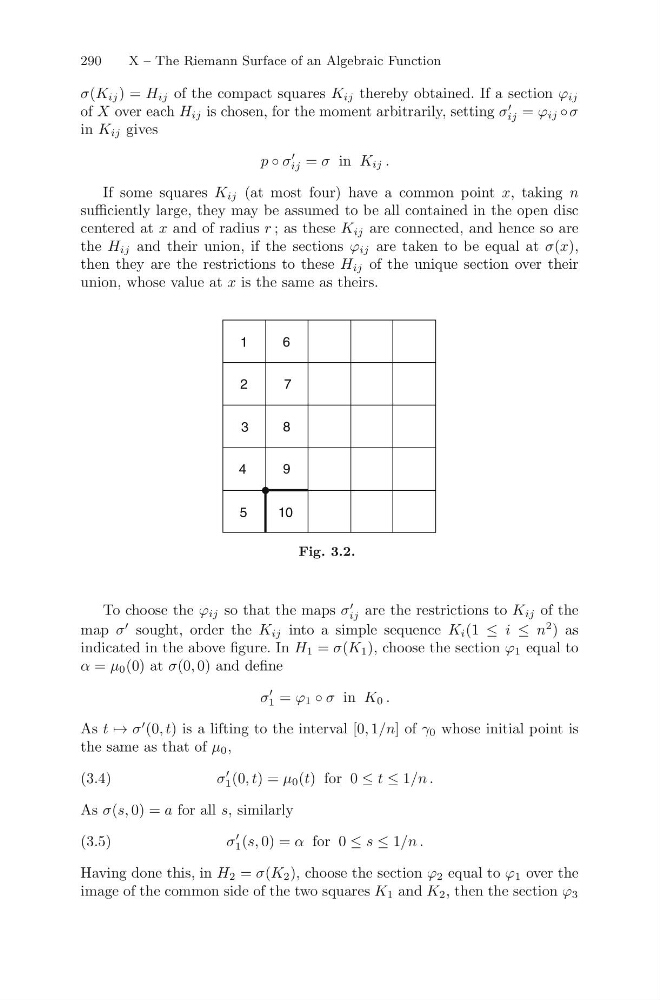
Fig. 3.2.
To choose the ϕ ij so that the maps σ
ij are the restrictions to K ij of the
map σ
sought, order the K ij into a simple sequence K i (1 ≤ i ≤ n
2 ) as
indicated in the above figure. In H 1 = σ(K 1 ), choose the section ϕ 1 equal to
α = μ 0 (0) at σ(0, 0) and define
σ
1 = ϕ 1 ◦ σ in K 0 .
As t → σ
(0, t) is a lifting to the interval [0, 1/n] of γ 0 whose initial point is
the same as that of μ 0 ,
σ
1 (0, t) = μ 0 (t) for 0 ≤ t ≤ 1/n .
(3.4)
As σ(s, 0) = a for all s, similarly
σ
1 (s, 0) = α for 0 ≤ s ≤ 1/n .
(3.5)
Having done this, in H 2 = σ(K 2 ), choose the section ϕ 2 equal to ϕ 1 over the
image of the common side of the two squares K 1 and K 2 , then the section ϕ 3
X – The Riemann Surface of an Algebraic Function
σ(K ij ) = H ij of the compact squares K ij thereby obtained. If a section ϕ ij
of X over each H ij is chosen, for the moment arbitrarily, setting σ
ij = ϕ ij ◦ σ
in K ij gives
p ◦ σ
ij = σ in K ij .
If some squares K ij (at most four) have a common point x, taking n
sufficiently large, they may be assumed to be all contained in the open disc
centered at x and of radius r ; as these K ij are connected, and hence so are
the H ij and their union, if the sections ϕ ij are taken to be equal at σ(x),
then they are the restrictions to these H ij of the unique section over their
union, whose value at x is the same as theirs.
1
2
3
4
5
6
7
8
9
10
Fig. 3.2.
To choose the ϕ ij so that the maps σ
ij are the restrictions to K ij of the
map σ
sought, order the K ij into a simple sequence K i (1 ≤ i ≤ n
2 ) as
indicated in the above figure. In H 1 = σ(K 1 ), choose the section ϕ 1 equal to
α = μ 0 (0) at σ(0, 0) and define
σ
1 = ϕ 1 ◦ σ in K 0 .
As t → σ
(0, t) is a lifting to the interval [0, 1/n] of γ 0 whose initial point is
the same as that of μ 0 ,
σ
1 (0, t) = μ 0 (t) for 0 ≤ t ≤ 1/n .
(3.4)
As σ(s, 0) = a for all s, similarly
σ
1 (s, 0) = α for 0 ≤ s ≤ 1/n .
(3.5)
Having done this, in H 2 = σ(K 2 ), choose the section ϕ 2 equal to ϕ 1 over the
image of the common side of the two squares K 1 and K 2 , then the section ϕ 3