

2 – Algebraic Functions
281
where
P (X, Y ) =
a pq X
p Y
q = P 0 (X)Y
n + . . . + P n (X) =
(2.2)
= Q 0 (Y )X
m + . . . + Q m (Y )
is a given polynomial
3 in two variables or “ indeterminates ”, with complex
coefficients, for example Y
3
− X in the case of z
1/3 and an equation of degree
24 in the third example.
4 If P 0 is not identically zero, in which case F will
be said to be of degree n (it would perhaps be better to say 1/n to avoid
confusion with the degree of a polynomial), equation (1) has at most n roots
and, if P 0 (z) = 0, then for given z, the number of possibly multiple roots is
exactly n.
−1
0
1
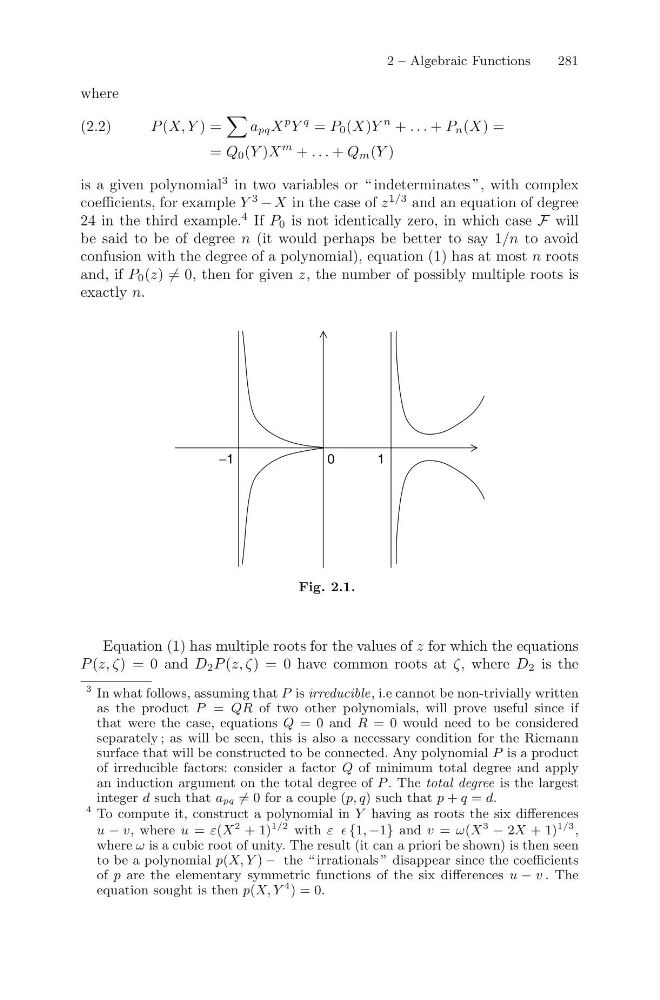
Fig. 2.1.
Equation (1) has multiple roots for the values of z for which the equations
P (z, ζ) = 0 and D 2 P (z, ζ) = 0 have common roots at ζ, where D 2 is the
3 In what follows, assuming that P is irreducible, i.e cannot be non-trivially written
as the product P = QR of two other polynomials, will prove useful since if
that were the case, equations Q = 0 and R = 0 would need to be considered
separately ; as will be seen, this is also a necessary condition for the Riemann
surface that will be constructed to be connected. Any polynomial P is a product
of irreducible factors: consider a factor Q of minimum total degree and apply
an induction argument on the total degree of P . The total degree is the largest
integer d such that apq = 0 for a couple (p, q) such that p + q = d.
4 To compute it, construct a polynomial in Y having as roots the six differences
u − v, where u = ε(X
2 + 1)
1/2 with ε ε {1, −1} and v = ω(X
3 − 2X + 1)
1/3 ,
where ω is a cubic root of unity. The result (it can a priori be shown) is then seen
to be a polynomial p(X, Y ) – the “ irrationals ” disappear since the coefficients
of p are the elementary symmetric functions of the six differences u − v . The
equation sought is then p(X, Y
4 ) = 0.
281
where
P (X, Y ) =
a pq X
p Y
q = P 0 (X)Y
n + . . . + P n (X) =
(2.2)
= Q 0 (Y )X
m + . . . + Q m (Y )
is a given polynomial
3 in two variables or “ indeterminates ”, with complex
coefficients, for example Y
3
− X in the case of z
1/3 and an equation of degree
24 in the third example.
4 If P 0 is not identically zero, in which case F will
be said to be of degree n (it would perhaps be better to say 1/n to avoid
confusion with the degree of a polynomial), equation (1) has at most n roots
and, if P 0 (z) = 0, then for given z, the number of possibly multiple roots is
exactly n.
−1
0
1
Fig. 2.1.
Equation (1) has multiple roots for the values of z for which the equations
P (z, ζ) = 0 and D 2 P (z, ζ) = 0 have common roots at ζ, where D 2 is the
3 In what follows, assuming that P is irreducible, i.e cannot be non-trivially written
as the product P = QR of two other polynomials, will prove useful since if
that were the case, equations Q = 0 and R = 0 would need to be considered
separately ; as will be seen, this is also a necessary condition for the Riemann
surface that will be constructed to be connected. Any polynomial P is a product
of irreducible factors: consider a factor Q of minimum total degree and apply
an induction argument on the total degree of P . The total degree is the largest
integer d such that apq = 0 for a couple (p, q) such that p + q = d.
4 To compute it, construct a polynomial in Y having as roots the six differences
u − v, where u = ε(X
2 + 1)
1/2 with ε ε {1, −1} and v = ω(X
3 − 2X + 1)
1/3 ,
where ω is a cubic root of unity. The result (it can a priori be shown) is then seen
to be a polynomial p(X, Y ) – the “ irrationals ” disappear since the coefficients
of p are the elementary symmetric functions of the six differences u − v . The
equation sought is then p(X, Y
4 ) = 0.