

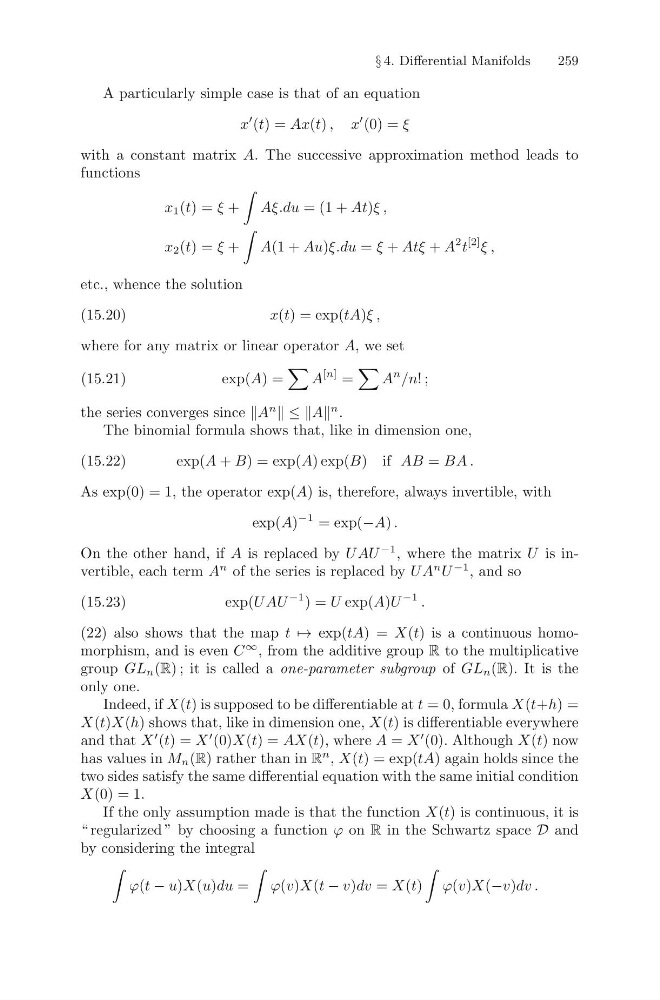
§ 4. Differential Manifolds
259
A particularly simple case is that of an equation
x
(t) = Ax(t) , x
(0) = ξ
with a constant matrix A. The successive approximation method leads to
functions
x 1 (t) = ξ +
Aξ.du = (1 + At)ξ ,
x 2 (t) = ξ +
A(1 + Au)ξ.du = ξ + Atξ + A
2 t
[2] ξ ,
etc., whence the solution
x(t) = exp(tA)ξ ,
(15.20)
where for any matrix or linear operator A, we set
exp(A) =
A
[n] =
A
n /n! ;
(15.21)
the series converges since A
n
≤ ≤A
n .
The binomial formula shows that, like in dimension one,
exp(A + B) = exp(A) exp(B) if AB = BA .
(15.22)
As exp(0) = 1, the operator exp(A) is, therefore, always invertible, with
exp(A)
−1 = exp(−A) .
On the other hand, if A is replaced by UAU
−1 , where the matrix U is invertible, each term A
n of the series is replaced by UA
n U
−1 , and so
exp(UAU
−1 ) = U exp(A)U
−1 .
(15.23)
(22) also shows that the map t → exp(tA) = X(t) is a continuous homomorphism, and is even C
∞ , from the additive group R to the multiplicative
group GL n (R) ; it is called a one-parameter subgroup of GL n (R). It is the
only one.
Indeed, if X(t) is supposed to be differentiable at t = 0, formula X(t+h) =
X(t)X(h) shows that, like in dimension one, X(t) is differentiable everywhere
and that X
(t) = X
(0)X(t) = AX(t), where A = X
(0). Although X(t) now
has values in M n (R) rather than in R
n , X(t) = exp(tA) again holds since the
two sides satisfy the same differential equation with the same initial condition
X(0) = 1.
If the only assumption made is that the function X(t) is continuous, it is
“ regularized ” by choosing a function ϕ on R in the Schwartz space D and
by considering the integral
ϕ(t − u)X(u)du =
ϕ(v)X(t − v)dv = X(t)
ϕ(v)X(−v)dv .
259
A particularly simple case is that of an equation
x
(t) = Ax(t) , x
(0) = ξ
with a constant matrix A. The successive approximation method leads to
functions
x 1 (t) = ξ +
Aξ.du = (1 + At)ξ ,
x 2 (t) = ξ +
A(1 + Au)ξ.du = ξ + Atξ + A
2 t
[2] ξ ,
etc., whence the solution
x(t) = exp(tA)ξ ,
(15.20)
where for any matrix or linear operator A, we set
exp(A) =
A
[n] =
A
n /n! ;
(15.21)
the series converges since A
n
≤ ≤A
n .
The binomial formula shows that, like in dimension one,
exp(A + B) = exp(A) exp(B) if AB = BA .
(15.22)
As exp(0) = 1, the operator exp(A) is, therefore, always invertible, with
exp(A)
−1 = exp(−A) .
On the other hand, if A is replaced by UAU
−1 , where the matrix U is invertible, each term A
n of the series is replaced by UA
n U
−1 , and so
exp(UAU
−1 ) = U exp(A)U
−1 .
(15.23)
(22) also shows that the map t → exp(tA) = X(t) is a continuous homomorphism, and is even C
∞ , from the additive group R to the multiplicative
group GL n (R) ; it is called a one-parameter subgroup of GL n (R). It is the
only one.
Indeed, if X(t) is supposed to be differentiable at t = 0, formula X(t+h) =
X(t)X(h) shows that, like in dimension one, X(t) is differentiable everywhere
and that X
(t) = X
(0)X(t) = AX(t), where A = X
(0). Although X(t) now
has values in M n (R) rather than in R
n , X(t) = exp(tA) again holds since the
two sides satisfy the same differential equation with the same initial condition
X(0) = 1.
If the only assumption made is that the function X(t) is continuous, it is
“ regularized ” by choosing a function ϕ on R in the Schwartz space D and
by considering the integral
ϕ(t − u)X(u)du =
ϕ(v)X(t − v)dv = X(t)
ϕ(v)X(−v)dv .