

256
IX – Multivariate Differential and Integral Calculus
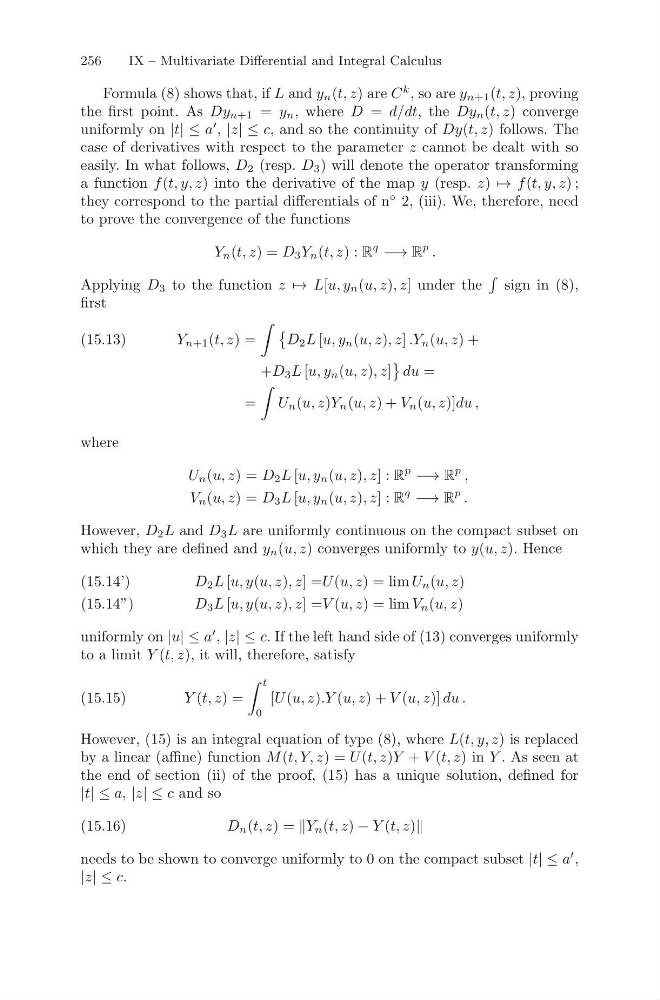
Formula (8) shows that, if L and y n (t, z) are C
k , so are y n+1 (t, z), proving
the first point. As Dy n+1 = y n , where D = d/dt, the Dy n (t, z) converge
uniformly on |t| ≤ a
, |z| ≤ c, and so the continuity of Dy(t, z) follows. The
case of derivatives with respect to the parameter z cannot be dealt with so
easily. In what follows, D 2 (resp. D 3 ) will denote the operator transforming
a function f (t, y, z) into the derivative of the map y (resp. z) → f (t, y, z) ;
they correspond to the partial differentials of n
◦ 2, (iii). We, therefore, need
to prove the convergence of the functions
Y n (t, z) = D 3 Y n (t, z) : R
q
−→ R
p .
Applying D 3 to the function z → L[u, y n (u, z), z] under the
sign in (8),
first
Y n+1 (t, z) =
D 2 L [u, y n (u, z), z] .Y n (u, z) +
(15.13)
+D 3 L [u, y n (u, z), z]
du =
=
U n (u, z)Y n (u, z) + V n (u, z)]du ,
where
U n (u, z) = D 2 L [u, y n (u, z), z] : R
p
−→ R
p ,
V n (u, z) = D 3 L [u, y n (u, z), z] : R
q
−→ R
p .
However, D 2 L and D 3 L are uniformly continuous on the compact subset on
which they are defined and y n (u, z) converges uniformly to y(u, z). Hence
D 2 L [u, y(u, z), z] =U (u, z) = lim U n (u, z)
(15.14’)
D 3 L [u, y(u, z), z] =V (u, z) = lim V n (u, z)
(15.14”)
uniformly on |u| ≤ a
, |z| ≤ c. If the left hand side of (13) converges uniformly
to a limit Y (t, z), it will, therefore, satisfy
Y (t, z) =
t
0
[U (u, z).Y (u, z) + V (u, z)] du .
(15.15)
However, (15) is an integral equation of type (8), where L(t, y, z) is replaced
by a linear (affine) function M (t, Y, z) = U (t, z)Y + V (t, z) in Y . As seen at
the end of section (ii) of the proof, (15) has a unique solution, defined for
|t| ≤ a, |z| ≤ c and so
D n (t, z) = Y n (t, z) − Y (t, z)
(15.16)
needs to be shown to converge uniformly to 0 on the compact subset |t| ≤ a
,
|z| ≤ c.
IX – Multivariate Differential and Integral Calculus
Formula (8) shows that, if L and y n (t, z) are C
k , so are y n+1 (t, z), proving
the first point. As Dy n+1 = y n , where D = d/dt, the Dy n (t, z) converge
uniformly on |t| ≤ a
, |z| ≤ c, and so the continuity of Dy(t, z) follows. The
case of derivatives with respect to the parameter z cannot be dealt with so
easily. In what follows, D 2 (resp. D 3 ) will denote the operator transforming
a function f (t, y, z) into the derivative of the map y (resp. z) → f (t, y, z) ;
they correspond to the partial differentials of n
◦ 2, (iii). We, therefore, need
to prove the convergence of the functions
Y n (t, z) = D 3 Y n (t, z) : R
q
−→ R
p .
Applying D 3 to the function z → L[u, y n (u, z), z] under the
sign in (8),
first
Y n+1 (t, z) =
D 2 L [u, y n (u, z), z] .Y n (u, z) +
(15.13)
+D 3 L [u, y n (u, z), z]
du =
=
U n (u, z)Y n (u, z) + V n (u, z)]du ,
where
U n (u, z) = D 2 L [u, y n (u, z), z] : R
p
−→ R
p ,
V n (u, z) = D 3 L [u, y n (u, z), z] : R
q
−→ R
p .
However, D 2 L and D 3 L are uniformly continuous on the compact subset on
which they are defined and y n (u, z) converges uniformly to y(u, z). Hence
D 2 L [u, y(u, z), z] =U (u, z) = lim U n (u, z)
(15.14’)
D 3 L [u, y(u, z), z] =V (u, z) = lim V n (u, z)
(15.14”)
uniformly on |u| ≤ a
, |z| ≤ c. If the left hand side of (13) converges uniformly
to a limit Y (t, z), it will, therefore, satisfy
Y (t, z) =
t
0
[U (u, z).Y (u, z) + V (u, z)] du .
(15.15)
However, (15) is an integral equation of type (8), where L(t, y, z) is replaced
by a linear (affine) function M (t, Y, z) = U (t, z)Y + V (t, z) in Y . As seen at
the end of section (ii) of the proof, (15) has a unique solution, defined for
|t| ≤ a, |z| ≤ c and so
D n (t, z) = Y n (t, z) − Y (t, z)
(15.16)
needs to be shown to converge uniformly to 0 on the compact subset |t| ≤ a
,
|z| ≤ c.