

254
IX – Multivariate Differential and Integral Calculus
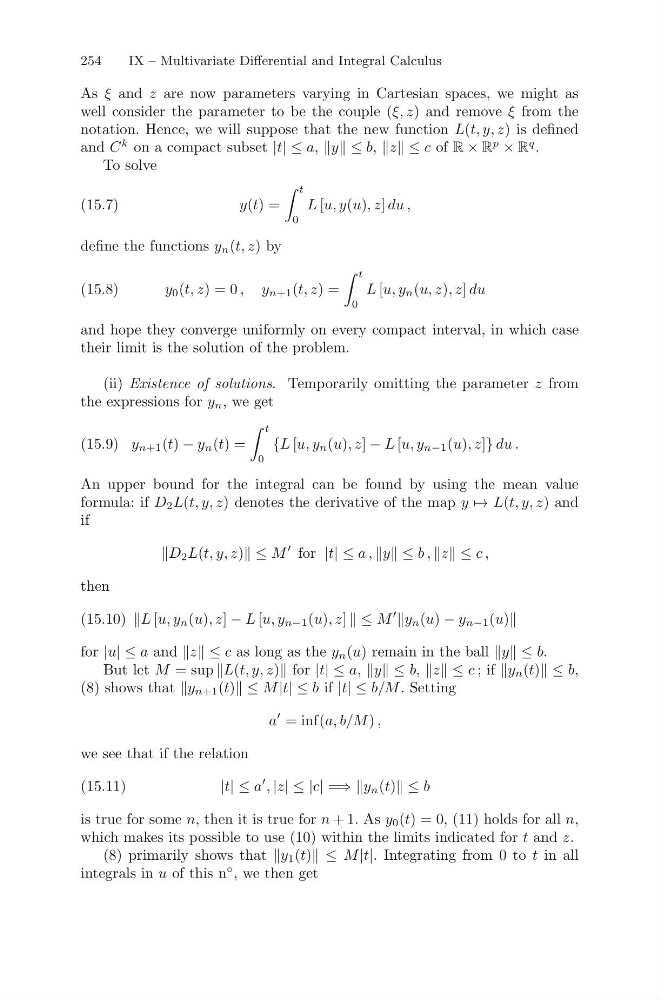
As ξ and z are now parameters varying in Cartesian spaces, we might as
well consider the parameter to be the couple (ξ, z) and remove ξ from the
notation. Hence, we will suppose that the new function L(t, y, z) is defined
and C
k on a compact subset |t| ≤ a, y ≤ b, z ≤ c of R × R
p
× R
q .
To solve
y(t) =
t
0
L [u, y(u), z] du ,
(15.7)
define the functions y n (t, z) by
y 0 (t, z) = 0 , y n+1 (t, z) =
t
0
L [u, y n (u, z), z] du
(15.8)
and hope they converge uniformly on every compact interval, in which case
their limit is the solution of the problem.
(ii) Existence of solutions. Temporarily omitting the parameter z from
the expressions for y n , we get
y n+1 (t) − y n (t) =
t
0
{L [u, y n (u), z] − L [u, y n−1 (u), z]} du .
(15.9)
An upper bound for the integral can be found by using the mean value
formula: if D 2 L(t, y, z) denotes the derivative of the map y → L(t, y, z) and
if
D 2 L(t, y, z) ≤ M
for |t| ≤ a , y ≤ b , z ≤ c ,
then
L [u, y n (u), z] − L [u, y n−1 (u), z] ≤ M
y n (u) − y n−1 (u)
(15.10)
for |u| ≤ a and z ≤ c as long as the y n (u) remain in the ball y ≤ b.
But let M = sup L(t, y, z) for |t| ≤ a, y ≤ b, z ≤ c ; if y n (t) ≤ b,
(8) shows that y n+1 (t) ≤ M |t| ≤ b if |t| ≤ b/M . Setting
a
= inf(a, b/M ) ,
we see that if the relation
|t| ≤ a
, |z| ≤ |c| =⇒ ⇒y n (t) ≤ b
(15.11)
is true for some n, then it is true for n + 1. As y 0 (t) = 0, (11) holds for all n,
which makes its possible to use (10) within the limits indicated for t and z.
(8) primarily shows that y 1 (t) ≤ M |t|. Integrating from 0 to t in all
integrals in u of this n
◦ , we then get
IX – Multivariate Differential and Integral Calculus
As ξ and z are now parameters varying in Cartesian spaces, we might as
well consider the parameter to be the couple (ξ, z) and remove ξ from the
notation. Hence, we will suppose that the new function L(t, y, z) is defined
and C
k on a compact subset |t| ≤ a, y ≤ b, z ≤ c of R × R
p
× R
q .
To solve
y(t) =
t
0
L [u, y(u), z] du ,
(15.7)
define the functions y n (t, z) by
y 0 (t, z) = 0 , y n+1 (t, z) =
t
0
L [u, y n (u, z), z] du
(15.8)
and hope they converge uniformly on every compact interval, in which case
their limit is the solution of the problem.
(ii) Existence of solutions. Temporarily omitting the parameter z from
the expressions for y n , we get
y n+1 (t) − y n (t) =
t
0
{L [u, y n (u), z] − L [u, y n−1 (u), z]} du .
(15.9)
An upper bound for the integral can be found by using the mean value
formula: if D 2 L(t, y, z) denotes the derivative of the map y → L(t, y, z) and
if
D 2 L(t, y, z) ≤ M
for |t| ≤ a , y ≤ b , z ≤ c ,
then
L [u, y n (u), z] − L [u, y n−1 (u), z] ≤ M
y n (u) − y n−1 (u)
(15.10)
for |u| ≤ a and z ≤ c as long as the y n (u) remain in the ball y ≤ b.
But let M = sup L(t, y, z) for |t| ≤ a, y ≤ b, z ≤ c ; if y n (t) ≤ b,
(8) shows that y n+1 (t) ≤ M |t| ≤ b if |t| ≤ b/M . Setting
a
= inf(a, b/M ) ,
we see that if the relation
|t| ≤ a
, |z| ≤ |c| =⇒ ⇒y n (t) ≤ b
(15.11)
is true for some n, then it is true for n + 1. As y 0 (t) = 0, (11) holds for all n,
which makes its possible to use (10) within the limits indicated for t and z.
(8) primarily shows that y 1 (t) ≤ M |t|. Integrating from 0 to t in all
integrals in u of this n
◦ , we then get