

240
IX – Multivariate Differential and Integral Calculus
(5) follows.
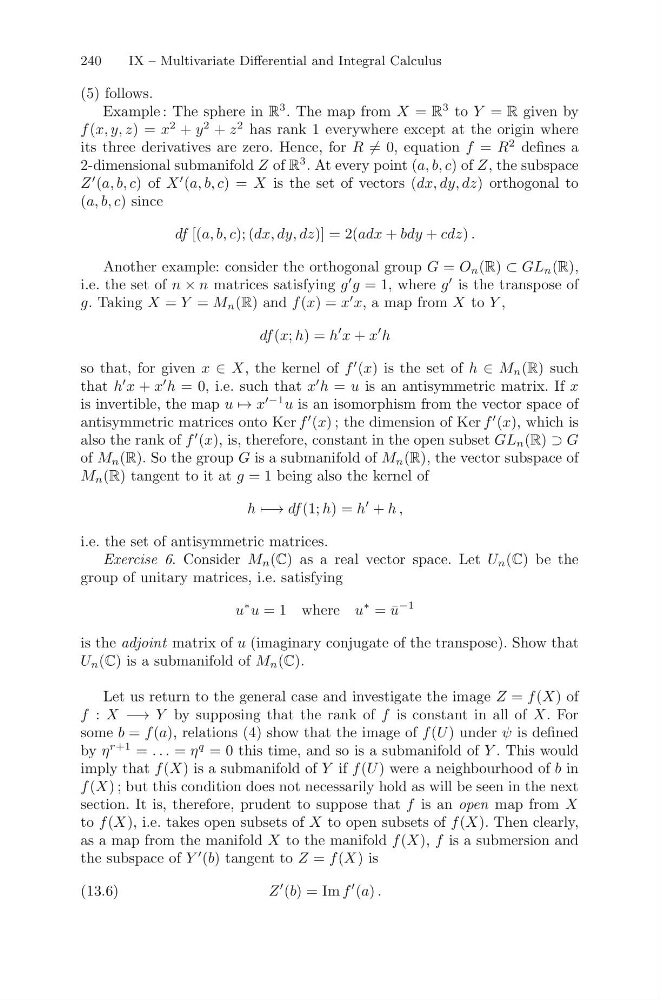
Example : The sphere in R
3 . The map from X = R
3 to Y = R given by
f (x, y, z) = x
2 + y
2 + z
2 has rank 1 everywhere except at the origin where
its three derivatives are zero. Hence, for R = 0, equation f = R
2 defines a
2-dimensional submanifold Z of R
3 . At every point (a, b, c) of Z, the subspace
Z
(a, b, c) of X
(a, b, c) = X is the set of vectors (dx, dy, dz) orthogonal to
(a, b, c) since
df [(a, b, c); (dx, dy, dz)] = 2(adx + bdy + cdz) .
Another example: consider the orthogonal group G = O n (R) ⊂ GL n (R),
i.e. the set of n × n matrices satisfying g
g = 1, where g
is the transpose of
g. Taking X = Y = M n (R) and f (x) = x
x, a map from X to Y ,
df (x; h) = h
x + x
h
so that, for given x ∈ X, the kernel of f
(x) is the set of h ∈ M n (R) such
that h
x + x
h = 0, i.e. such that x
h = u is an antisymmetric matrix. If x
is invertible, the map u → x
−1 u is an isomorphism from the vector space of
antisymmetric matrices onto Ker f
(x) ; the dimension of Ker f
(x), which is
also the rank of f
(x), is, therefore, constant in the open subset GL n (R) ⊃ G
of M n (R). So the group G is a submanifold of M n (R), the vector subspace of
M n (R) tangent to it at g = 1 being also the kernel of
h −→ df (1; h) = h
+ h ,
i.e. the set of antisymmetric matrices.
Exercise 6. Consider M n (C) as a real vector space. Let U n (C) be the
group of unitary matrices, i.e. satisfying
u
∗ u = 1 where u
∗ = ¯
u
−1
is the adjoint matrix of u (imaginary conjugate of the transpose). Show that
U n (C) is a submanifold of M n (C).
Let us return to the general case and investigate the image Z = f (X) of
f : X −→ Y by supposing that the rank of f is constant in all of X. For
some b = f (a), relations (4) show that the image of f (U ) under ψ is defined
by η
r+1 = . . . = η
q = 0 this time, and so is a submanifold of Y . This would
imply that f (X) is a submanifold of Y if f (U ) were a neighbourhood of b in
f (X) ; but this condition does not necessarily hold as will be seen in the next
section. It is, therefore, prudent to suppose that f is an open map from X
to f (X), i.e. takes open subsets of X to open subsets of f (X). Then clearly,
as a map from the manifold X to the manifold f (X), f is a submersion and
the subspace of Y
(b) tangent to Z = f (X) is
Z
(b) = Im f
(a) .
(13.6)
IX – Multivariate Differential and Integral Calculus
(5) follows.
Example : The sphere in R
3 . The map from X = R
3 to Y = R given by
f (x, y, z) = x
2 + y
2 + z
2 has rank 1 everywhere except at the origin where
its three derivatives are zero. Hence, for R = 0, equation f = R
2 defines a
2-dimensional submanifold Z of R
3 . At every point (a, b, c) of Z, the subspace
Z
(a, b, c) of X
(a, b, c) = X is the set of vectors (dx, dy, dz) orthogonal to
(a, b, c) since
df [(a, b, c); (dx, dy, dz)] = 2(adx + bdy + cdz) .
Another example: consider the orthogonal group G = O n (R) ⊂ GL n (R),
i.e. the set of n × n matrices satisfying g
g = 1, where g
is the transpose of
g. Taking X = Y = M n (R) and f (x) = x
x, a map from X to Y ,
df (x; h) = h
x + x
h
so that, for given x ∈ X, the kernel of f
(x) is the set of h ∈ M n (R) such
that h
x + x
h = 0, i.e. such that x
h = u is an antisymmetric matrix. If x
is invertible, the map u → x
−1 u is an isomorphism from the vector space of
antisymmetric matrices onto Ker f
(x) ; the dimension of Ker f
(x), which is
also the rank of f
(x), is, therefore, constant in the open subset GL n (R) ⊃ G
of M n (R). So the group G is a submanifold of M n (R), the vector subspace of
M n (R) tangent to it at g = 1 being also the kernel of
h −→ df (1; h) = h
+ h ,
i.e. the set of antisymmetric matrices.
Exercise 6. Consider M n (C) as a real vector space. Let U n (C) be the
group of unitary matrices, i.e. satisfying
u
∗ u = 1 where u
∗ = ¯
u
−1
is the adjoint matrix of u (imaginary conjugate of the transpose). Show that
U n (C) is a submanifold of M n (C).
Let us return to the general case and investigate the image Z = f (X) of
f : X −→ Y by supposing that the rank of f is constant in all of X. For
some b = f (a), relations (4) show that the image of f (U ) under ψ is defined
by η
r+1 = . . . = η
q = 0 this time, and so is a submanifold of Y . This would
imply that f (X) is a submanifold of Y if f (U ) were a neighbourhood of b in
f (X) ; but this condition does not necessarily hold as will be seen in the next
section. It is, therefore, prudent to suppose that f is an open map from X
to f (X), i.e. takes open subsets of X to open subsets of f (X). Then clearly,
as a map from the manifold X to the manifold f (X), f is a submersion and
the subspace of Y
(b) tangent to Z = f (X) is
Z
(b) = Im f
(a) .
(13.6)