

§ 4. Differential Manifolds
237
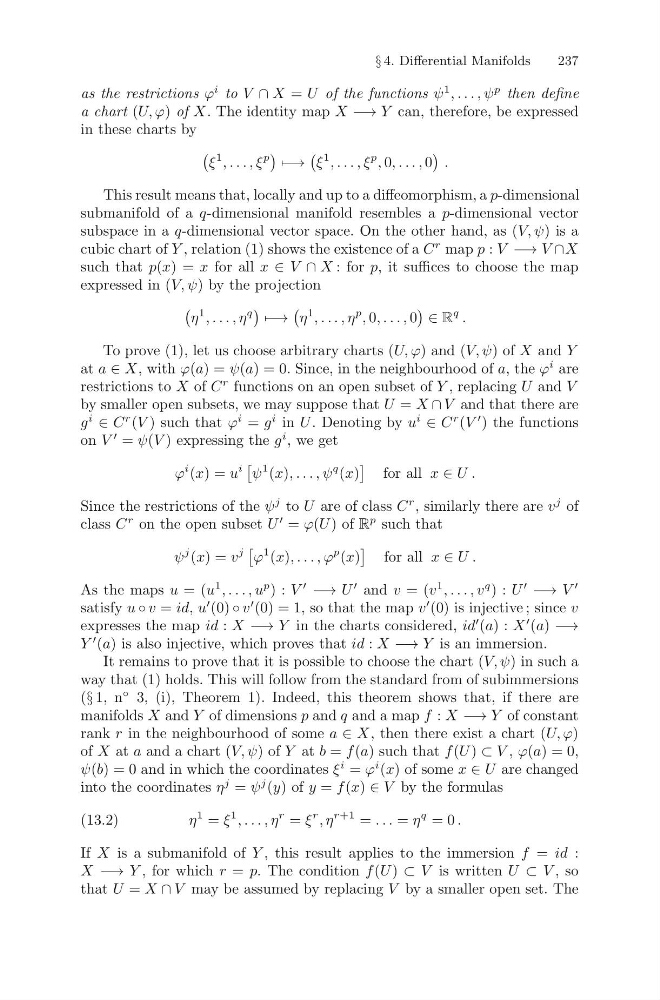
as the restrictions ϕ
i to V ∩ X = U of the functions ψ
1 , . . . , ψ
p then define
a chart (U, ϕ) of X. The identity map X −→ Y can, therefore, be expressed
in these charts by
ξ
1 , . . . , ξ
p
−→
ξ
1 , . . . , ξ
p , 0, . . . , 0
.
This result means that, locally and up to a diffeomorphism, a p-dimensional
submanifold of a q-dimensional manifold resembles a p-dimensional vector
subspace in a q-dimensional vector space. On the other hand, as (V, ψ) is a
cubic chart of Y , relation (1) shows the existence of a C
r map p : V −→ V ∩X
such that p(x) = x for all x ∈ V ∩ X : for p, it suffices to choose the map
expressed in (V, ψ) by the projection
η
1 , . . . , η
q
−→
η
1 , . . . , η
p , 0, . . . , 0
∈ R
q .
To prove (1), let us choose arbitrary charts (U, ϕ) and (V, ψ) of X and Y
at a ∈ X, with ϕ(a) = ψ(a) = 0. Since, in the neighbourhood of a, the ϕ
i are
restrictions to X of C
r functions on an open subset of Y , replacing U and V
by smaller open subsets, we may suppose that U = X ∩ V and that there are
g
i
∈ C
r (V ) such that ϕ
i = g
i in U . Denoting by u
i
∈ C
r (V
) the functions
on V
= ψ(V ) expressing the g
i , we get
ϕ
i (x) = u
i
ψ
1 (x), . . . , ψ
q (x)
for all x ∈ U .
Since the restrictions of the ψ
j to U are of class C
r , similarly there are v
j of
class C
r on the open subset U
= ϕ(U ) of R
p such that
ψ
j (x) = v
j
ϕ
1 (x), . . . , ϕ
p (x)
for all x ∈ U .
As the maps u = (u
1 , . . . , u
p ) : V
−→ U
and v = (v
1 , . . . , v
q ) : U
−→ V
satisfy u ◦ v = id, u
(0) ◦ v
(0) = 1, so that the map v
(0) is injective ; since v
expresses the map id : X −→ Y in the charts considered, id
(a) : X
(a) −→
Y
(a) is also injective, which proves that id : X −→ Y is an immersion.
It remains to prove that it is possible to choose the chart (V, ψ) in such a
way that (1) holds. This will follow from the standard from of subimmersions
(§ 1, n
◦ 3, (i), Theorem 1). Indeed, this theorem shows that, if there are
manifolds X and Y of dimensions p and q and a map f : X −→ Y of constant
rank r in the neighbourhood of some a ∈ X, then there exist a chart (U, ϕ)
of X at a and a chart (V, ψ) of Y at b = f (a) such that f (U ) ⊂ V , ϕ(a) = 0,
ψ(b) = 0 and in which the coordinates ξ
i = ϕ
i (x) of some x ∈ U are changed
into the coordinates η
j = ψ
j (y) of y = f (x) ∈ V by the formulas
η
1 = ξ
1 , . . . , η
r = ξ
r , η
r+1 = . . . = η
q = 0 .
(13.2)
If X is a submanifold of Y , this result applies to the immersion f = id :
X −→ Y , for which r = p. The condition f (U ) ⊂ V is written U ⊂ V , so
that U = X ∩ V may be assumed by replacing V by a smaller open set. The
237
as the restrictions ϕ
i to V ∩ X = U of the functions ψ
1 , . . . , ψ
p then define
a chart (U, ϕ) of X. The identity map X −→ Y can, therefore, be expressed
in these charts by
ξ
1 , . . . , ξ
p
−→
ξ
1 , . . . , ξ
p , 0, . . . , 0
.
This result means that, locally and up to a diffeomorphism, a p-dimensional
submanifold of a q-dimensional manifold resembles a p-dimensional vector
subspace in a q-dimensional vector space. On the other hand, as (V, ψ) is a
cubic chart of Y , relation (1) shows the existence of a C
r map p : V −→ V ∩X
such that p(x) = x for all x ∈ V ∩ X : for p, it suffices to choose the map
expressed in (V, ψ) by the projection
η
1 , . . . , η
q
−→
η
1 , . . . , η
p , 0, . . . , 0
∈ R
q .
To prove (1), let us choose arbitrary charts (U, ϕ) and (V, ψ) of X and Y
at a ∈ X, with ϕ(a) = ψ(a) = 0. Since, in the neighbourhood of a, the ϕ
i are
restrictions to X of C
r functions on an open subset of Y , replacing U and V
by smaller open subsets, we may suppose that U = X ∩ V and that there are
g
i
∈ C
r (V ) such that ϕ
i = g
i in U . Denoting by u
i
∈ C
r (V
) the functions
on V
= ψ(V ) expressing the g
i , we get
ϕ
i (x) = u
i
ψ
1 (x), . . . , ψ
q (x)
for all x ∈ U .
Since the restrictions of the ψ
j to U are of class C
r , similarly there are v
j of
class C
r on the open subset U
= ϕ(U ) of R
p such that
ψ
j (x) = v
j
ϕ
1 (x), . . . , ϕ
p (x)
for all x ∈ U .
As the maps u = (u
1 , . . . , u
p ) : V
−→ U
and v = (v
1 , . . . , v
q ) : U
−→ V
satisfy u ◦ v = id, u
(0) ◦ v
(0) = 1, so that the map v
(0) is injective ; since v
expresses the map id : X −→ Y in the charts considered, id
(a) : X
(a) −→
Y
(a) is also injective, which proves that id : X −→ Y is an immersion.
It remains to prove that it is possible to choose the chart (V, ψ) in such a
way that (1) holds. This will follow from the standard from of subimmersions
(§ 1, n
◦ 3, (i), Theorem 1). Indeed, this theorem shows that, if there are
manifolds X and Y of dimensions p and q and a map f : X −→ Y of constant
rank r in the neighbourhood of some a ∈ X, then there exist a chart (U, ϕ)
of X at a and a chart (V, ψ) of Y at b = f (a) such that f (U ) ⊂ V , ϕ(a) = 0,
ψ(b) = 0 and in which the coordinates ξ
i = ϕ
i (x) of some x ∈ U are changed
into the coordinates η
j = ψ
j (y) of y = f (x) ∈ V by the formulas
η
1 = ξ
1 , . . . , η
r = ξ
r , η
r+1 = . . . = η
q = 0 .
(13.2)
If X is a submanifold of Y , this result applies to the immersion f = id :
X −→ Y , for which r = p. The condition f (U ) ⊂ V is written U ⊂ V , so
that U = X ∩ V may be assumed by replacing V by a smaller open set. The