

232
IX – Multivariate Differential and Integral Calculus
f
(a)h =
d
dt
f [μ(t)] for t = 0 .
(12.12)
Even more particularly, suppose that E = R
d , where d = dim(X), consider a chart (U, ϕ) of X in the neighbourhood of a and take f = ϕ, so that
f
(a) is bijective. This leads to the derivative at the origin of the function
ϕ[μ(t)] ; but by (9), it is precisely the element h(ϕ) of R
d which defined h in
the chart (U, ϕ). Hence
ϕ
(a)h = h(ϕ)
(12.13)
for all h ∈ X
(a) and all charts (U, ϕ) in the neighbourhood of a.
This is not surprising. Indeed, the aim is to find a preferably natural
way to transform every h ∈ X
(a) into a vector of R
d by using ϕ. Now,
the definition of tangent vectors itself provides us with such a vector, namely
h(ϕ). What other possibilities are there? The preestablished harmony in these
domains could have saved us a proof. . .
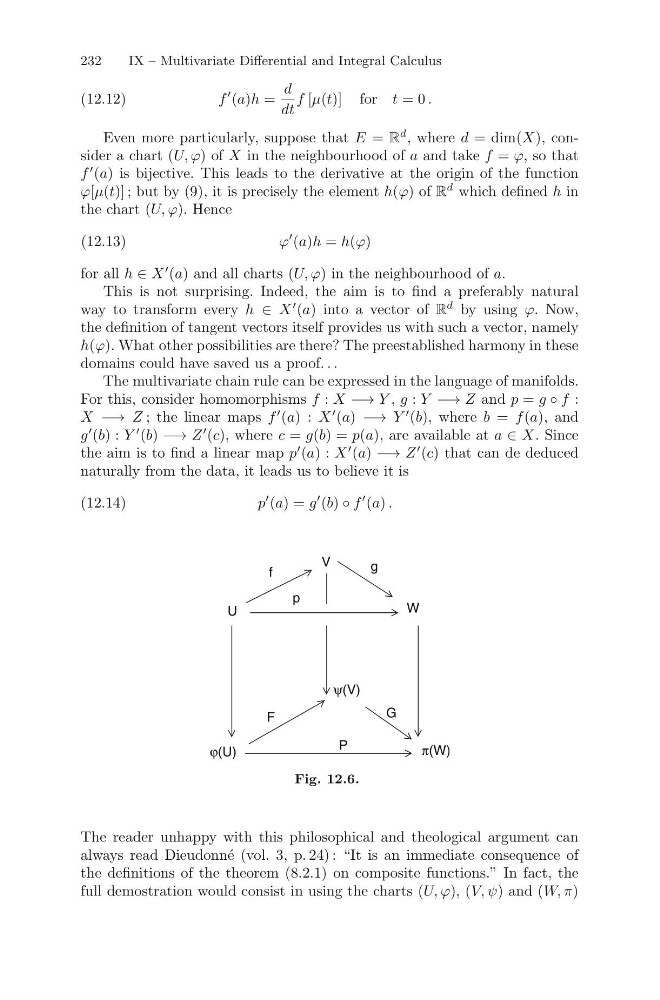
The multivariate chain rule can be expressed in the language of manifolds.
For this, consider homomorphisms f : X −→ Y , g : Y −→ Z and p = g ◦ f :
X −→ Z ; the linear maps f
(a) : X
(a) −→ Y
(b), where b = f (a), and
g
(b) : Y
(b) −→ Z
(c), where c = g(b) = p(a), are available at a ∈ X. Since
the aim is to find a linear map p
(a) : X
(a) −→ Z
(c) that can de deduced
naturally from the data, it leads us to believe it is
p
(a) = g
(b) ◦ f
(a) .
(12.14)
U
W
ϕ(U)
π(W)
ψ(V)
V
f
g
p
F
G
P
Fig. 12.6.
The reader unhappy with this philosophical and theological argument can
always read Dieudonn´ e (vol. 3, p. 24) : “It is an immediate consequence of
the definitions of the theorem (8.2.1) on composite functions.” In fact, the
full demostration would consist in using the charts (U, ϕ), (V, ψ) and (W, π)
IX – Multivariate Differential and Integral Calculus
f
(a)h =
d
dt
f [μ(t)] for t = 0 .
(12.12)
Even more particularly, suppose that E = R
d , where d = dim(X), consider a chart (U, ϕ) of X in the neighbourhood of a and take f = ϕ, so that
f
(a) is bijective. This leads to the derivative at the origin of the function
ϕ[μ(t)] ; but by (9), it is precisely the element h(ϕ) of R
d which defined h in
the chart (U, ϕ). Hence
ϕ
(a)h = h(ϕ)
(12.13)
for all h ∈ X
(a) and all charts (U, ϕ) in the neighbourhood of a.
This is not surprising. Indeed, the aim is to find a preferably natural
way to transform every h ∈ X
(a) into a vector of R
d by using ϕ. Now,
the definition of tangent vectors itself provides us with such a vector, namely
h(ϕ). What other possibilities are there? The preestablished harmony in these
domains could have saved us a proof. . .
The multivariate chain rule can be expressed in the language of manifolds.
For this, consider homomorphisms f : X −→ Y , g : Y −→ Z and p = g ◦ f :
X −→ Z ; the linear maps f
(a) : X
(a) −→ Y
(b), where b = f (a), and
g
(b) : Y
(b) −→ Z
(c), where c = g(b) = p(a), are available at a ∈ X. Since
the aim is to find a linear map p
(a) : X
(a) −→ Z
(c) that can de deduced
naturally from the data, it leads us to believe it is
p
(a) = g
(b) ◦ f
(a) .
(12.14)
U
W
ϕ(U)
π(W)
ψ(V)
V
f
g
p
F
G
P
Fig. 12.6.
The reader unhappy with this philosophical and theological argument can
always read Dieudonn´ e (vol. 3, p. 24) : “It is an immediate consequence of
the definitions of the theorem (8.2.1) on composite functions.” In fact, the
full demostration would consist in using the charts (U, ϕ), (V, ψ) and (W, π)