

220
IX – Multivariate Differential and Integral Calculus
phic to an open subset of some space R
d , where d is a given integer,
47 the
dimension of X. Such a homeomorphism ϕ = (ϕ
1 , . . . , ϕ
d ), where the ϕ
i (x)
are the canonical coordinates of ϕ(x), is, by definition, a local topological
chart (U, ϕ) of X which makes it possible to identify points x ∈ U by using d
real scalars ξ
i = ϕ
i (x), its coordinates in the chart considered.
48 The integer
d is uniquely determined thanks to a well-known theorem (J. L. E. Brouwer)
according to which an open subset of R
p can be homeomorphic to an open
subset of R
q only if p = q. Peano’s curve (p = 1, q = 2) is not a homeomorphism.
U
U
θ
p
p
q
q
pq
ϕ
ϕ
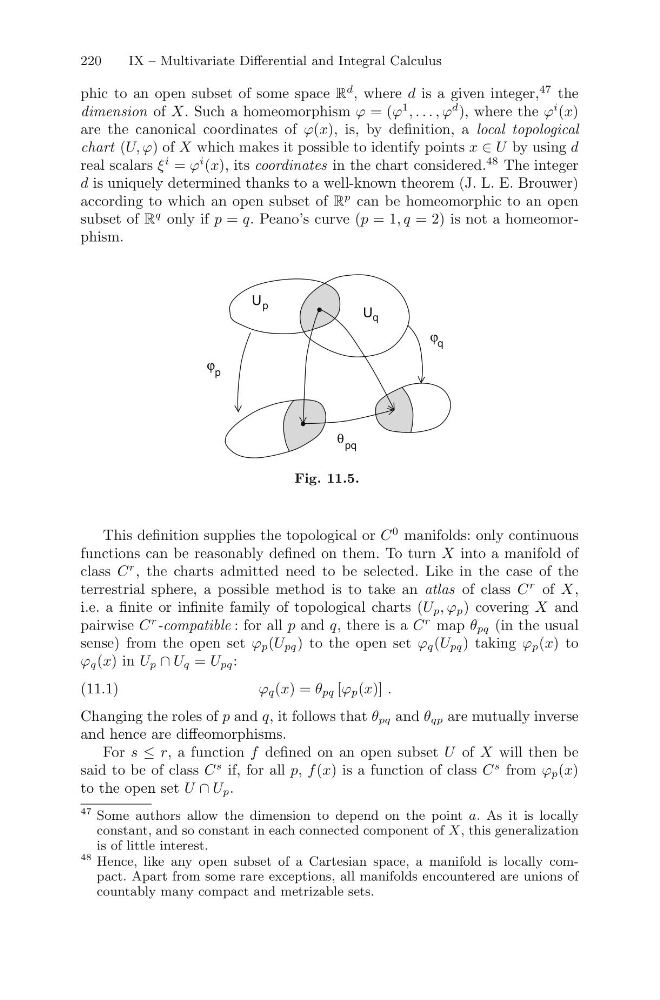
Fig. 11.5.
This definition supplies the topological or C
0 manifolds: only continuous
functions can be reasonably defined on them. To turn X into a manifold of
class C
r , the charts admitted need to be selected. Like in the case of the
terrestrial sphere, a possible method is to take an atlas of class C
r of X,
i.e. a finite or infinite family of topological charts (U p , ϕ p ) covering X and
pairwise C
r -compatible : for all p and q, there is a C
r map θ pq (in the usual
sense) from the open set ϕ p (U pq ) to the open set ϕ q (U pq ) taking ϕ p (x) to
ϕ q (x) in U p ∩ U q = U pq :
ϕ q (x) = θ pq [ϕ p (x)] .
(11.1)
Changing the roles of p and q, it follows that θ pq and θ qp are mutually inverse
and hence are diffeomorphisms.
For s ≤ r, a function f defined on an open subset U of X will then be
said to be of class C
s if, for all p, f (x) is a function of class C
s from ϕ p (x)
to the open set U ∩ U p .
47 Some authors allow the dimension to depend on the point a. As it is locally
constant, and so constant in each connected component of X, this generalization
is of little interest.
48 Hence, like any open subset of a Cartesian space, a manifold is locally compact. Apart from some rare exceptions, all manifolds encountered are unions of
countably many compact and metrizable sets.
IX – Multivariate Differential and Integral Calculus
phic to an open subset of some space R
d , where d is a given integer,
47 the
dimension of X. Such a homeomorphism ϕ = (ϕ
1 , . . . , ϕ
d ), where the ϕ
i (x)
are the canonical coordinates of ϕ(x), is, by definition, a local topological
chart (U, ϕ) of X which makes it possible to identify points x ∈ U by using d
real scalars ξ
i = ϕ
i (x), its coordinates in the chart considered.
48 The integer
d is uniquely determined thanks to a well-known theorem (J. L. E. Brouwer)
according to which an open subset of R
p can be homeomorphic to an open
subset of R
q only if p = q. Peano’s curve (p = 1, q = 2) is not a homeomorphism.
U
U
θ
p
p
q
q
pq
ϕ
ϕ
Fig. 11.5.
This definition supplies the topological or C
0 manifolds: only continuous
functions can be reasonably defined on them. To turn X into a manifold of
class C
r , the charts admitted need to be selected. Like in the case of the
terrestrial sphere, a possible method is to take an atlas of class C
r of X,
i.e. a finite or infinite family of topological charts (U p , ϕ p ) covering X and
pairwise C
r -compatible : for all p and q, there is a C
r map θ pq (in the usual
sense) from the open set ϕ p (U pq ) to the open set ϕ q (U pq ) taking ϕ p (x) to
ϕ q (x) in U p ∩ U q = U pq :
ϕ q (x) = θ pq [ϕ p (x)] .
(11.1)
Changing the roles of p and q, it follows that θ pq and θ qp are mutually inverse
and hence are diffeomorphisms.
For s ≤ r, a function f defined on an open subset U of X will then be
said to be of class C
s if, for all p, f (x) is a function of class C
s from ϕ p (x)
to the open set U ∩ U p .
47 Some authors allow the dimension to depend on the point a. As it is locally
constant, and so constant in each connected component of X, this generalization
is of little interest.
48 Hence, like any open subset of a Cartesian space, a manifold is locally compact. Apart from some rare exceptions, all manifolds encountered are unions of
countably many compact and metrizable sets.