

214
IX – Multivariate Differential and Integral Calculus
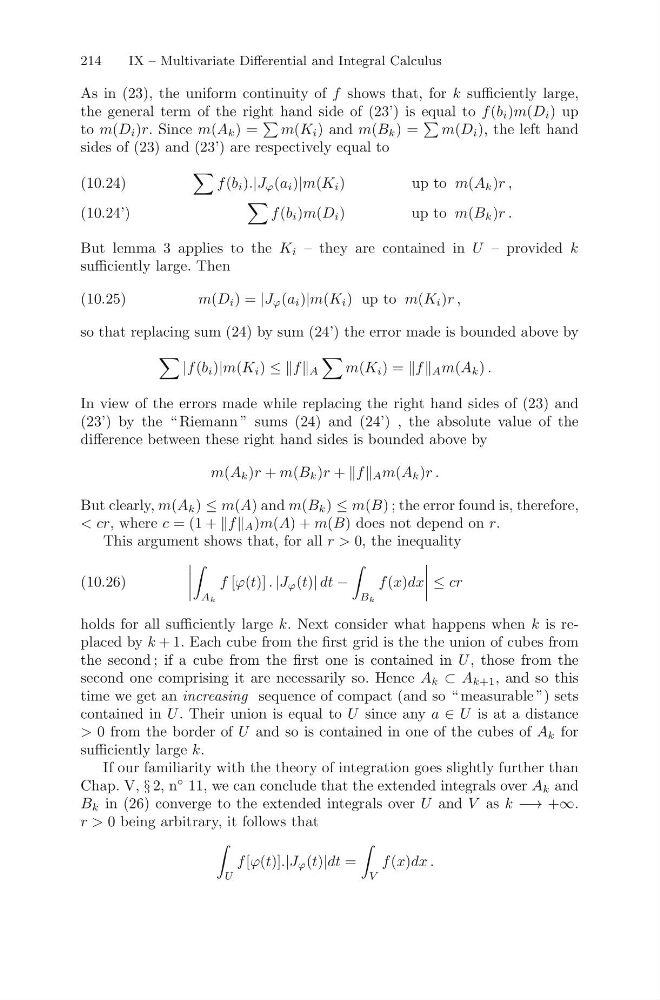
As in (23), the uniform continuity of f shows that, for k sufficiently large,
the general term of the right hand side of (23’) is equal to f (b i )m(D i ) up
to m(D i )r. Since m(A k ) =
m(K i ) and m(B k ) =
m(D i ), the left hand
sides of (23) and (23’) are respectively equal to
f (b i ).|J ϕ (a i )|m(K i )
u pt o m(A k )r ,
(10.24)
f (b i )m(D i )
u pt o m(B k )r .
(10.24’)
But lemma 3 applies to the K i – they are contained in U – provided k
sufficiently large. Then
m(D i ) = |J ϕ (a i )|m(K i ) up to m(K i )r ,
(10.25)
so that replacing sum (24) by sum (24’) the error made is bounded above by
|f (b i )|m(K i ) ≤ ≤f A
m(K i ) = f A m(A k ) .
In view of the errors made while replacing the right hand sides of (23) and
(23’) by the “ Riemann ” sums (24) and (24’) , the absolute value of the
difference between these right hand sides is bounded above by
m(A k )r + m(B k )r + f A m(A k )r .
But clearly, m(A k ) ≤ m(A) and m(B k ) ≤ m(B) ; the error found is, therefore,
< cr, where c = (1 + f A )m(A) + m(B) does not depend on r.
This argument shows that, for all r > 0, the inequality
A k
f [ϕ(t)] . |J ϕ (t)| dt −
B k
f (x)dx
≤ cr
(10.26)
holds for all sufficiently large k. Next consider what happens when k is replaced by k + 1. Each cube from the first grid is the the union of cubes from
the second ; if a cube from the first one is contained in U , those from the
second one comprising it are necessarily so. Hence A k ⊂ A k+1 , and so this
time we get an increasing sequence of compact (and so “ measurable ”) sets
contained in U . Their union is equal to U since any a ∈ U is at a distance
> 0 from the border of U and so is contained in one of the cubes of A k for
sufficiently large k.
If our familiarity with the theory of integration goes slightly further than
Chap. V, § 2, n
◦ 11, we can conclude that the extended integrals over A k and
B k in (26) converge to the extended integrals over U and V as k −→ +∞.
r > 0 being arbitrary, it follows that
U
f [ϕ(t)].|J ϕ (t)|dt =
V
f (x)dx .
IX – Multivariate Differential and Integral Calculus
As in (23), the uniform continuity of f shows that, for k sufficiently large,
the general term of the right hand side of (23’) is equal to f (b i )m(D i ) up
to m(D i )r. Since m(A k ) =
m(K i ) and m(B k ) =
m(D i ), the left hand
sides of (23) and (23’) are respectively equal to
f (b i ).|J ϕ (a i )|m(K i )
u pt o m(A k )r ,
(10.24)
f (b i )m(D i )
u pt o m(B k )r .
(10.24’)
But lemma 3 applies to the K i – they are contained in U – provided k
sufficiently large. Then
m(D i ) = |J ϕ (a i )|m(K i ) up to m(K i )r ,
(10.25)
so that replacing sum (24) by sum (24’) the error made is bounded above by
|f (b i )|m(K i ) ≤ ≤f A
m(K i ) = f A m(A k ) .
In view of the errors made while replacing the right hand sides of (23) and
(23’) by the “ Riemann ” sums (24) and (24’) , the absolute value of the
difference between these right hand sides is bounded above by
m(A k )r + m(B k )r + f A m(A k )r .
But clearly, m(A k ) ≤ m(A) and m(B k ) ≤ m(B) ; the error found is, therefore,
< cr, where c = (1 + f A )m(A) + m(B) does not depend on r.
This argument shows that, for all r > 0, the inequality
A k
f [ϕ(t)] . |J ϕ (t)| dt −
B k
f (x)dx
≤ cr
(10.26)
holds for all sufficiently large k. Next consider what happens when k is replaced by k + 1. Each cube from the first grid is the the union of cubes from
the second ; if a cube from the first one is contained in U , those from the
second one comprising it are necessarily so. Hence A k ⊂ A k+1 , and so this
time we get an increasing sequence of compact (and so “ measurable ”) sets
contained in U . Their union is equal to U since any a ∈ U is at a distance
> 0 from the border of U and so is contained in one of the cubes of A k for
sufficiently large k.
If our familiarity with the theory of integration goes slightly further than
Chap. V, § 2, n
◦ 11, we can conclude that the extended integrals over A k and
B k in (26) converge to the extended integrals over U and V as k −→ +∞.
r > 0 being arbitrary, it follows that
U
f [ϕ(t)].|J ϕ (t)|dt =
V
f (x)dx .