

§ 3. Integration of Differential Forms
211
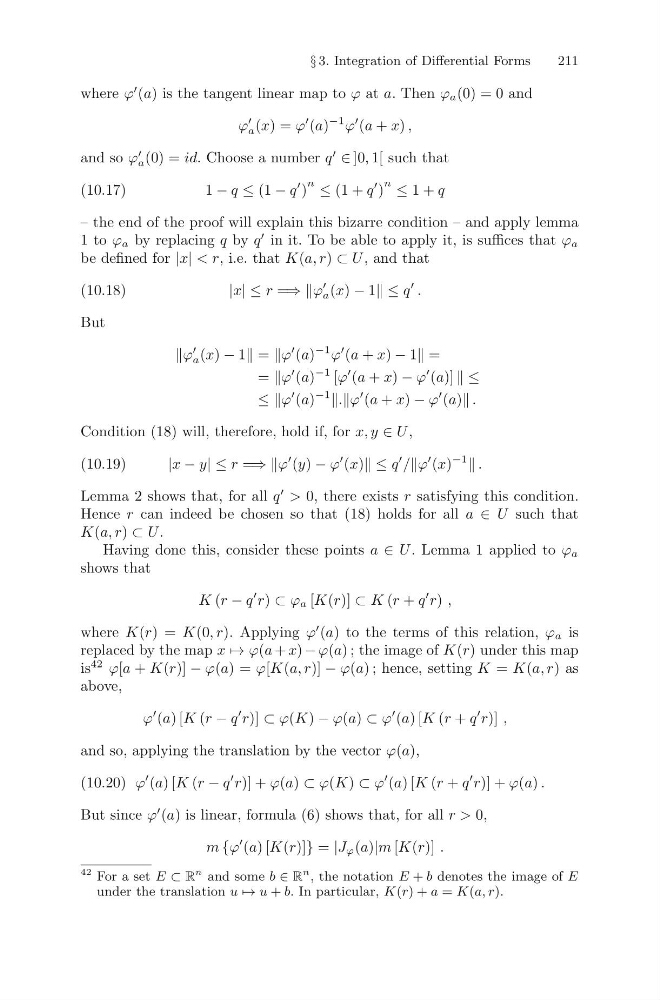
where ϕ
(a) is the tangent linear map to ϕ at a. Then ϕ a (0) = 0 and
ϕ
a (x) = ϕ
(a)
−1 ϕ
(a + x) ,
and so ϕ
a (0) = id. Choose a number q
∈ ]0, 1[ such that
1 − q ≤ (1 − q
)
n ≤ (1 + q
)
n ≤ 1 + q
(10.17)
– the end of the proof will explain this bizarre condition – and apply lemma
1 to ϕ a by replacing q by q
in it. To be able to apply it, is suffices that ϕ a
be defined for |x| < r, i.e. that K(a, r) ⊂ U , and that
|x| ≤ r =⇒ ⇒ϕ
a (x) − 1 ≤ q
.
(10.18)
But
ϕ
a (x) − 1 = ϕ
(a)
−1 ϕ
(a + x) − 1 =
= ϕ
(a)
−1 [ϕ
(a + x) − ϕ
(a)] ≤
≤ ≤ϕ
(a)
−1
.ϕ
(a + x) − ϕ
(a) .
Condition (18) will, therefore, hold if, for x, y ∈ U ,
|x − y| ≤ r =⇒ ⇒ϕ
(y) − ϕ
(x) ≤ q
/ϕ
(x)
−1
.
(10.19)
Lemma 2 shows that, for all q
> 0, there exists r satisfying this condition.
Hence r can indeed be chosen so that (18) holds for all a ∈ U such that
K(a, r) ⊂ U .
Having done this, consider these points a ∈ U . Lemma 1 applied to ϕ a
shows that
K (r − q
r) ⊂ ϕ a [K(r)] ⊂ K (r + q
r) ,
where K(r) = K(0, r). Applying ϕ
(a) to the terms of this relation, ϕ a is
replaced by the map x → ϕ(a + x) − ϕ(a) ; the image of K(r) under this map
is
42 ϕ[a + K(r)] − ϕ(a) = ϕ[K(a, r)] − ϕ(a) ; hence, setting K = K(a, r) as
above,
ϕ
(a) [K (r − q
r)] ⊂ ϕ(K) − ϕ(a) ⊂ ϕ
(a) [K (r + q
r)] ,
and so, applying the translation by the vector ϕ(a),
ϕ
(a) [K (r − q
r)] + ϕ(a) ⊂ ϕ(K) ⊂ ϕ
(a) [K (r + q
r)] + ϕ(a) .
(10.20)
But since ϕ
(a) is linear, formula (6) shows that, for all r > 0,
m {ϕ
(a) [K(r)]} = |J ϕ (a)|m [K(r)] .
42 For a set E ⊂ R
n and some b ∈ R
n , the notation E + b denotes the image of E
under the translation u → u + b. In particular, K(r) + a = K(a, r).
211
where ϕ
(a) is the tangent linear map to ϕ at a. Then ϕ a (0) = 0 and
ϕ
a (x) = ϕ
(a)
−1 ϕ
(a + x) ,
and so ϕ
a (0) = id. Choose a number q
∈ ]0, 1[ such that
1 − q ≤ (1 − q
)
n ≤ (1 + q
)
n ≤ 1 + q
(10.17)
– the end of the proof will explain this bizarre condition – and apply lemma
1 to ϕ a by replacing q by q
in it. To be able to apply it, is suffices that ϕ a
be defined for |x| < r, i.e. that K(a, r) ⊂ U , and that
|x| ≤ r =⇒ ⇒ϕ
a (x) − 1 ≤ q
.
(10.18)
But
ϕ
a (x) − 1 = ϕ
(a)
−1 ϕ
(a + x) − 1 =
= ϕ
(a)
−1 [ϕ
(a + x) − ϕ
(a)] ≤
≤ ≤ϕ
(a)
−1
.ϕ
(a + x) − ϕ
(a) .
Condition (18) will, therefore, hold if, for x, y ∈ U ,
|x − y| ≤ r =⇒ ⇒ϕ
(y) − ϕ
(x) ≤ q
/ϕ
(x)
−1
.
(10.19)
Lemma 2 shows that, for all q
> 0, there exists r satisfying this condition.
Hence r can indeed be chosen so that (18) holds for all a ∈ U such that
K(a, r) ⊂ U .
Having done this, consider these points a ∈ U . Lemma 1 applied to ϕ a
shows that
K (r − q
r) ⊂ ϕ a [K(r)] ⊂ K (r + q
r) ,
where K(r) = K(0, r). Applying ϕ
(a) to the terms of this relation, ϕ a is
replaced by the map x → ϕ(a + x) − ϕ(a) ; the image of K(r) under this map
is
42 ϕ[a + K(r)] − ϕ(a) = ϕ[K(a, r)] − ϕ(a) ; hence, setting K = K(a, r) as
above,
ϕ
(a) [K (r − q
r)] ⊂ ϕ(K) − ϕ(a) ⊂ ϕ
(a) [K (r + q
r)] ,
and so, applying the translation by the vector ϕ(a),
ϕ
(a) [K (r − q
r)] + ϕ(a) ⊂ ϕ(K) ⊂ ϕ
(a) [K (r + q
r)] + ϕ(a) .
(10.20)
But since ϕ
(a) is linear, formula (6) shows that, for all r > 0,
m {ϕ
(a) [K(r)]} = |J ϕ (a)|m [K(r)] .
42 For a set E ⊂ R
n and some b ∈ R
n , the notation E + b denotes the image of E
under the translation u → u + b. In particular, K(r) + a = K(a, r).