

§ 3. Integration of Differential Forms
207
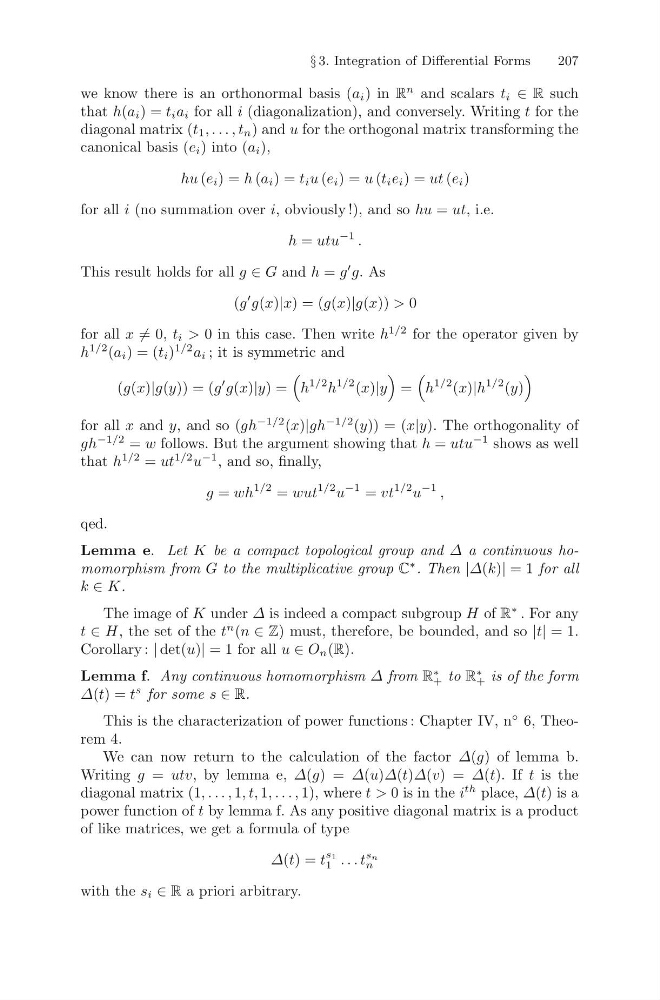
we know there is an orthonormal basis (a i ) in R
n and scalars t i ∈ R such
that h(a i ) = t i a i for all i (diagonalization), and conversely. Writing t for the
diagonal matrix (t 1 , . . . , t n ) and u for the orthogonal matrix transforming the
canonical basis (e i ) into (a i ),
hu (e i ) = h (a i ) = t i u (e i ) = u (t i e i ) = ut (e i )
for all i (no summation over i, obviously !), and so hu = ut, i.e.
h = utu
−1 .
This result holds for all g ∈ G and h = g
g. As
(g
g(x)|x) = (g(x)|g(x)) > 0
for all x = 0, t i > 0 in this case. Then write h
1/2 for the operator given by
h
1/2 (a i ) = (t i )
1/2 a i ; it is symmetric and
(g(x)|g(y)) = (g
g(x)|y) =
h
1/2 h
1/2 (x)|y
=
h
1/2 (x)|h
1/2 (y)
for all x and y, and so (gh
−1/2 (x)|gh
−1/2 (y)) = (x|y). The orthogonality of
gh
−1/2 = w follows. But the argument showing that h = utu
−1 shows as well
that h
1/2 = ut
1/2 u
−1 , and so, finally,
g = wh
1/2 = wut
1/2 u
−1 = vt
1/2 u
−1 ,
qed.
Lemma e. Let K be a compact topological group and Δ a continuous homomorphism from G to the multiplicative group C
∗ . Then |Δ(k)| = 1 for all
k ∈ K.
The image of K under Δ is indeed a compact subgroup H of R
∗ . For any
t ∈ H, the set of the t
n (n ∈ Z) must, therefore, be bounded, and so |t| = 1.
Corollary : | det(u)| = 1 for all u ∈ O n (R).
Lemma f. Any continuous homomorphism Δ from R
∗
+ to R
∗
+ is of the form
Δ(t) = t
s for some s ∈ R.
This is the characterization of power functions : Chapter IV, n
◦ 6, Theorem 4.
We can now return to the calculation of the factor Δ(g) of lemma b.
Writing g = utv, by lemma e, Δ(g) = Δ(u)Δ(t)Δ(v) = Δ(t). If t is the
diagonal matrix (1, . . . , 1, t, 1, . . . , 1), where t > 0 is in the i
th place, Δ(t) is a
power function of t by lemma f. As any positive diagonal matrix is a product
of like matrices, we get a formula of type
Δ(t) = t
s1
1 . . . t
sn
n
with the s i ∈ R a priori arbitrary.
207
we know there is an orthonormal basis (a i ) in R
n and scalars t i ∈ R such
that h(a i ) = t i a i for all i (diagonalization), and conversely. Writing t for the
diagonal matrix (t 1 , . . . , t n ) and u for the orthogonal matrix transforming the
canonical basis (e i ) into (a i ),
hu (e i ) = h (a i ) = t i u (e i ) = u (t i e i ) = ut (e i )
for all i (no summation over i, obviously !), and so hu = ut, i.e.
h = utu
−1 .
This result holds for all g ∈ G and h = g
g. As
(g
g(x)|x) = (g(x)|g(x)) > 0
for all x = 0, t i > 0 in this case. Then write h
1/2 for the operator given by
h
1/2 (a i ) = (t i )
1/2 a i ; it is symmetric and
(g(x)|g(y)) = (g
g(x)|y) =
h
1/2 h
1/2 (x)|y
=
h
1/2 (x)|h
1/2 (y)
for all x and y, and so (gh
−1/2 (x)|gh
−1/2 (y)) = (x|y). The orthogonality of
gh
−1/2 = w follows. But the argument showing that h = utu
−1 shows as well
that h
1/2 = ut
1/2 u
−1 , and so, finally,
g = wh
1/2 = wut
1/2 u
−1 = vt
1/2 u
−1 ,
qed.
Lemma e. Let K be a compact topological group and Δ a continuous homomorphism from G to the multiplicative group C
∗ . Then |Δ(k)| = 1 for all
k ∈ K.
The image of K under Δ is indeed a compact subgroup H of R
∗ . For any
t ∈ H, the set of the t
n (n ∈ Z) must, therefore, be bounded, and so |t| = 1.
Corollary : | det(u)| = 1 for all u ∈ O n (R).
Lemma f. Any continuous homomorphism Δ from R
∗
+ to R
∗
+ is of the form
Δ(t) = t
s for some s ∈ R.
This is the characterization of power functions : Chapter IV, n
◦ 6, Theorem 4.
We can now return to the calculation of the factor Δ(g) of lemma b.
Writing g = utv, by lemma e, Δ(g) = Δ(u)Δ(t)Δ(v) = Δ(t). If t is the
diagonal matrix (1, . . . , 1, t, 1, . . . , 1), where t > 0 is in the i
th place, Δ(t) is a
power function of t by lemma f. As any positive diagonal matrix is a product
of like matrices, we get a formula of type
Δ(t) = t
s1
1 . . . t
sn
n
with the s i ∈ R a priori arbitrary.