

§ 3. Integration of Differential Forms
203
Nevertheless, it should be mentioned that he spent far more efforts to give
the theory a formal concise and esthetic aspect than to justify its formulas:
a quite impossible task before the modern development of topology and of
the theory of differentiable manifolds and which continues to raise serious
problems today.
38
10 – Change of Variables in a Multiple Integral
Thus in the classical version, a “ surface integral ” needed to be shown to be
solely dependent on the geometric surface and not on its parametric representation (9.26). It is exact – up to sign as in dimension one where a question
of orientation arises – for injective maps σ of maximum rank everywhere,
but even in this case the answer is obviously not easily available: the corresponding statement in dimension one already requiring the change of variable
formula in a simple integral, the same will necessarily hold in dimension two.
Indeed, suppose that σ is replaced by σ ◦ ϕ where ϕ is a diffeomorphism from
I
2 to I
2 , which leaves the image of the square invariant. The integral over I
2
of
ω ◦ σ = r(s, t)ds ∧ dt
is then replaced by that of
ω ◦ (σ ◦ ϕ) = (ω ◦ σ) ◦ ϕ = r [ϕ(s, t)] J ϕ (s, t)ds ∧ dt .
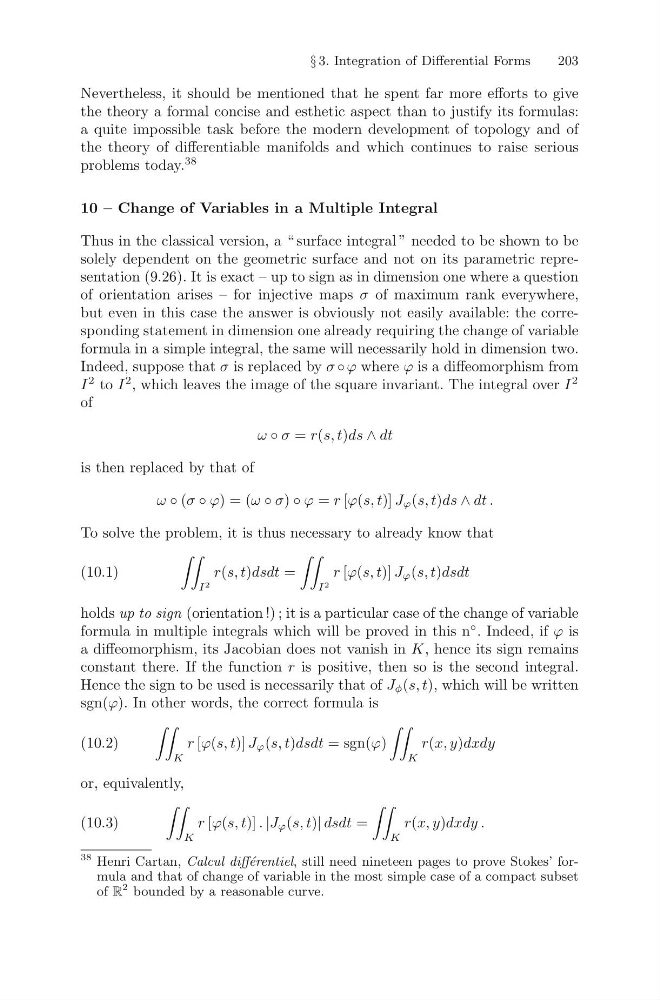
To solve the problem, it is thus necessary to already know that
I 2
r(s, t)dsdt =
I 2
r [ϕ(s, t)] J ϕ (s, t)dsdt
(10.1)
holds up to sign (orientation !) ; it is a particular case of the change of variable
formula in multiple integrals which will be proved in this n
◦ . Indeed, if ϕ is
a diffeomorphism, its Jacobian does not vanish in K, hence its sign remains
constant there. If the function r is positive, then so is the second integral.
Hence the sign to be used is necessarily that of J φ (s, t), which will be written
sgn(ϕ). In other words, the correct formula is
K
r [ϕ(s, t)] J ϕ (s, t)dsdt = sgn(ϕ)
K
r(x, y)dxdy
(10.2)
or, equivalently,
K
r [ϕ(s, t)] . |J ϕ (s, t)| dsdt =
K
r(x, y)dxdy .
(10.3)
38 Henri Cartan, Calcul diff´ erentiel, still need nineteen pages to prove Stokes’ formula and that of change of variable in the most simple case of a compact subset
of R
2 bounded by a reasonable curve.
203
Nevertheless, it should be mentioned that he spent far more efforts to give
the theory a formal concise and esthetic aspect than to justify its formulas:
a quite impossible task before the modern development of topology and of
the theory of differentiable manifolds and which continues to raise serious
problems today.
38
10 – Change of Variables in a Multiple Integral
Thus in the classical version, a “ surface integral ” needed to be shown to be
solely dependent on the geometric surface and not on its parametric representation (9.26). It is exact – up to sign as in dimension one where a question
of orientation arises – for injective maps σ of maximum rank everywhere,
but even in this case the answer is obviously not easily available: the corresponding statement in dimension one already requiring the change of variable
formula in a simple integral, the same will necessarily hold in dimension two.
Indeed, suppose that σ is replaced by σ ◦ ϕ where ϕ is a diffeomorphism from
I
2 to I
2 , which leaves the image of the square invariant. The integral over I
2
of
ω ◦ σ = r(s, t)ds ∧ dt
is then replaced by that of
ω ◦ (σ ◦ ϕ) = (ω ◦ σ) ◦ ϕ = r [ϕ(s, t)] J ϕ (s, t)ds ∧ dt .
To solve the problem, it is thus necessary to already know that
I 2
r(s, t)dsdt =
I 2
r [ϕ(s, t)] J ϕ (s, t)dsdt
(10.1)
holds up to sign (orientation !) ; it is a particular case of the change of variable
formula in multiple integrals which will be proved in this n
◦ . Indeed, if ϕ is
a diffeomorphism, its Jacobian does not vanish in K, hence its sign remains
constant there. If the function r is positive, then so is the second integral.
Hence the sign to be used is necessarily that of J φ (s, t), which will be written
sgn(ϕ). In other words, the correct formula is
K
r [ϕ(s, t)] J ϕ (s, t)dsdt = sgn(ϕ)
K
r(x, y)dxdy
(10.2)
or, equivalently,
K
r [ϕ(s, t)] . |J ϕ (s, t)| dsdt =
K
r(x, y)dxdy .
(10.3)
38 Henri Cartan, Calcul diff´ erentiel, still need nineteen pages to prove Stokes’ formula and that of change of variable in the most simple case of a compact subset
of R
2 bounded by a reasonable curve.