

§ 3. Integration of Differential Forms
193
x + k
x + tk
x + h
P
x + sh
x
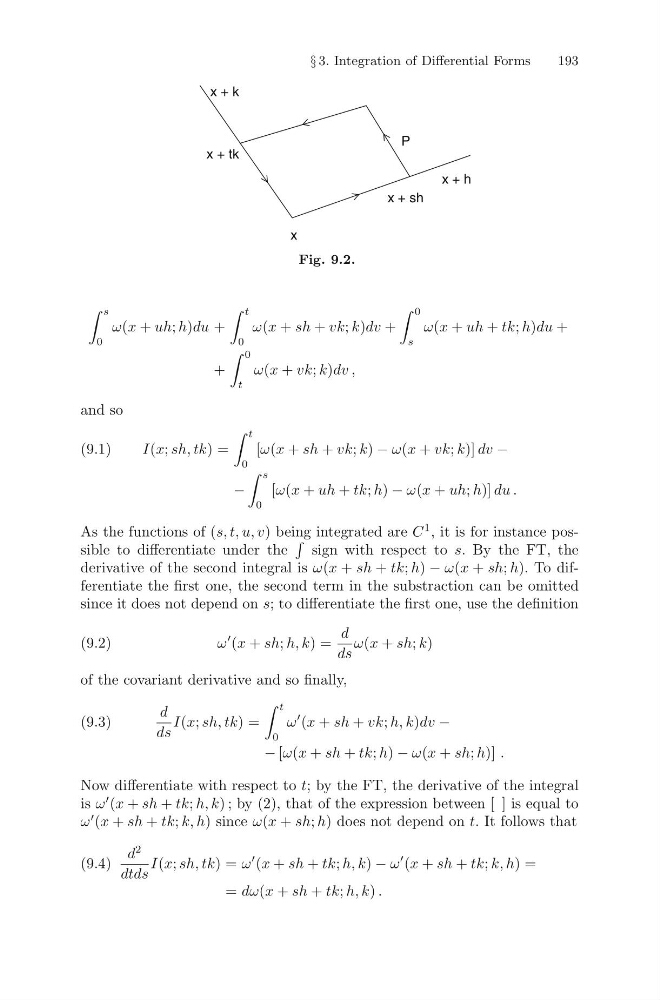
Fig. 9.2.
s
0
ω(x + uh; h)du +
t
0
ω(x + sh + vk; k)dv +
0
s
ω(x + uh + tk; h)du +
+
0
t
ω(x + vk; k)dv ,
and so
I(x; sh, tk) =
t
0
[ω(x + sh + vk; k) − ω(x + vk; k)] dv −
(9.1)
−
s
0
[ω(x + uh + tk; h) − ω(x + uh; h)] du .
As the functions of (s, t, u, v) being integrated are C
1 , it is for instance possible to differentiate under the
sign with respect to s. By the FT, the
derivative of the second integral is ω(x + sh + tk; h) − ω(x + sh; h). To differentiate the first one, the second term in the substraction can be omitted
since it does not depend on s; to differentiate the first one, use the definition
ω
(x + sh; h, k) =
d
ds
ω(x + sh; k)
(9.2)
of the covariant derivative and so finally,
d
ds
I(x; sh, tk) =
t
0
ω
(x + sh + vk; h, k)dv −
(9.3)
− [ω(x + sh + tk; h) − ω(x + sh; h)] .
Now differentiate with respect to t; by the FT, the derivative of the integral
is ω
(x + sh + tk; h, k) ; by (2), that of the expression between [ ] is equal to
ω
(x + sh + tk; k, h) since ω(x + sh; h) does not depend on t. It follows that
d
2
dtds
I(x; sh, tk) = ω
(x + sh + tk; h, k) − ω
(x + sh + tk; k, h) =
(9.4)
= dω(x + sh + tk; h, k) .
193
x + k
x + tk
x + h
P
x + sh
x
Fig. 9.2.
s
0
ω(x + uh; h)du +
t
0
ω(x + sh + vk; k)dv +
0
s
ω(x + uh + tk; h)du +
+
0
t
ω(x + vk; k)dv ,
and so
I(x; sh, tk) =
t
0
[ω(x + sh + vk; k) − ω(x + vk; k)] dv −
(9.1)
−
s
0
[ω(x + uh + tk; h) − ω(x + uh; h)] du .
As the functions of (s, t, u, v) being integrated are C
1 , it is for instance possible to differentiate under the
sign with respect to s. By the FT, the
derivative of the second integral is ω(x + sh + tk; h) − ω(x + sh; h). To differentiate the first one, the second term in the substraction can be omitted
since it does not depend on s; to differentiate the first one, use the definition
ω
(x + sh; h, k) =
d
ds
ω(x + sh; k)
(9.2)
of the covariant derivative and so finally,
d
ds
I(x; sh, tk) =
t
0
ω
(x + sh + vk; h, k)dv −
(9.3)
− [ω(x + sh + tk; h) − ω(x + sh; h)] .
Now differentiate with respect to t; by the FT, the derivative of the integral
is ω
(x + sh + tk; h, k) ; by (2), that of the expression between [ ] is equal to
ω
(x + sh + tk; k, h) since ω(x + sh; h) does not depend on t. It follows that
d
2
dtds
I(x; sh, tk) = ω
(x + sh + tk; h, k) − ω
(x + sh + tk; k, h) =
(9.4)
= dω(x + sh + tk; h, k) .