

188
IX – Multivariate Differential and Integral Calculus
where det
ijk (h, k, l) is the determinant of order 3 consisting of the coordinates
with indices i, j, k of the vectors h, k, l ; we could get rid of the factor 1/2 by
summing only over the i, j, k such that j ≤ k. We do the bare minimum to
transform ω
into an alternating form. In particular, considering the form
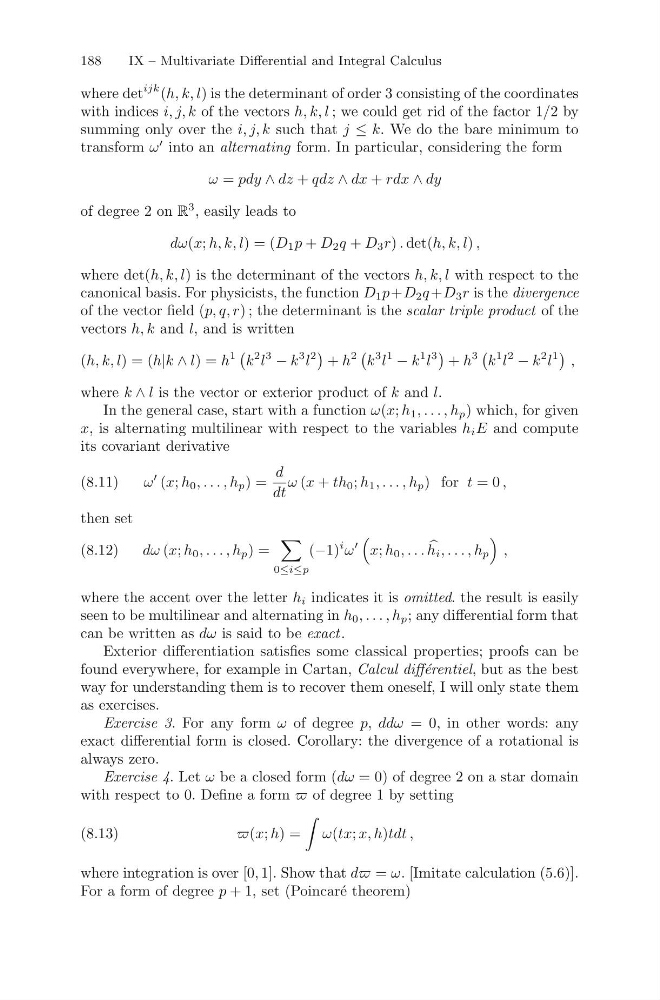
ω = pdy ∧ dz + qdz ∧ dx + rdx ∧ dy
of degree 2 on R
3 , easily leads to
dω(x; h, k, l) = (D 1 p + D 2 q + D 3 r) . det(h, k, l) ,
where det(h, k, l) is the determinant of the vectors h, k, l with respect to the
canonical basis. For physicists, the function D 1 p+D 2 q +D 3 r is the divergence
of the vector field (p, q, r) ; the determinant is the scalar triple product of the
vectors h, k and l, and is written
(h, k, l) = (h|k ∧ l) = h
1
k
2 l
3
− k
3 l
2
+ h
2
k
3 l
1
− k
1 l
3
+ h
3
k
1 l
2
− k
2 l
1
,
where k ∧ l is the vector or exterior product of k and l.
In the general case, start with a function ω(x; h 1 , . . . , h p ) which, for given
x, is alternating multilinear with respect to the variables h i E and compute
its covariant derivative
ω
(x; h 0 , . . . , h p ) =
d
dt
ω (x + th 0 ; h 1 , . . . , h p ) for t = 0 ,
(8.11)
then set
dω (x; h 0 , . . . , h p ) =
0≤i≤p
(−1)
i ω
x; h 0 , . . .
h i , . . . , h p
,
(8.12)
where the accent over the letter h i indicates it is omitted. the result is easily
seen to be multilinear and alternating in h 0 , . . . , h p ; any differential form that
can be written as dω is said to be exact.
Exterior differentiation satisfies some classical properties; proofs can be
found everywhere, for example in Cartan, Calcul diff´ erentiel, but as the best
way for understanding them is to recover them oneself, I will only state them
as exercises.
Exercise 3. For any form ω of degree p, ddω = 0, in other words: any
exact differential form is closed. Corollary: the divergence of a rotational is
always zero.
Exercise 4. Let ω be a closed form (dω = 0) of degree 2 on a star domain
with respect to 0. Define a form of degree 1 by setting
(x; h) =
ω(tx; x, h)tdt ,
(8.13)
where integration is over [0, 1]. Show that dd = ω. [Imitate calculation (5.6)].
For a form of degree p + 1, set (Poincar´ e theorem)
IX – Multivariate Differential and Integral Calculus
where det
ijk (h, k, l) is the determinant of order 3 consisting of the coordinates
with indices i, j, k of the vectors h, k, l ; we could get rid of the factor 1/2 by
summing only over the i, j, k such that j ≤ k. We do the bare minimum to
transform ω
into an alternating form. In particular, considering the form
ω = pdy ∧ dz + qdz ∧ dx + rdx ∧ dy
of degree 2 on R
3 , easily leads to
dω(x; h, k, l) = (D 1 p + D 2 q + D 3 r) . det(h, k, l) ,
where det(h, k, l) is the determinant of the vectors h, k, l with respect to the
canonical basis. For physicists, the function D 1 p+D 2 q +D 3 r is the divergence
of the vector field (p, q, r) ; the determinant is the scalar triple product of the
vectors h, k and l, and is written
(h, k, l) = (h|k ∧ l) = h
1
k
2 l
3
− k
3 l
2
+ h
2
k
3 l
1
− k
1 l
3
+ h
3
k
1 l
2
− k
2 l
1
,
where k ∧ l is the vector or exterior product of k and l.
In the general case, start with a function ω(x; h 1 , . . . , h p ) which, for given
x, is alternating multilinear with respect to the variables h i E and compute
its covariant derivative
ω
(x; h 0 , . . . , h p ) =
d
dt
ω (x + th 0 ; h 1 , . . . , h p ) for t = 0 ,
(8.11)
then set
dω (x; h 0 , . . . , h p ) =
0≤i≤p
(−1)
i ω
x; h 0 , . . .
h i , . . . , h p
,
(8.12)
where the accent over the letter h i indicates it is omitted. the result is easily
seen to be multilinear and alternating in h 0 , . . . , h p ; any differential form that
can be written as dω is said to be exact.
Exterior differentiation satisfies some classical properties; proofs can be
found everywhere, for example in Cartan, Calcul diff´ erentiel, but as the best
way for understanding them is to recover them oneself, I will only state them
as exercises.
Exercise 3. For any form ω of degree p, ddω = 0, in other words: any
exact differential form is closed. Corollary: the divergence of a rotational is
always zero.
Exercise 4. Let ω be a closed form (dω = 0) of degree 2 on a star domain
with respect to 0. Define a form of degree 1 by setting
(x; h) =
ω(tx; x, h)tdt ,
(8.13)
where integration is over [0, 1]. Show that dd = ω. [Imitate calculation (5.6)].
For a form of degree p + 1, set (Poincar´ e theorem)