

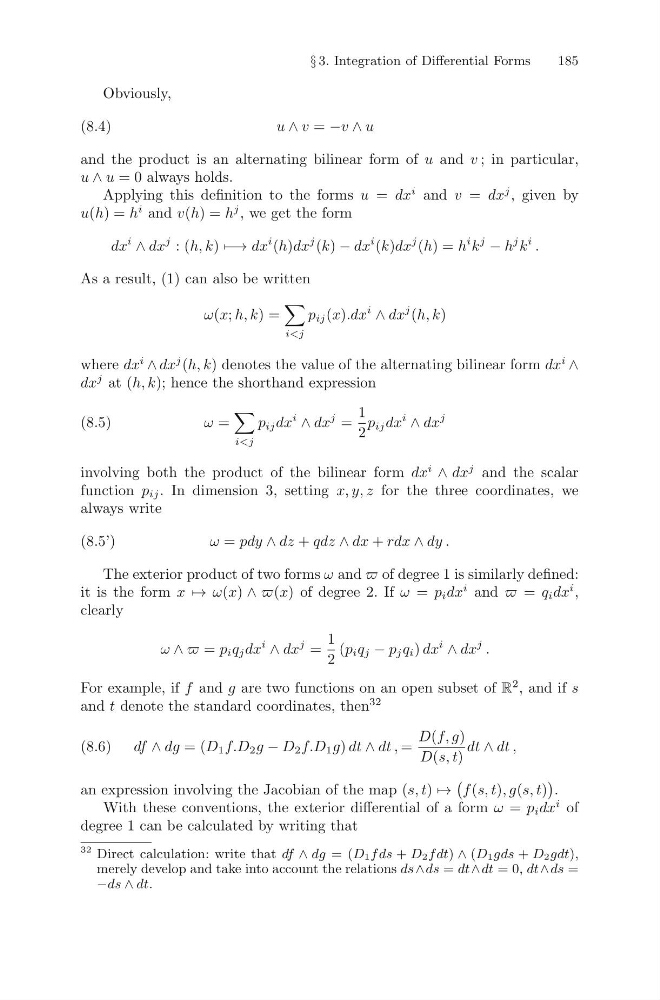
§ 3. Integration of Differential Forms
185
Obviously,
u ∧ v = −v ∧ u
(8.4)
and the product is an alternating bilinear form of u and v ; in particular,
u ∧ u = 0 always holds.
Applying this definition to the forms u = dx
i and v = dx
j , given by
u(h) = h
i and v(h) = h
j , we get the form
dx
i
∧ dx
j : (h, k) −→ dx
i (h)dx
j (k) − dx
i (k)dx
j (h) = h
i k
j
− h
j k
i .
As a result, (1) can also be written
ω(x; h, k) =
i
i
∧ dx
j (h, k)
where dx
i
∧ dx
j (h, k) denotes the value of the alternating bilinear form dx
i
∧
dx
j at (h, k); hence the shorthand expression
ω =
i
i
∧ dx
j =
1
2
p ij dx
i
∧ dx
j
(8.5)
involving both the product of the bilinear form dx
i
∧ dx
j and the scalar
function p ij . In dimension 3, setting x, y, z for the three coordinates, we
always write
ω = pdy ∧ dz + qdz ∧ dx + rdx ∧ dy .
(8.5’)
The exterior product of two forms ω and of degree 1 is similarly defined:
it is the form x → ω(x) ∧ (x) of degree 2. If ω = p i dx
i and = q i dx
i ,
clearly
ω ∧ = p i q j dx
i
∧ dx
j =
1
2
(p i q j − p j q i ) dx
i
∧ dx
j .
For example, if f and g are two functions on an open subset of R
2 , and if s
and t denote the standard coordinates, then
32
df ∧ dg = (D 1 f.D 2 g − D 2 f.D 1 g) dt ∧ dt , =
D(f, g)
D(s, t)
dt ∧ dt ,
(8.6)
an expression involving the Jacobian of the map (s, t) →
f (s, t), g(s, t)
.
With these conventions, the exterior differential of a form ω = p i dx
i of
degree 1 can be calculated by writing that
32 Direct calculation: write that df ∧ dg = (D1fds + D2fdt) ∧ (D1gds + D2gdt),
merely develop and take into account the relations ds∧ds = dt∧dt = 0, dt∧ds =
−ds ∧ dt.
185
Obviously,
u ∧ v = −v ∧ u
(8.4)
and the product is an alternating bilinear form of u and v ; in particular,
u ∧ u = 0 always holds.
Applying this definition to the forms u = dx
i and v = dx
j , given by
u(h) = h
i and v(h) = h
j , we get the form
dx
i
∧ dx
j : (h, k) −→ dx
i (h)dx
j (k) − dx
i (k)dx
j (h) = h
i k
j
− h
j k
i .
As a result, (1) can also be written
ω(x; h, k) =
i
i
∧ dx
j (h, k)
where dx
i
∧ dx
j (h, k) denotes the value of the alternating bilinear form dx
i
∧
dx
j at (h, k); hence the shorthand expression
ω =
i
i
∧ dx
j =
1
2
p ij dx
i
∧ dx
j
(8.5)
involving both the product of the bilinear form dx
i
∧ dx
j and the scalar
function p ij . In dimension 3, setting x, y, z for the three coordinates, we
always write
ω = pdy ∧ dz + qdz ∧ dx + rdx ∧ dy .
(8.5’)
The exterior product of two forms ω and of degree 1 is similarly defined:
it is the form x → ω(x) ∧ (x) of degree 2. If ω = p i dx
i and = q i dx
i ,
clearly
ω ∧ = p i q j dx
i
∧ dx
j =
1
2
(p i q j − p j q i ) dx
i
∧ dx
j .
For example, if f and g are two functions on an open subset of R
2 , and if s
and t denote the standard coordinates, then
32
df ∧ dg = (D 1 f.D 2 g − D 2 f.D 1 g) dt ∧ dt , =
D(f, g)
D(s, t)
dt ∧ dt ,
(8.6)
an expression involving the Jacobian of the map (s, t) →
f (s, t), g(s, t)
.
With these conventions, the exterior differential of a form ω = p i dx
i of
degree 1 can be calculated by writing that
32 Direct calculation: write that df ∧ dg = (D1fds + D2fdt) ∧ (D1gds + D2gdt),
merely develop and take into account the relations ds∧ds = dt∧dt = 0, dt∧ds =
−ds ∧ dt.