

176
IX – Multivariate Differential and Integral Calculus
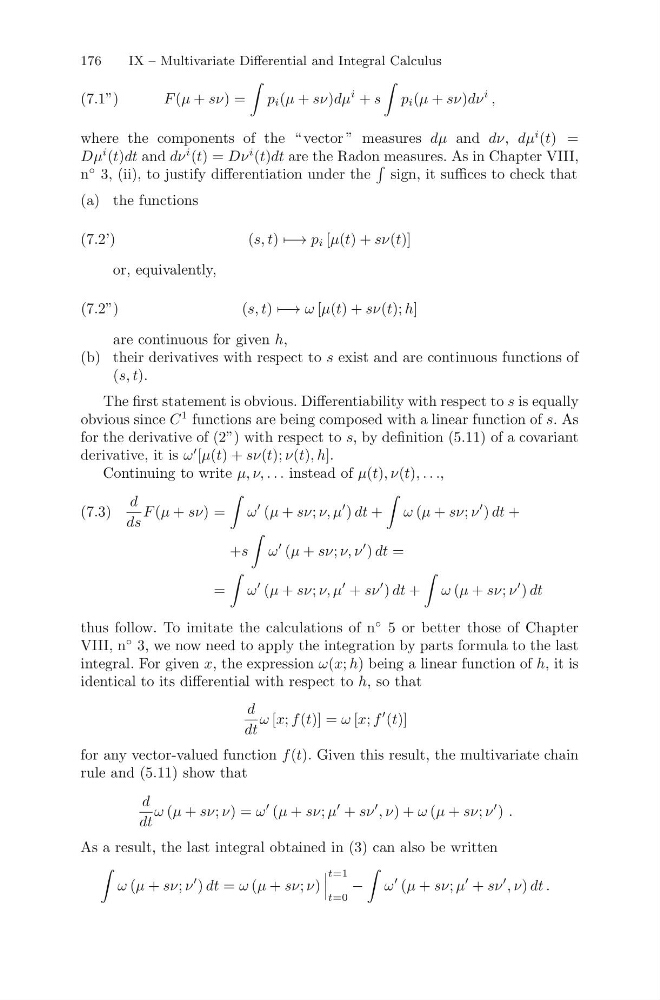
F (μ + sν) =
p i (μ + sν)dμ
i + s
p i (μ + sν)dν
i ,
(7.1”)
where the components of the “ vector ” measures dμ and dν, dμ
i (t) =
Dμ
i (t)dt and dν
i (t) = Dν
i (t)dt are the Radon measures. As in Chapter VIII,
n
◦ 3, (ii), to justify differentiation under the
sign, it suffices to check that
(a) the functions
(s, t) −→ p i [μ(t) + sν(t)]
(7.2’)
or, equivalently,
(s, t) −→ ω [μ(t) + sν(t); h]
(7.2”)
are continuous for given h,
(b) their derivatives with respect to s exist and are continuous functions of
(s, t).
The first statement is obvious. Differentiability with respect to s is equally
obvious since C
1 functions are being composed with a linear function of s. As
for the derivative of (2”) with respect to s, by definition (5.11) of a covariant
derivative, it is ω
[μ(t) + sν(t); ν(t), h].
Continuing to write μ, ν, . . . instead of μ(t), ν(t), . . .,
d
ds
F (μ + sν) =
ω
(μ + sν; ν, μ
) dt +
ω (μ + sν; ν
) dt +
(7.3)
+s
ω
(μ + sν; ν, ν
) dt =
=
ω
(μ + sν; ν, μ
+ sν
) dt +
ω (μ + sν; ν
) dt
thus follow. To imitate the calculations of n
◦ 5 or better those of Chapter
VIII, n
◦ 3, we now need to apply the integration by parts formula to the last
integral. For given x, the expression ω(x; h) being a linear function of h, it is
identical to its differential with respect to h, so that
d
dt
ω [x; f (t)] = ω [x; f
(t)]
for any vector-valued function f (t). Given this result, the multivariate chain
rule and (5.11) show that
d
dt
ω (μ + sν; ν) = ω
(μ + sν; μ
+ sν
, ν) + ω (μ + sν; ν
) .
As a result, the last integral obtained in (3) can also be written
ω (μ + sν; ν
) dt = ω (μ + sν; ν)
t=1
t=0
−
ω
(μ + sν; μ
+ sν
, ν) dt .
IX – Multivariate Differential and Integral Calculus
F (μ + sν) =
p i (μ + sν)dμ
i + s
p i (μ + sν)dν
i ,
(7.1”)
where the components of the “ vector ” measures dμ and dν, dμ
i (t) =
Dμ
i (t)dt and dν
i (t) = Dν
i (t)dt are the Radon measures. As in Chapter VIII,
n
◦ 3, (ii), to justify differentiation under the
sign, it suffices to check that
(a) the functions
(s, t) −→ p i [μ(t) + sν(t)]
(7.2’)
or, equivalently,
(s, t) −→ ω [μ(t) + sν(t); h]
(7.2”)
are continuous for given h,
(b) their derivatives with respect to s exist and are continuous functions of
(s, t).
The first statement is obvious. Differentiability with respect to s is equally
obvious since C
1 functions are being composed with a linear function of s. As
for the derivative of (2”) with respect to s, by definition (5.11) of a covariant
derivative, it is ω
[μ(t) + sν(t); ν(t), h].
Continuing to write μ, ν, . . . instead of μ(t), ν(t), . . .,
d
ds
F (μ + sν) =
ω
(μ + sν; ν, μ
) dt +
ω (μ + sν; ν
) dt +
(7.3)
+s
ω
(μ + sν; ν, ν
) dt =
=
ω
(μ + sν; ν, μ
+ sν
) dt +
ω (μ + sν; ν
) dt
thus follow. To imitate the calculations of n
◦ 5 or better those of Chapter
VIII, n
◦ 3, we now need to apply the integration by parts formula to the last
integral. For given x, the expression ω(x; h) being a linear function of h, it is
identical to its differential with respect to h, so that
d
dt
ω [x; f (t)] = ω [x; f
(t)]
for any vector-valued function f (t). Given this result, the multivariate chain
rule and (5.11) show that
d
dt
ω (μ + sν; ν) = ω
(μ + sν; μ
+ sν
, ν) + ω (μ + sν; ν
) .
As a result, the last integral obtained in (3) can also be written
ω (μ + sν; ν
) dt = ω (μ + sν; ν)
t=1
t=0
−
ω
(μ + sν; μ
+ sν
, ν) dt .