

§ 2. Differential Forms of Degree 1
173
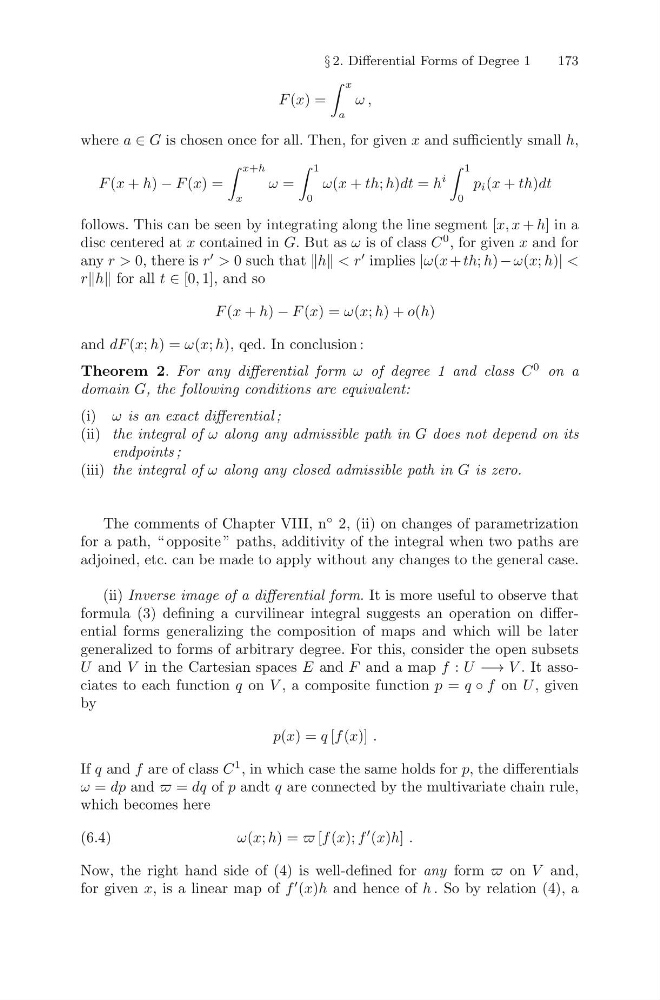
F (x) =
x
a
ω ,
where a ∈ G is chosen once for all. Then, for given x and sufficiently small h,
F (x + h) − F (x) =
x+h
x
ω =
1
0
ω(x + th; h)dt = h
i
1
0
p i (x + th)dt
follows. This can be seen by integrating along the line segment [x, x + h] in a
disc centered at x contained in G. But as ω is of class C
0 , for given x and for
any r > 0, there is r
> 0 such that h < r
implies |ω(x + th; h) − ω(x; h)| <
rh for all t ∈ [0, 1], and so
F (x + h) − F (x) = ω(x; h) + o(h)
and dF (x; h) = ω(x; h), qed. In conclusion :
Theorem 2. For any differential form ω of degree 1 and class C
0 on a
domain G, the following conditions are equivalent:
(i) ω is an exact differential ;
(ii) the integral of ω along any admissible path in G does not depend on its
endpoints ;
(iii) the integral of ω along any closed admissible path in G is zero.
The comments of Chapter VIII, n
◦ 2, (ii) on changes of parametrization
for a path, “ opposite ” paths, additivity of the integral when two paths are
adjoined, etc. can be made to apply without any changes to the general case.
(ii) Inverse image of a differential form. It is more useful to observe that
formula (3) defining a curvilinear integral suggests an operation on differential forms generalizing the composition of maps and which will be later
generalized to forms of arbitrary degree. For this, consider the open subsets
U and V in the Cartesian spaces E and F and a map f : U −→ V . It associates to each function q on V , a composite function p = q ◦ f on U , given
by
p(x) = q [f (x)] .
If q and f are of class C
1 , in which case the same holds for p, the differentials
ω = dp and = dq of p andt q are connected by the multivariate chain rule,
which becomes here
ω(x; h) = [f (x); f
(x)h] .
(6.4)
Now, the right hand side of (4) is well-defined for any form on V and,
for given x, is a linear map of f
(x)h and hence of h . So by relation (4), a
173
F (x) =
x
a
ω ,
where a ∈ G is chosen once for all. Then, for given x and sufficiently small h,
F (x + h) − F (x) =
x+h
x
ω =
1
0
ω(x + th; h)dt = h
i
1
0
p i (x + th)dt
follows. This can be seen by integrating along the line segment [x, x + h] in a
disc centered at x contained in G. But as ω is of class C
0 , for given x and for
any r > 0, there is r
> 0 such that h < r
implies |ω(x + th; h) − ω(x; h)| <
rh for all t ∈ [0, 1], and so
F (x + h) − F (x) = ω(x; h) + o(h)
and dF (x; h) = ω(x; h), qed. In conclusion :
Theorem 2. For any differential form ω of degree 1 and class C
0 on a
domain G, the following conditions are equivalent:
(i) ω is an exact differential ;
(ii) the integral of ω along any admissible path in G does not depend on its
endpoints ;
(iii) the integral of ω along any closed admissible path in G is zero.
The comments of Chapter VIII, n
◦ 2, (ii) on changes of parametrization
for a path, “ opposite ” paths, additivity of the integral when two paths are
adjoined, etc. can be made to apply without any changes to the general case.
(ii) Inverse image of a differential form. It is more useful to observe that
formula (3) defining a curvilinear integral suggests an operation on differential forms generalizing the composition of maps and which will be later
generalized to forms of arbitrary degree. For this, consider the open subsets
U and V in the Cartesian spaces E and F and a map f : U −→ V . It associates to each function q on V , a composite function p = q ◦ f on U , given
by
p(x) = q [f (x)] .
If q and f are of class C
1 , in which case the same holds for p, the differentials
ω = dp and = dq of p andt q are connected by the multivariate chain rule,
which becomes here
ω(x; h) = [f (x); f
(x)h] .
(6.4)
Now, the right hand side of (4) is well-defined for any form on V and,
for given x, is a linear map of f
(x)h and hence of h . So by relation (4), a