

170
IX – Multivariate Differential and Integral Calculus
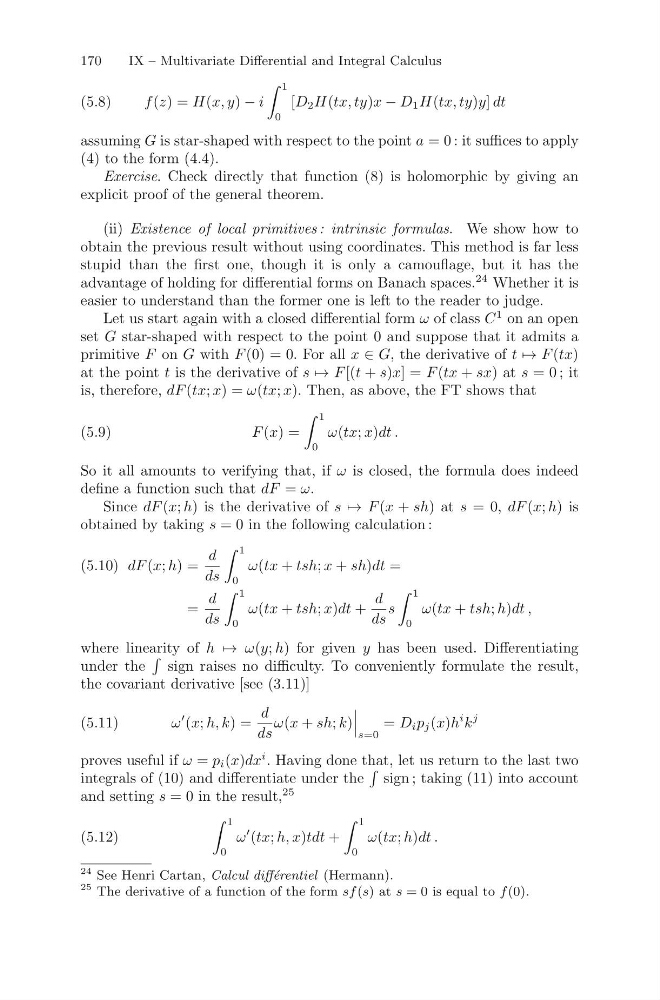
f (z) = H(x, y) − i
1
0
[D 2 H(tx, ty)x − D 1 H(tx, ty)y] dt
(5.8)
assuming G is star-shaped with respect to the point a = 0 : it suffices to apply
(4) to the form (4.4).
Exercise. Check directly that function (8) is holomorphic by giving an
explicit proof of the general theorem.
(ii) Existence of local primitives : intrinsic formulas. We show how to
obtain the previous result without using coordinates. This method is far less
stupid than the first one, though it is only a camouflage, but it has the
advantage of holding for differential forms on Banach spaces.
24 Whether it is
easier to understand than the former one is left to the reader to judge.
Let us start again with a closed differential form ω of class C
1 on an open
set G star-shaped with respect to the point 0 and suppose that it admits a
primitive F on G with F (0) = 0. For all x ∈ G, the derivative of t → F (tx)
at the point t is the derivative of s → F [(t + s)x] = F (tx + sx) at s = 0 ; it
is, therefore, dF (tx; x) = ω(tx; x). Then, as above, the FT shows that
F (x) =
1
0
ω(tx; x)dt .
(5.9)
So it all amounts to verifying that, if ω is closed, the formula does indeed
define a function such that dF = ω.
Since dF (x; h) is the derivative of s → F (x + sh) at s = 0, dF (x; h) is
obtained by taking s = 0 in the following calculation :
dF (x; h) =
d
ds
1
0
ω(tx + tsh; x + sh)dt =
(5.10)
=
d
ds
1
0
ω(tx + tsh; x)dt +
d
ds
s
1
0
ω(tx + tsh; h)dt ,
where linearity of h → ω(y; h) for given y has been used. Differentiating
under the
sign raises no difficulty. To conveniently formulate the result,
the covariant derivative [see (3.11)]
ω
(x; h, k) =
d
ds
ω(x + sh; k)
s=0
= D i p j (x)h
i k
j
(5.11)
proves useful if ω = p i (x)dx
i . Having done that, let us return to the last two
integrals of (10) and differentiate under the
sign ; taking (11) into account
and setting s = 0 in the result,
25
1
0
ω
(tx; h, x)tdt +
1
0
ω(tx; h)dt .
(5.12)
24 See Henri Cartan, Calcul diff´ erentiel (Hermann).
25 The derivative of a function of the form sf (s) at s = 0 is equal to f (0).
IX – Multivariate Differential and Integral Calculus
f (z) = H(x, y) − i
1
0
[D 2 H(tx, ty)x − D 1 H(tx, ty)y] dt
(5.8)
assuming G is star-shaped with respect to the point a = 0 : it suffices to apply
(4) to the form (4.4).
Exercise. Check directly that function (8) is holomorphic by giving an
explicit proof of the general theorem.
(ii) Existence of local primitives : intrinsic formulas. We show how to
obtain the previous result without using coordinates. This method is far less
stupid than the first one, though it is only a camouflage, but it has the
advantage of holding for differential forms on Banach spaces.
24 Whether it is
easier to understand than the former one is left to the reader to judge.
Let us start again with a closed differential form ω of class C
1 on an open
set G star-shaped with respect to the point 0 and suppose that it admits a
primitive F on G with F (0) = 0. For all x ∈ G, the derivative of t → F (tx)
at the point t is the derivative of s → F [(t + s)x] = F (tx + sx) at s = 0 ; it
is, therefore, dF (tx; x) = ω(tx; x). Then, as above, the FT shows that
F (x) =
1
0
ω(tx; x)dt .
(5.9)
So it all amounts to verifying that, if ω is closed, the formula does indeed
define a function such that dF = ω.
Since dF (x; h) is the derivative of s → F (x + sh) at s = 0, dF (x; h) is
obtained by taking s = 0 in the following calculation :
dF (x; h) =
d
ds
1
0
ω(tx + tsh; x + sh)dt =
(5.10)
=
d
ds
1
0
ω(tx + tsh; x)dt +
d
ds
s
1
0
ω(tx + tsh; h)dt ,
where linearity of h → ω(y; h) for given y has been used. Differentiating
under the
sign raises no difficulty. To conveniently formulate the result,
the covariant derivative [see (3.11)]
ω
(x; h, k) =
d
ds
ω(x + sh; k)
s=0
= D i p j (x)h
i k
j
(5.11)
proves useful if ω = p i (x)dx
i . Having done that, let us return to the last two
integrals of (10) and differentiate under the
sign ; taking (11) into account
and setting s = 0 in the result,
25
1
0
ω
(tx; h, x)tdt +
1
0
ω(tx; h)dt .
(5.12)
24 See Henri Cartan, Calcul diff´ erentiel (Hermann).
25 The derivative of a function of the form sf (s) at s = 0 is equal to f (0).