

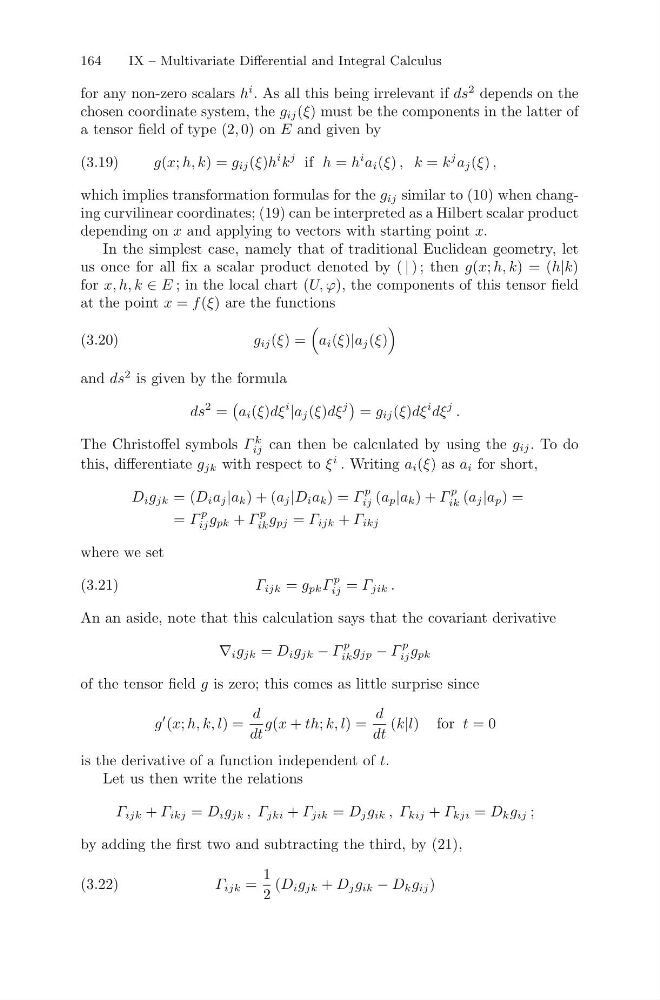
164
IX – Multivariate Differential and Integral Calculus
for any non-zero scalars h
i . As all this being irrelevant if ds
2 depends on the
chosen coordinate system, the g ij (ξ) must be the components in the latter of
a tensor field of type (2, 0) on E and given by
g(x; h, k) = g ij (ξ)h
i k
j if h = h
i a i (ξ) , k = k
j a j (ξ) ,
(3.19)
which implies transformation formulas for the g ij similar to (10) when changing curvilinear coordinates; (19) can be interpreted as a Hilbert scalar product
depending on x and applying to vectors with starting point x.
In the simplest case, namely that of traditional Euclidean geometry, let
us once for all fix a scalar product denoted by ( | ) ; then g(x; h, k) = (h|k)
for x, h, k ∈ E ; in the local chart (U, ϕ), the components of this tensor field
at the point x = f (ξ) are the functions
g ij (ξ) =
a i (ξ)|a j (ξ)
(3.20)
and ds
2 is given by the formula
ds
2 =
a i (ξ)dξ
i
|a j (ξ)dξ
j
= g ij (ξ)dξ
i dξ
j .
The Christoffel symbols Γ
k
ij can then be calculated by using the g ij . To do
this, differentiate g jk with respect to ξ
i . Writing a i (ξ) as a i for short,
D i g jk = (D i a j |a k ) + (a j |D i a k ) = Γ
p
ij (a p |a k ) + Γ
p
ik (a j |a p ) =
= Γ
p
ij g pk + Γ
p
ik g pj = Γ ijk + Γ ikj
where we set
Γ ijk = g pk Γ
p
ij = Γ jik .
(3.21)
An an aside, note that this calculation says that the covariant derivative
∇ i g jk = D i g jk − Γ
p
ik g jp − Γ
p
ij g pk
of the tensor field g is zero; this comes as little surprise since
g
(x; h, k, l) =
d
dt
g(x + th; k, l) =
d
dt
(k|l) for t = 0
is the derivative of a function independent of t.
Let us then write the relations
Γ ijk + Γ ikj = D i g jk , Γ jki + Γ jik = D j g ik , Γ kij + Γ kji = D k g ij ;
by adding the first two and subtracting the third, by (21),
Γ ijk =
1
2
(D i g jk + D j g ik − D k g ij )
(3.22)
IX – Multivariate Differential and Integral Calculus
for any non-zero scalars h
i . As all this being irrelevant if ds
2 depends on the
chosen coordinate system, the g ij (ξ) must be the components in the latter of
a tensor field of type (2, 0) on E and given by
g(x; h, k) = g ij (ξ)h
i k
j if h = h
i a i (ξ) , k = k
j a j (ξ) ,
(3.19)
which implies transformation formulas for the g ij similar to (10) when changing curvilinear coordinates; (19) can be interpreted as a Hilbert scalar product
depending on x and applying to vectors with starting point x.
In the simplest case, namely that of traditional Euclidean geometry, let
us once for all fix a scalar product denoted by ( | ) ; then g(x; h, k) = (h|k)
for x, h, k ∈ E ; in the local chart (U, ϕ), the components of this tensor field
at the point x = f (ξ) are the functions
g ij (ξ) =
a i (ξ)|a j (ξ)
(3.20)
and ds
2 is given by the formula
ds
2 =
a i (ξ)dξ
i
|a j (ξ)dξ
j
= g ij (ξ)dξ
i dξ
j .
The Christoffel symbols Γ
k
ij can then be calculated by using the g ij . To do
this, differentiate g jk with respect to ξ
i . Writing a i (ξ) as a i for short,
D i g jk = (D i a j |a k ) + (a j |D i a k ) = Γ
p
ij (a p |a k ) + Γ
p
ik (a j |a p ) =
= Γ
p
ij g pk + Γ
p
ik g pj = Γ ijk + Γ ikj
where we set
Γ ijk = g pk Γ
p
ij = Γ jik .
(3.21)
An an aside, note that this calculation says that the covariant derivative
∇ i g jk = D i g jk − Γ
p
ik g jp − Γ
p
ij g pk
of the tensor field g is zero; this comes as little surprise since
g
(x; h, k, l) =
d
dt
g(x + th; k, l) =
d
dt
(k|l) for t = 0
is the derivative of a function independent of t.
Let us then write the relations
Γ ijk + Γ ikj = D i g jk , Γ jki + Γ jik = D j g ik , Γ kij + Γ kji = D k g ij ;
by adding the first two and subtracting the third, by (21),
Γ ijk =
1
2
(D i g jk + D j g ik − D k g ij )
(3.22)