

§ 1. Classical Differential Calculus
147
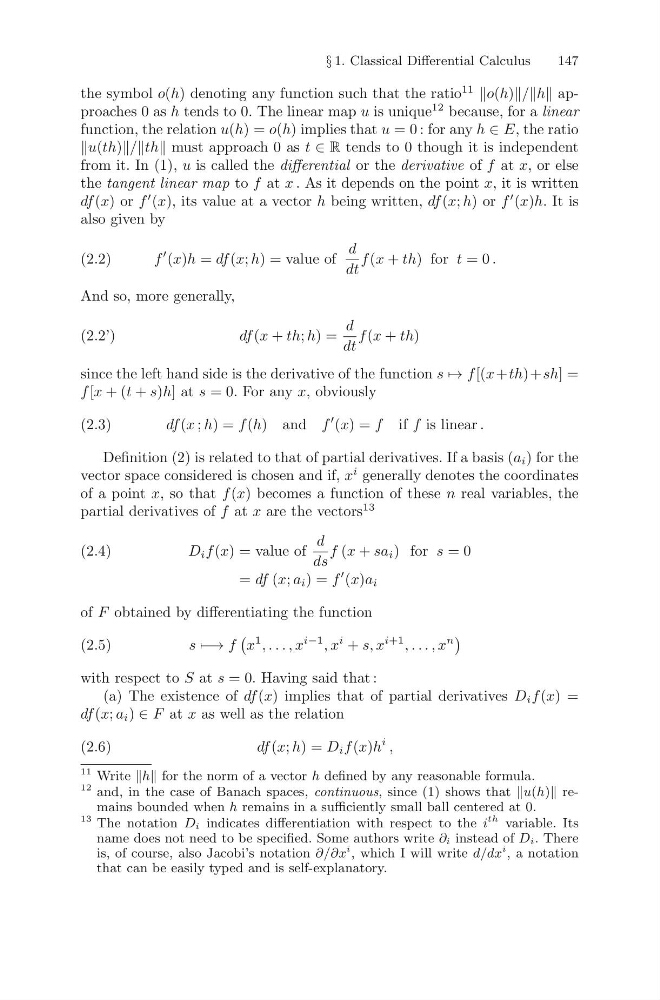
the symbol o(h) denoting any function such that the ratio
11
o(h)/h approaches 0 as h tends to 0. The linear map u is unique
12 because, for a linear
function, the relation u(h) = o(h) implies that u = 0 : for any h ∈ E, the ratio
u(th)/th must approach 0 as t ∈ R tends to 0 though it is independent
from it. In (1), u is called the differential or the derivative of f at x, or else
the tangent linear map to f at x . As it depends on the point x, it is written
df (x) or f
(x), its value at a vector h being written, df (x; h) or f
(x)h. It is
also given by
f
(x)h = df (x; h) = value of
d
dt
f (x + th) for t = 0 .
(2.2)
And so, more generally,
df (x + th; h) =
d
dt
f (x + th)
(2.2’)
since the left hand side is the derivative of the function s → f [(x+th)+sh] =
f [x + (t + s)h] at s = 0. For any x, obviously
df (x ; h) = f (h) and f
(x) = f if f is linear .
(2.3)
Definition (2) is related to that of partial derivatives. If a basis (a i ) for the
vector space considered is chosen and if, x
i generally denotes the coordinates
of a point x, so that f (x) becomes a function of these n real variables, the
partial derivatives of f at x are the vectors
13
D i f (x) = value of
d
ds
f (x + sa i ) for s = 0
(2.4)
= df (x; a i ) = f
(x)a i
of F obtained by differentiating the function
s −→ f
x
1 , . . . , x
i−1 , x
i + s, x
i+1 , . . . , x
n
(2.5)
with respect to S at s = 0. Having said that :
(a) The existence of df (x) implies that of partial derivatives D i f (x) =
df (x; a i ) ∈ F at x as well as the relation
df (x; h) = D i f (x)h
i ,
(2.6)
11 Write h for the norm of a vector h defined by any reasonable formula.
12 and, in the case of Banach spaces, continuous, since (1) shows that u(h) remains bounded when h remains in a sufficiently small ball centered at 0.
13 The notation Di indicates differentiation with respect to the i
th variable. Its
name does not need to be specified. Some authors write ∂i instead of Di. There
is, of course, also Jacobi’s notation ∂/∂x
i , which I will write d/dx
i , a notation
that can be easily typed and is self-explanatory.
147
the symbol o(h) denoting any function such that the ratio
11
o(h)/h approaches 0 as h tends to 0. The linear map u is unique
12 because, for a linear
function, the relation u(h) = o(h) implies that u = 0 : for any h ∈ E, the ratio
u(th)/th must approach 0 as t ∈ R tends to 0 though it is independent
from it. In (1), u is called the differential or the derivative of f at x, or else
the tangent linear map to f at x . As it depends on the point x, it is written
df (x) or f
(x), its value at a vector h being written, df (x; h) or f
(x)h. It is
also given by
f
(x)h = df (x; h) = value of
d
dt
f (x + th) for t = 0 .
(2.2)
And so, more generally,
df (x + th; h) =
d
dt
f (x + th)
(2.2’)
since the left hand side is the derivative of the function s → f [(x+th)+sh] =
f [x + (t + s)h] at s = 0. For any x, obviously
df (x ; h) = f (h) and f
(x) = f if f is linear .
(2.3)
Definition (2) is related to that of partial derivatives. If a basis (a i ) for the
vector space considered is chosen and if, x
i generally denotes the coordinates
of a point x, so that f (x) becomes a function of these n real variables, the
partial derivatives of f at x are the vectors
13
D i f (x) = value of
d
ds
f (x + sa i ) for s = 0
(2.4)
= df (x; a i ) = f
(x)a i
of F obtained by differentiating the function
s −→ f
x
1 , . . . , x
i−1 , x
i + s, x
i+1 , . . . , x
n
(2.5)
with respect to S at s = 0. Having said that :
(a) The existence of df (x) implies that of partial derivatives D i f (x) =
df (x; a i ) ∈ F at x as well as the relation
df (x; h) = D i f (x)h
i ,
(2.6)
11 Write h for the norm of a vector h defined by any reasonable formula.
12 and, in the case of Banach spaces, continuous, since (1) shows that u(h) remains bounded when h remains in a sufficiently small ball centered at 0.
13 The notation Di indicates differentiation with respect to the i
th variable. Its
name does not need to be specified. Some authors write ∂i instead of Di. There
is, of course, also Jacobi’s notation ∂/∂x
i , which I will write d/dx
i , a notation
that can be easily typed and is self-explanatory.