

§ 3. Some Applications of Cauchy’s Method
131
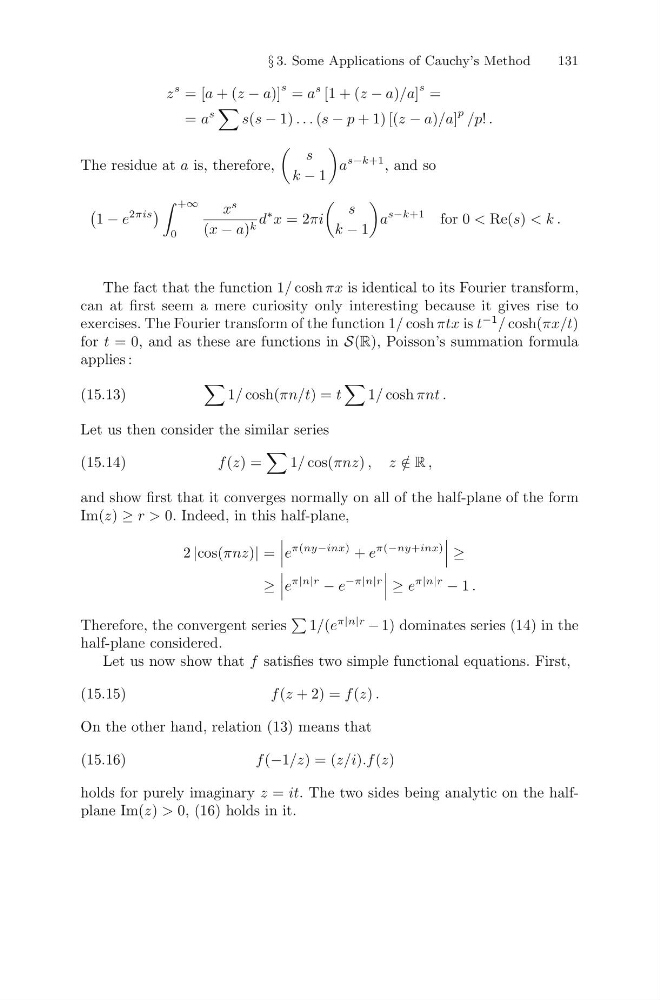
z
s = [a + (z − a)]
s = a
s [1 + (z − a)/a]
s =
= a
s
s(s − 1) . . . (s − p + 1) [(z − a)/a]
p /p! .
The residue at a is, therefore,
s
k − 1
a
s−k+1 , and so
1 − e
2πis
+∞
0
x
s
(x − a) k d
∗ x = 2πi
s
k − 1
a
s−k+1
for 0 < Re(s) < k .
The fact that the function 1/ cosh πx is identical to its Fourier transform,
can at first seem a mere curiosity only interesting because it gives rise to
exercises. The Fourier transform of the function 1/ cosh πtx is t
−1 / cosh(πx/t)
for t = 0, and as these are functions in S(R), Poisson’s summation formula
applies :
1/ cosh(πn/t) = t
1/ cosh πnt .
(15.13)
Let us then consider the similar series
f (z) =
1/ cos(πnz) , z /
∈ R ,
(15.14)
and show first that it converges normally on all of the half-plane of the form
Im(z) ≥ r > 0. Indeed, in this half-plane,
2 |cos(πnz)| =
e
π(ny−inx) + e
π(−ny+inx)
≥
≥
e
π|n|r
− e
−π|n|r
≥ e
π|n|r
− 1 .
Therefore, the convergent series
1/(e
π|n|r
− 1) dominates series (14) in the
half-plane considered.
Let us now show that f satisfies two simple functional equations. First,
f (z + 2) = f (z) .
(15.15)
On the other hand, relation (13) means that
f (−1/z) = (z/i).f (z)
(15.16)
holds for purely imaginary z = it. The two sides being analytic on the halfplane Im(z) > 0, (16) holds in it.
131
z
s = [a + (z − a)]
s = a
s [1 + (z − a)/a]
s =
= a
s
s(s − 1) . . . (s − p + 1) [(z − a)/a]
p /p! .
The residue at a is, therefore,
s
k − 1
a
s−k+1 , and so
1 − e
2πis
+∞
0
x
s
(x − a) k d
∗ x = 2πi
s
k − 1
a
s−k+1
for 0 < Re(s) < k .
The fact that the function 1/ cosh πx is identical to its Fourier transform,
can at first seem a mere curiosity only interesting because it gives rise to
exercises. The Fourier transform of the function 1/ cosh πtx is t
−1 / cosh(πx/t)
for t = 0, and as these are functions in S(R), Poisson’s summation formula
applies :
1/ cosh(πn/t) = t
1/ cosh πnt .
(15.13)
Let us then consider the similar series
f (z) =
1/ cos(πnz) , z /
∈ R ,
(15.14)
and show first that it converges normally on all of the half-plane of the form
Im(z) ≥ r > 0. Indeed, in this half-plane,
2 |cos(πnz)| =
e
π(ny−inx) + e
π(−ny+inx)
≥
≥
e
π|n|r
− e
−π|n|r
≥ e
π|n|r
− 1 .
Therefore, the convergent series
1/(e
π|n|r
− 1) dominates series (14) in the
half-plane considered.
Let us now show that f satisfies two simple functional equations. First,
f (z + 2) = f (z) .
(15.15)
On the other hand, relation (13) means that
f (−1/z) = (z/i).f (z)
(15.16)
holds for purely imaginary z = it. The two sides being analytic on the halfplane Im(z) > 0, (16) holds in it.