

128
VIII – Cauchy Theory
of calculating ϕ(s). It is far less simple and miraculous, but can be generalized
to all rational fractions.
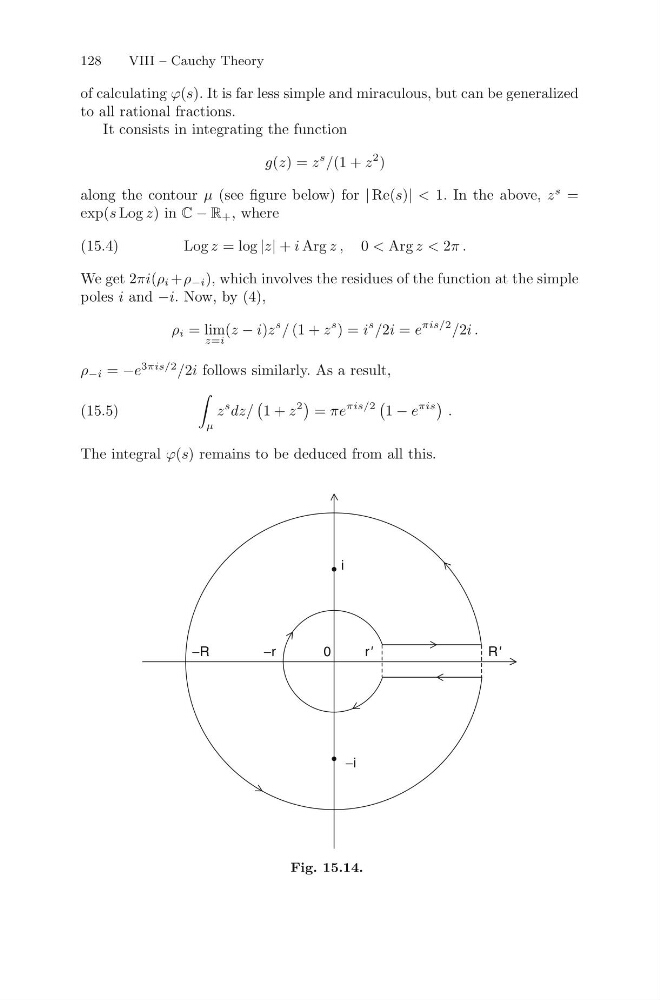
It consists in integrating the function
g(z) = z
s /(1 + z
2 )
along the contour μ (see figure below) for | Re(s)| < 1. In the above, z
s =
exp(s Log z) in C − R + , where
Log z = log |z| + i Arg z , 0 < Arg z < 2π .
(15.4)
We get 2πi(ρ i +ρ −i ), which involves the residues of the function at the simple
poles i and −i. Now, by (4),
ρ i = lim
z=i
(z − i)z
s / (1 + z
s ) = i
s /2i = e
πis/2 /2i .
ρ −i = −e
3πis/2 /2i follows similarly. As a result,
μ
z
s dz/
1 + z
2
= πe
πis/2
1 − e
πis
.
(15.5)
The integral ϕ(s) remains to be deduced from all this.
−i
i
−R
−r
r '
R'
0
Fig. 15.14.
VIII – Cauchy Theory
of calculating ϕ(s). It is far less simple and miraculous, but can be generalized
to all rational fractions.
It consists in integrating the function
g(z) = z
s /(1 + z
2 )
along the contour μ (see figure below) for | Re(s)| < 1. In the above, z
s =
exp(s Log z) in C − R + , where
Log z = log |z| + i Arg z , 0 < Arg z < 2π .
(15.4)
We get 2πi(ρ i +ρ −i ), which involves the residues of the function at the simple
poles i and −i. Now, by (4),
ρ i = lim
z=i
(z − i)z
s / (1 + z
s ) = i
s /2i = e
πis/2 /2i .
ρ −i = −e
3πis/2 /2i follows similarly. As a result,
μ
z
s dz/
1 + z
2
= πe
πis/2
1 − e
πis
.
(15.5)
The integral ϕ(s) remains to be deduced from all this.
−i
i
−R
−r
r '
R'
0
Fig. 15.14.