

126
VIII – Cauchy Theory
2ϕ(2iy)/π = 1/ cosh πy
as expected. We give three methods for this calculation.
First proof. It is the shortest. Start with the formula
Γ (s)Γ (1 − s) = π/ sin πs
and, for 0 < Re(s) < 1, write
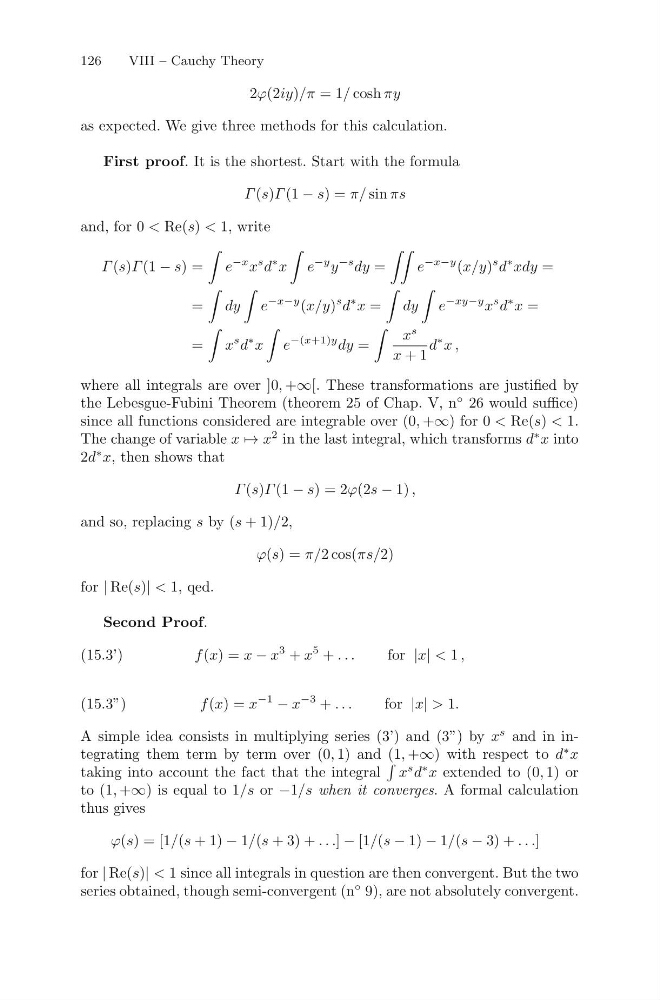
Γ (s)Γ (1 − s) =
e
−x x
s d
∗ x
e
−y y
−s dy =
e
−x−y (x/y)
s d
∗ xdy =
=
dy
e
−x−y (x/y)
s d
∗ x =
dy
e
−xy−y x
s d
∗ x =
=
x
s d
∗ x
e
−(x+1)y dy =
x
s
x + 1
d
∗ x ,
where all integrals are over ]0, +∞[. These transformations are justified by
the Lebesgue-Fubini Theorem (theorem 25 of Chap. V, n
◦ 26 would suffice)
since all functions considered are integrable over (0, +∞) for 0 < Re(s) < 1.
The change of variable x → x
2 in the last integral, which transforms d
∗ x into
2d
∗ x, then shows that
Γ (s)Γ (1 − s) = 2ϕ(2s − 1) ,
and so, replacing s by (s + 1)/2,
ϕ(s) = π/2 cos(πs/2)
for | Re(s)| < 1, qed.
Second Proof.
f (x) = x − x
3 + x
5 + . . .
for |x| < 1 ,
(15.3’)
f (x) = x
−1
− x
−3 + . . .
for |x| > 1.
(15.3”)
A simple idea consists in multiplying series (3’) and (3”) by x
s and in integrating them term by term over (0, 1) and (1, +∞) with respect to d
∗ x
taking into account the fact that the integral
x
s d
∗ x extended to (0, 1) or
to (1, +∞) is equal to 1/s or −1/s when it converges. A formal calculation
thus gives
ϕ(s) = [1/(s + 1) − 1/(s + 3) + . . .] − [1/(s − 1) − 1/(s − 3) + . . .]
for | Re(s)| < 1 since all integrals in question are then convergent. But the two
series obtained, though semi-convergent (n
◦ 9), are not absolutely convergent.
VIII – Cauchy Theory
2ϕ(2iy)/π = 1/ cosh πy
as expected. We give three methods for this calculation.
First proof. It is the shortest. Start with the formula
Γ (s)Γ (1 − s) = π/ sin πs
and, for 0 < Re(s) < 1, write
Γ (s)Γ (1 − s) =
e
−x x
s d
∗ x
e
−y y
−s dy =
e
−x−y (x/y)
s d
∗ xdy =
=
dy
e
−x−y (x/y)
s d
∗ x =
dy
e
−xy−y x
s d
∗ x =
=
x
s d
∗ x
e
−(x+1)y dy =
x
s
x + 1
d
∗ x ,
where all integrals are over ]0, +∞[. These transformations are justified by
the Lebesgue-Fubini Theorem (theorem 25 of Chap. V, n
◦ 26 would suffice)
since all functions considered are integrable over (0, +∞) for 0 < Re(s) < 1.
The change of variable x → x
2 in the last integral, which transforms d
∗ x into
2d
∗ x, then shows that
Γ (s)Γ (1 − s) = 2ϕ(2s − 1) ,
and so, replacing s by (s + 1)/2,
ϕ(s) = π/2 cos(πs/2)
for | Re(s)| < 1, qed.
Second Proof.
f (x) = x − x
3 + x
5 + . . .
for |x| < 1 ,
(15.3’)
f (x) = x
−1
− x
−3 + . . .
for |x| > 1.
(15.3”)
A simple idea consists in multiplying series (3’) and (3”) by x
s and in integrating them term by term over (0, 1) and (1, +∞) with respect to d
∗ x
taking into account the fact that the integral
x
s d
∗ x extended to (0, 1) or
to (1, +∞) is equal to 1/s or −1/s when it converges. A formal calculation
thus gives
ϕ(s) = [1/(s + 1) − 1/(s + 3) + . . .] − [1/(s − 1) − 1/(s − 3) + . . .]
for | Re(s)| < 1 since all integrals in question are then convergent. But the two
series obtained, though semi-convergent (n
◦ 9), are not absolutely convergent.