

§ 3. Some Applications of Cauchy’s Method
123
n
0
Log(s + p) = (s + n) Log(s + n) −
−s Log s − n +
1
2
[Log s + Log(s + n)] −
−
n
0
(s + x)
−2 P
∗
2 (x)dx .
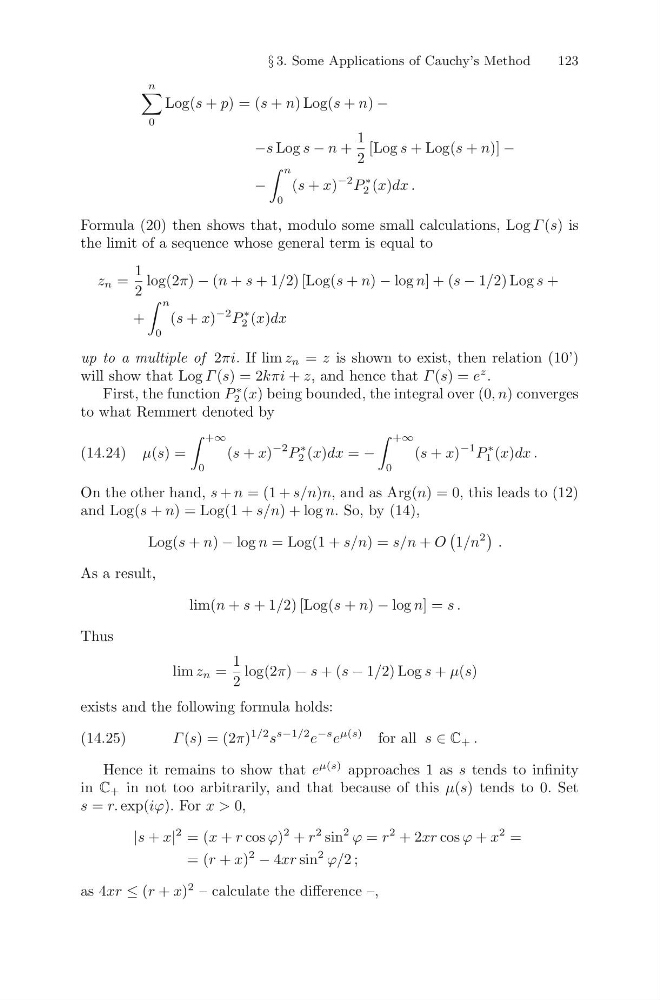
Formula (20) then shows that, modulo some small calculations, Log Γ (s) is
the limit of a sequence whose general term is equal to
z n =
1
2
log(2π) − (n + s + 1/2) [Log(s + n) − log n] + (s − 1/2) Log s +
+
n
0
(s + x)
−2 P
∗
2 (x)dx
up to a multiple of 2πi. If lim z n = z is shown to exist, then relation (10’)
will show that Log Γ (s) = 2kπi + z, and hence that Γ (s) = e
z .
First, the function P
∗
2 (x) being bounded, the integral over (0, n) converges
to what Remmert denoted by
μ(s) =
+∞
0
(s + x)
−2 P
∗
2 (x)dx = −
+∞
0
(s + x)
−1 P
∗
1 (x)dx .
(14.24)
On the other hand, s + n = (1 + s/n)n, and as Arg(n) = 0, this leads to (12)
and Log(s + n) = Log(1 + s/n) + log n. So, by (14),
Log(s + n) − log n = Log(1 + s/n) = s/n + O
1/n
2
.
As a result,
lim(n + s + 1/2) [Log(s + n) − log n] = s .
Thus
lim z n =
1
2
log(2π) − s + (s − 1/2) Log s + μ(s)
exists and the following formula holds:
Γ (s) = (2π)
1/2 s
s−1/2 e
−s e
μ(s)
for all s ∈ C + .
(14.25)
Hence it remains to show that e
μ(s) approaches 1 as s tends to infinity
in C + in not too arbitrarily, and that because of this μ(s) tends to 0. Set
s = r. exp(iϕ). For x > 0,
|s + x|
2 = (x + r cos ϕ)
2 + r
2 sin
2 ϕ = r
2 + 2xr cos ϕ + x
2 =
= (r + x)
2
− 4xr sin
2 ϕ/2 ;
as 4xr ≤ (r + x)
2 – calculate the difference –,
123
n
0
Log(s + p) = (s + n) Log(s + n) −
−s Log s − n +
1
2
[Log s + Log(s + n)] −
−
n
0
(s + x)
−2 P
∗
2 (x)dx .
Formula (20) then shows that, modulo some small calculations, Log Γ (s) is
the limit of a sequence whose general term is equal to
z n =
1
2
log(2π) − (n + s + 1/2) [Log(s + n) − log n] + (s − 1/2) Log s +
+
n
0
(s + x)
−2 P
∗
2 (x)dx
up to a multiple of 2πi. If lim z n = z is shown to exist, then relation (10’)
will show that Log Γ (s) = 2kπi + z, and hence that Γ (s) = e
z .
First, the function P
∗
2 (x) being bounded, the integral over (0, n) converges
to what Remmert denoted by
μ(s) =
+∞
0
(s + x)
−2 P
∗
2 (x)dx = −
+∞
0
(s + x)
−1 P
∗
1 (x)dx .
(14.24)
On the other hand, s + n = (1 + s/n)n, and as Arg(n) = 0, this leads to (12)
and Log(s + n) = Log(1 + s/n) + log n. So, by (14),
Log(s + n) − log n = Log(1 + s/n) = s/n + O
1/n
2
.
As a result,
lim(n + s + 1/2) [Log(s + n) − log n] = s .
Thus
lim z n =
1
2
log(2π) − s + (s − 1/2) Log s + μ(s)
exists and the following formula holds:
Γ (s) = (2π)
1/2 s
s−1/2 e
−s e
μ(s)
for all s ∈ C + .
(14.25)
Hence it remains to show that e
μ(s) approaches 1 as s tends to infinity
in C + in not too arbitrarily, and that because of this μ(s) tends to 0. Set
s = r. exp(iϕ). For x > 0,
|s + x|
2 = (x + r cos ϕ)
2 + r
2 sin
2 ϕ = r
2 + 2xr cos ϕ + x
2 =
= (r + x)
2
− 4xr sin
2 ϕ/2 ;
as 4xr ≤ (r + x)
2 – calculate the difference –,