

§ 3. Some Applications of Cauchy’s Method
117
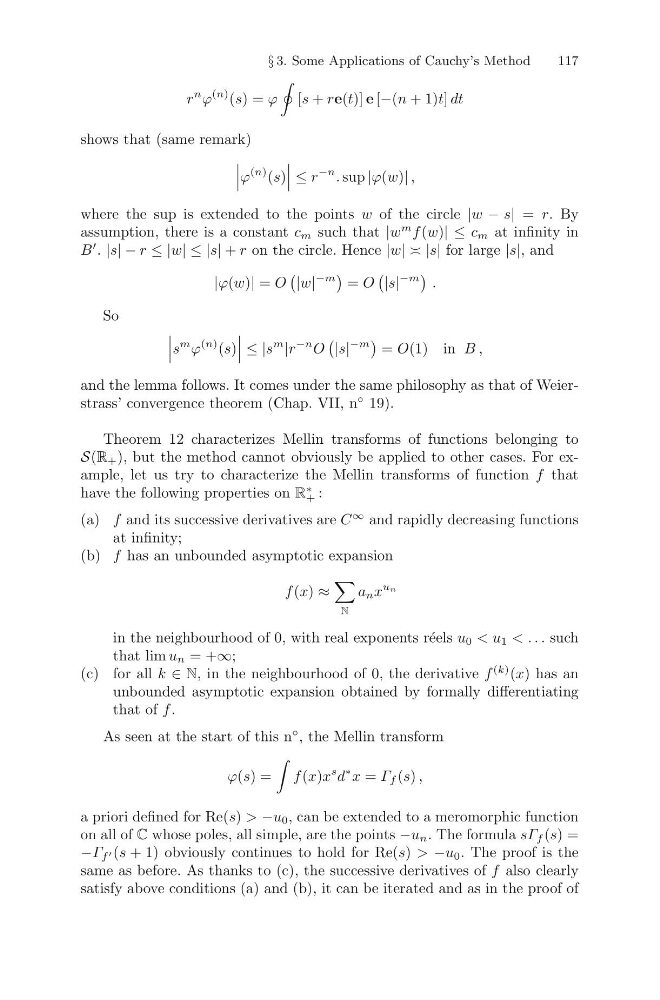
r
n ϕ
(n) (s) = ϕ
[s + re(t)] e [−(n + 1)t] dt
shows that (same remark)
ϕ
(n) (s)
≤ r
−n . sup |ϕ(w)| ,
where the sup is extended to the points w of the circle |w − s| = r. By
assumption, there is a constant c m such that |w
m f (w)| ≤ c m at infinity in
B
. |s| − r ≤ |w| ≤ |s| + r on the circle. Hence |w| | |s| for large |s|, and
|ϕ(w)| = O
|w|
−m
= O
|s|
−m
.
So
s
m ϕ
(n) (s)
≤ |s
m
|r
−n O
|s|
−m
= O(1) in B ,
and the lemma follows. It comes under the same philosophy as that of Weierstrass’ convergence theorem (Chap. VII, n
◦ 19).
Theorem 12 characterizes Mellin transforms of functions belonging to
S(R + ), but the method cannot obviously be applied to other cases. For example, let us try to characterize the Mellin transforms of function f that
have the following properties on R
∗
+ :
(a) f and its successive derivatives are C
∞ and rapidly decreasing functions
at infinity;
(b) f has an unbounded asymptotic expansion
f (x) ≈
N
a n x
un
in the neighbourhood of 0, with real exponents r´ eels u 0 < u 1 < . . . such
that lim u n = +∞;
(c) for all k ∈ N, in the neighbourhood of 0, the derivative f
(k) (x) has an
unbounded asymptotic expansion obtained by formally differentiating
that of f .
As seen at the start of this n
◦ , the Mellin transform
ϕ(s) =
f (x)x
s d
∗ x = Γ f (s) ,
a priori defined for Re(s) > −u 0 , can be extended to a meromorphic function
on all of C whose poles, all simple, are the points −u n . The formula sΓ f (s) =
−Γ f (s + 1) obviously continues to hold for Re(s) > −u 0 . The proof is the
same as before. As thanks to (c), the successive derivatives of f also clearly
satisfy above conditions (a) and (b), it can be iterated and as in the proof of
117
r
n ϕ
(n) (s) = ϕ
[s + re(t)] e [−(n + 1)t] dt
shows that (same remark)
ϕ
(n) (s)
≤ r
−n . sup |ϕ(w)| ,
where the sup is extended to the points w of the circle |w − s| = r. By
assumption, there is a constant c m such that |w
m f (w)| ≤ c m at infinity in
B
. |s| − r ≤ |w| ≤ |s| + r on the circle. Hence |w| | |s| for large |s|, and
|ϕ(w)| = O
|w|
−m
= O
|s|
−m
.
So
s
m ϕ
(n) (s)
≤ |s
m
|r
−n O
|s|
−m
= O(1) in B ,
and the lemma follows. It comes under the same philosophy as that of Weierstrass’ convergence theorem (Chap. VII, n
◦ 19).
Theorem 12 characterizes Mellin transforms of functions belonging to
S(R + ), but the method cannot obviously be applied to other cases. For example, let us try to characterize the Mellin transforms of function f that
have the following properties on R
∗
+ :
(a) f and its successive derivatives are C
∞ and rapidly decreasing functions
at infinity;
(b) f has an unbounded asymptotic expansion
f (x) ≈
N
a n x
un
in the neighbourhood of 0, with real exponents r´ eels u 0 < u 1 < . . . such
that lim u n = +∞;
(c) for all k ∈ N, in the neighbourhood of 0, the derivative f
(k) (x) has an
unbounded asymptotic expansion obtained by formally differentiating
that of f .
As seen at the start of this n
◦ , the Mellin transform
ϕ(s) =
f (x)x
s d
∗ x = Γ f (s) ,
a priori defined for Re(s) > −u 0 , can be extended to a meromorphic function
on all of C whose poles, all simple, are the points −u n . The formula sΓ f (s) =
−Γ f (s + 1) obviously continues to hold for Re(s) > −u 0 . The proof is the
same as before. As thanks to (c), the successive derivatives of f also clearly
satisfy above conditions (a) and (b), it can be iterated and as in the proof of