

§ 3. Some Applications of Cauchy’s Method
111
As pages and pages have been written and continue to be written on the
Riemann function, we will not pursue these investigations here; for the sequel
see Chap. XII.
(iv) A Paley-Wiener type theorem. There are Paley-Wiener type results
for the Mellin transform. For example, the next fairly long application of
Cauchy theory; the method and even the result are used to study the relations
between Dirichlet series and modular functions.
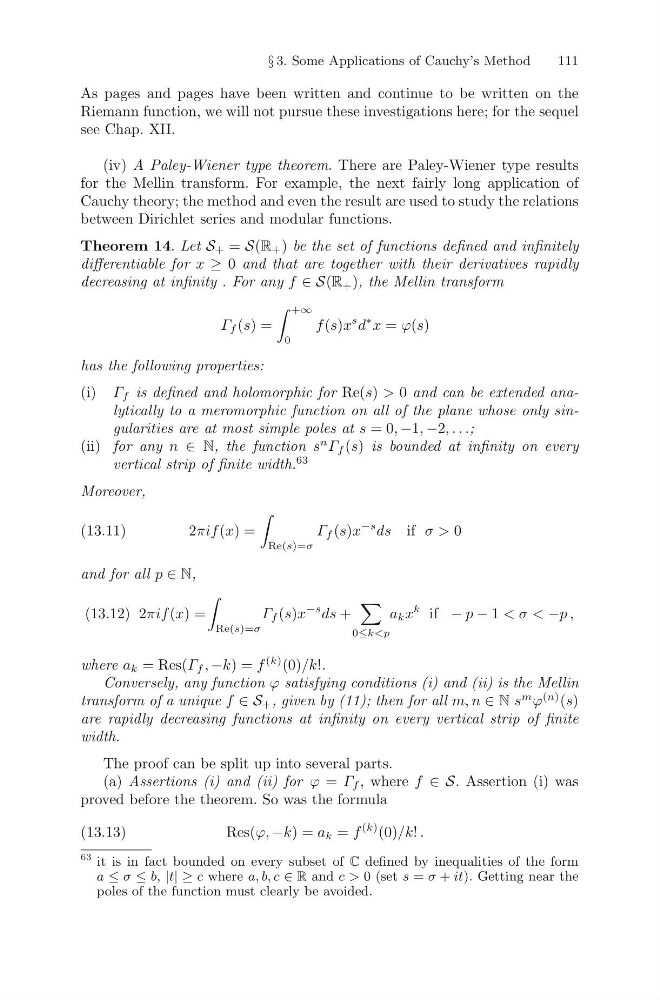
Theorem 14. Let S + = S(R + ) be the set of functions defined and infinitely
differentiable for x ≥ 0 and that are together with their derivatives rapidly
decreasing at infinity . For any f ∈ S(R + ), the Mellin transform
Γ f (s) =
+∞
0
f (s)x
s d
∗ x = ϕ(s)
has the following properties:
(i) Γ f is defined and holomorphic for Re(s) > 0 and can be extended analytically to a meromorphic function on all of the plane whose only singularities are at most simple poles at s = 0, −1, −2, . . .;
(ii) for any n ∈ N, the function s
n Γ f (s) is bounded at infinity on every
vertical strip of finite width.
63
Moreover,
2πif (x) =
Re(s)=σ
Γ f (s)x
−s ds if σ > 0
(13.11)
and for all p ∈ N,
2πif (x) =
Re(s)=σ
Γ f (s)x
−s ds +
0≤k
k if − p − 1 < σ < −p ,
(13.12)
where a k = Res(Γ f , −k) = f
(k) (0)/k!.
Conversely, any function ϕ satisfying conditions (i) and (ii) is the Mellin
transform of a unique f ∈ S + , given by (11); then for all m, n ∈ N s
m ϕ
(n) (s)
are rapidly decreasing functions at infinity on every vertical strip of finite
width.
The proof can be split up into several parts.
(a) Assertions (i) and (ii) for ϕ = Γ f , where f ∈ S. Assertion (i) was
proved before the theorem. So was the formula
Res(ϕ, −k) = a k = f
(k) (0)/k! .
(13.13)
63 it is in fact bounded on every subset of C defined by inequalities of the form
a ≤ σ ≤ b, |t| ≥ c where a, b, c ∈ R and c > 0 (set s = σ + it). Getting near the
poles of the function must clearly be avoided.
111
As pages and pages have been written and continue to be written on the
Riemann function, we will not pursue these investigations here; for the sequel
see Chap. XII.
(iv) A Paley-Wiener type theorem. There are Paley-Wiener type results
for the Mellin transform. For example, the next fairly long application of
Cauchy theory; the method and even the result are used to study the relations
between Dirichlet series and modular functions.
Theorem 14. Let S + = S(R + ) be the set of functions defined and infinitely
differentiable for x ≥ 0 and that are together with their derivatives rapidly
decreasing at infinity . For any f ∈ S(R + ), the Mellin transform
Γ f (s) =
+∞
0
f (s)x
s d
∗ x = ϕ(s)
has the following properties:
(i) Γ f is defined and holomorphic for Re(s) > 0 and can be extended analytically to a meromorphic function on all of the plane whose only singularities are at most simple poles at s = 0, −1, −2, . . .;
(ii) for any n ∈ N, the function s
n Γ f (s) is bounded at infinity on every
vertical strip of finite width.
63
Moreover,
2πif (x) =
Re(s)=σ
Γ f (s)x
−s ds if σ > 0
(13.11)
and for all p ∈ N,
2πif (x) =
Re(s)=σ
Γ f (s)x
−s ds +
0≤k
k if − p − 1 < σ < −p ,
(13.12)
where a k = Res(Γ f , −k) = f
(k) (0)/k!.
Conversely, any function ϕ satisfying conditions (i) and (ii) is the Mellin
transform of a unique f ∈ S + , given by (11); then for all m, n ∈ N s
m ϕ
(n) (s)
are rapidly decreasing functions at infinity on every vertical strip of finite
width.
The proof can be split up into several parts.
(a) Assertions (i) and (ii) for ϕ = Γ f , where f ∈ S. Assertion (i) was
proved before the theorem. So was the formula
Res(ϕ, −k) = a k = f
(k) (0)/k! .
(13.13)
63 it is in fact bounded on every subset of C defined by inequalities of the form
a ≤ σ ≤ b, |t| ≥ c where a, b, c ∈ R and c > 0 (set s = σ + it). Getting near the
poles of the function must clearly be avoided.