

§ 3. Some Applications of Cauchy’s Method
109
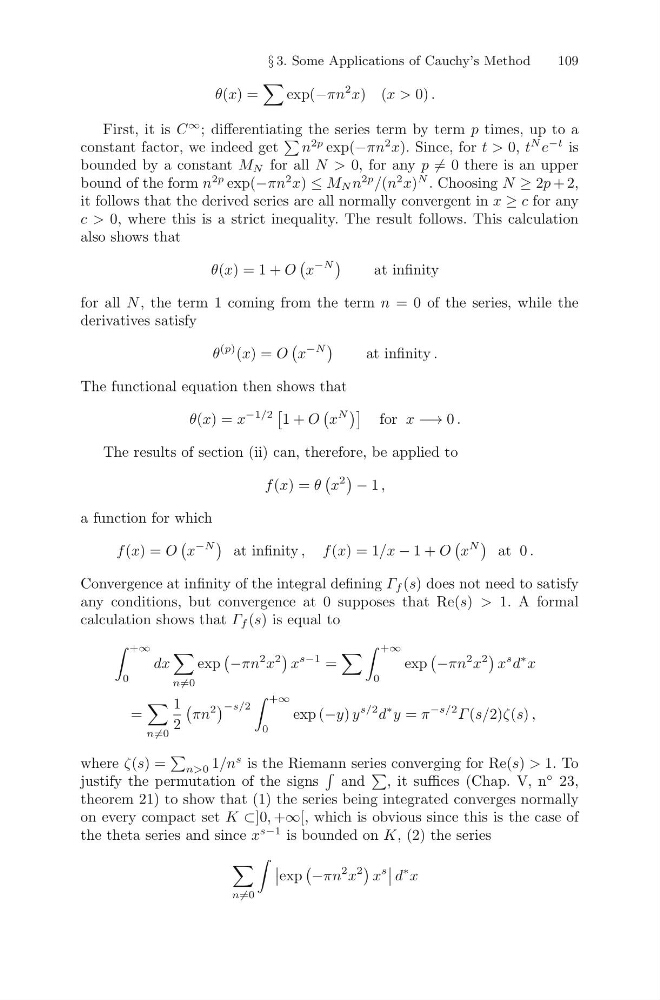
θ(x) =
exp(−πn
2 x) (x > 0) .
First, it is C
∞ ; differentiating the series term by term p times, up to a
constant factor, we indeed get
n
2p exp(−πn
2 x). Since, for t > 0, t
N e
−t is
bounded by a constant M N for all N > 0, for any p = 0 there is an upper
bound of the form n
2p exp(−πn
2 x) ≤ M N n
2p /(n
2 x)
N . Choosing N ≥ 2p + 2,
it follows that the derived series are all normally convergent in x ≥ c for any
c > 0, where this is a strict inequality. The result follows. This calculation
also shows that
θ(x) = 1 + O
x
−N
at infinity
for all N , the term 1 coming from the term n = 0 of the series, while the
derivatives satisfy
θ
(p) (x) = O
x
−N
at infinity .
The functional equation then shows that
θ(x) = x
−1/2
1 + O
x
N
for x −→ 0 .
The results of section (ii) can, therefore, be applied to
f (x) = θ
x
2
− 1 ,
a function for which
f (x) = O
x
−N
at infinity , f(x) = 1/x − 1 + O
x
N
at 0 .
Convergence at infinity of the integral defining Γ f (s) does not need to satisfy
any conditions, but convergence at 0 supposes that Re(s) > 1. A formal
calculation shows that Γ f (s) is equal to
+∞
0
dx
n =0
exp
−πn
2 x
2
x
s−1 =
+∞
0
exp
−πn
2 x
2
x
s d
∗ x
=
n =0
1
2
πn
2
−s/2
+∞
0
exp (−y) y
s/2 d
∗ y = π
−s/2 Γ (s/2)ζ(s) ,
where ζ(s) =
n>0 1/n
s is the Riemann series converging for Re(s) > 1. To
justify the permutation of the signs
and
, it suffices (Chap. V, n
◦ 23,
theorem 21) to show that (1) the series being integrated converges normally
on every compact set K ⊂]0, +∞[, which is obvious since this is the case of
the theta series and since x
s−1 is bounded on K, (2) the series
n =0
exp
−πn
2 x
2
x
s
d
∗ x
109
θ(x) =
exp(−πn
2 x) (x > 0) .
First, it is C
∞ ; differentiating the series term by term p times, up to a
constant factor, we indeed get
n
2p exp(−πn
2 x). Since, for t > 0, t
N e
−t is
bounded by a constant M N for all N > 0, for any p = 0 there is an upper
bound of the form n
2p exp(−πn
2 x) ≤ M N n
2p /(n
2 x)
N . Choosing N ≥ 2p + 2,
it follows that the derived series are all normally convergent in x ≥ c for any
c > 0, where this is a strict inequality. The result follows. This calculation
also shows that
θ(x) = 1 + O
x
−N
at infinity
for all N , the term 1 coming from the term n = 0 of the series, while the
derivatives satisfy
θ
(p) (x) = O
x
−N
at infinity .
The functional equation then shows that
θ(x) = x
−1/2
1 + O
x
N
for x −→ 0 .
The results of section (ii) can, therefore, be applied to
f (x) = θ
x
2
− 1 ,
a function for which
f (x) = O
x
−N
at infinity , f(x) = 1/x − 1 + O
x
N
at 0 .
Convergence at infinity of the integral defining Γ f (s) does not need to satisfy
any conditions, but convergence at 0 supposes that Re(s) > 1. A formal
calculation shows that Γ f (s) is equal to
+∞
0
dx
n =0
exp
−πn
2 x
2
x
s−1 =
+∞
0
exp
−πn
2 x
2
x
s d
∗ x
=
n =0
1
2
πn
2
−s/2
+∞
0
exp (−y) y
s/2 d
∗ y = π
−s/2 Γ (s/2)ζ(s) ,
where ζ(s) =
n>0 1/n
s is the Riemann series converging for Re(s) > 1. To
justify the permutation of the signs
and
, it suffices (Chap. V, n
◦ 23,
theorem 21) to show that (1) the series being integrated converges normally
on every compact set K ⊂]0, +∞[, which is obvious since this is the case of
the theta series and since x
s−1 is bounded on K, (2) the series
n =0
exp
−πn
2 x
2
x
s
d
∗ x