

§ 3. Some Applications of Cauchy’s Method
99
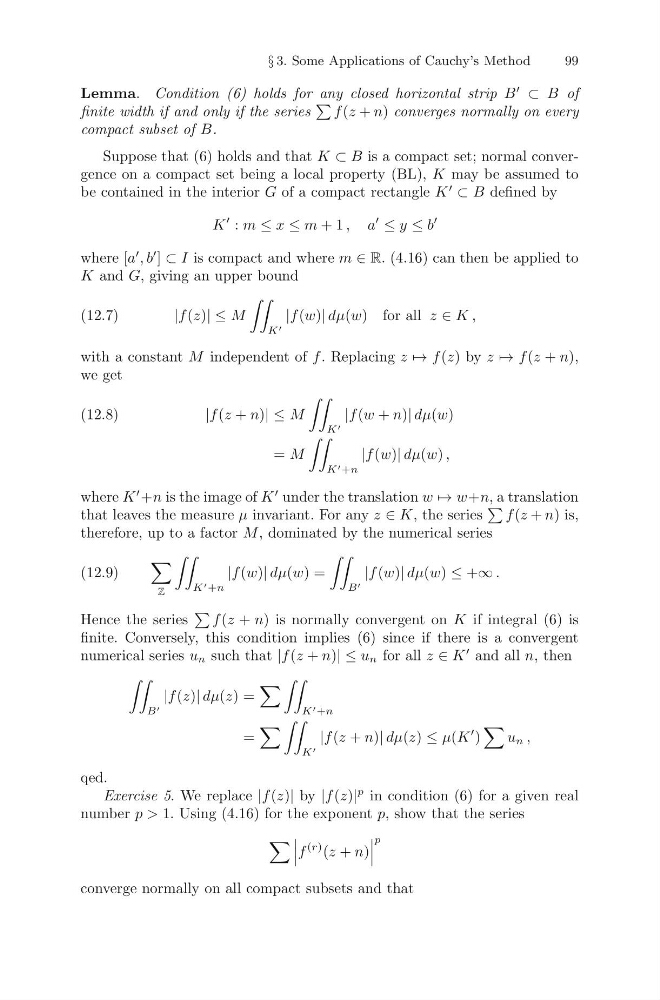
Lemma. Condition (6) holds for any closed horizontal strip B
⊂ B of
finite width if and only if the series
f (z + n) converges normally on every
compact subset of B.
Suppose that (6) holds and that K ⊂ B is a compact set; normal convergence on a compact set being a local property (BL), K may be assumed to
be contained in the interior G of a compact rectangle K
⊂ B defined by
K
: m ≤ x ≤ m + 1 , a
≤ y ≤ b
where [a
, b
] ⊂ I is compact and where m ∈ R. (4.16) can then be applied to
K and G, giving an upper bound
|f (z)| ≤ M
K
|f (w)| dμ(w) for all z ∈ K ,
(12.7)
with a constant M independent of f . Replacing z → f (z) by z → f (z + n),
we get
|f (z + n)| ≤ M
K
|f (w + n)| dμ(w)
(12.8)
= M
K +n
|f (w)| dμ(w) ,
where K
+n is the image of K
under the translation w → w+n, a translation
that leaves the measure μ invariant. For any z ∈ K, the series
f (z + n) is,
therefore, up to a factor M , dominated by the numerical series
Z
K +n
|f (w)| dμ(w) =
B
|f (w)| dμ(w) ≤ +∞ .
(12.9)
Hence the series
f (z + n) is normally convergent on K if integral (6) is
finite. Conversely, this condition implies (6) since if there is a convergent
numerical series u n such that |f (z + n)| ≤ u n for all z ∈ K
and all n, then
B
|f (z)| dμ(z) =
K +n
=
K
|f (z + n)| dμ(z) ≤ μ(K
)
u n ,
qed.
Exercise 5. We replace |f (z)| by |f (z)|
p in condition (6) for a given real
number p > 1. Using (4.16) for the exponent p, show that the series
f
(r) (z + n)
p
converge normally on all compact subsets and that
99
Lemma. Condition (6) holds for any closed horizontal strip B
⊂ B of
finite width if and only if the series
f (z + n) converges normally on every
compact subset of B.
Suppose that (6) holds and that K ⊂ B is a compact set; normal convergence on a compact set being a local property (BL), K may be assumed to
be contained in the interior G of a compact rectangle K
⊂ B defined by
K
: m ≤ x ≤ m + 1 , a
≤ y ≤ b
where [a
, b
] ⊂ I is compact and where m ∈ R. (4.16) can then be applied to
K and G, giving an upper bound
|f (z)| ≤ M
K
|f (w)| dμ(w) for all z ∈ K ,
(12.7)
with a constant M independent of f . Replacing z → f (z) by z → f (z + n),
we get
|f (z + n)| ≤ M
K
|f (w + n)| dμ(w)
(12.8)
= M
K +n
|f (w)| dμ(w) ,
where K
+n is the image of K
under the translation w → w+n, a translation
that leaves the measure μ invariant. For any z ∈ K, the series
f (z + n) is,
therefore, up to a factor M , dominated by the numerical series
Z
K +n
|f (w)| dμ(w) =
B
|f (w)| dμ(w) ≤ +∞ .
(12.9)
Hence the series
f (z + n) is normally convergent on K if integral (6) is
finite. Conversely, this condition implies (6) since if there is a convergent
numerical series u n such that |f (z + n)| ≤ u n for all z ∈ K
and all n, then
B
|f (z)| dμ(z) =
K +n
=
K
|f (z + n)| dμ(z) ≤ μ(K
)
u n ,
qed.
Exercise 5. We replace |f (z)| by |f (z)|
p in condition (6) for a given real
number p > 1. Using (4.16) for the exponent p, show that the series
f
(r) (z + n)
p
converge normally on all compact subsets and that