

68
II - Convergence: Discrete variables
a long time 12 . Having recalled this, one says that a sequence (un) of complex
numbers converges or is convergent if there exists a number u, the limit of
the sequence, such that, for all r > 0,
(5.1)
d( U, un) < r for all sufficiently large n,
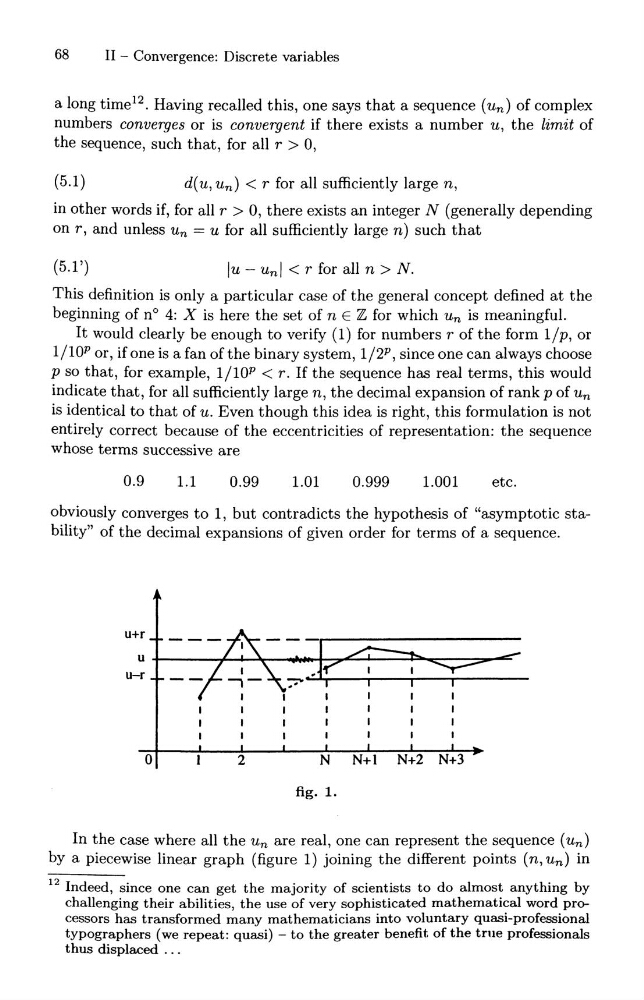
in other words if, for all r > 0, there exists an integer N (generally depending
on r, and unless Un = U for all sufficiently large n) such that
(5.1')
Iu - 'Un I < r for all n> N.
This definition is only a particular case of the general concept defined at the
beginning of n° 4: X is here the set of n E Z for which Un is meaningful.
It would clearly be enough to verify (1) for numbers r of the form I/p, or
I/IOP or, if one is a fan of the binary system, I/2P, since one can always choose
p so that, for example, I/IOP < r. If the sequence has real terms, this would
indicate that, for all sufficiently large n, the decimal expansion of rank p of Un
is identical to that of u. Even though this idea is right, this formulation is not
entirely correct because of the eccentricities of representation: the sequence
whose terms successive are
0.9
1.1
0.99
1.01
0.999
1.001
etc.
obviously converges to 1, but contradicts the hypothesis of "asymptotic stability" of the decimal expansions of given order for terms of a sequence.
u+r
u 4-----~~~~~~~~~~~~~~~~~~
u-r
o
2
N N+l N+2 N+3
fig. 1.
In the case where all the Un are real, one can represent the sequence (un)
by a piecewise linear graph (figure 1) joining the different points (n,un ) in
12 Indeed, since one can get the majority of scientists to do almost anything by
challenging their abilities, the use of very sophisticated mathematical word processors has transformed many mathematicians into voluntary quasi-professional
typographers (we repeat: quasi) - to the greater benefit of the true professionals
thus displaced ...
II - Convergence: Discrete variables
a long time 12 . Having recalled this, one says that a sequence (un) of complex
numbers converges or is convergent if there exists a number u, the limit of
the sequence, such that, for all r > 0,
(5.1)
d( U, un) < r for all sufficiently large n,
in other words if, for all r > 0, there exists an integer N (generally depending
on r, and unless Un = U for all sufficiently large n) such that
(5.1')
Iu - 'Un I < r for all n> N.
This definition is only a particular case of the general concept defined at the
beginning of n° 4: X is here the set of n E Z for which Un is meaningful.
It would clearly be enough to verify (1) for numbers r of the form I/p, or
I/IOP or, if one is a fan of the binary system, I/2P, since one can always choose
p so that, for example, I/IOP < r. If the sequence has real terms, this would
indicate that, for all sufficiently large n, the decimal expansion of rank p of Un
is identical to that of u. Even though this idea is right, this formulation is not
entirely correct because of the eccentricities of representation: the sequence
whose terms successive are
0.9
1.1
0.99
1.01
0.999
1.001
etc.
obviously converges to 1, but contradicts the hypothesis of "asymptotic stability" of the decimal expansions of given order for terms of a sequence.
u+r
u 4-----~~~~~~~~~~~~~~~~~~
u-r
o
2
N N+l N+2 N+3
fig. 1.
In the case where all the Un are real, one can represent the sequence (un)
by a piecewise linear graph (figure 1) joining the different points (n,un ) in
12 Indeed, since one can get the majority of scientists to do almost anything by
challenging their abilities, the use of very sophisticated mathematical word processors has transformed many mathematicians into voluntary quasi-professional
typographers (we repeat: quasi) - to the greater benefit of the true professionals
thus displaced ...