

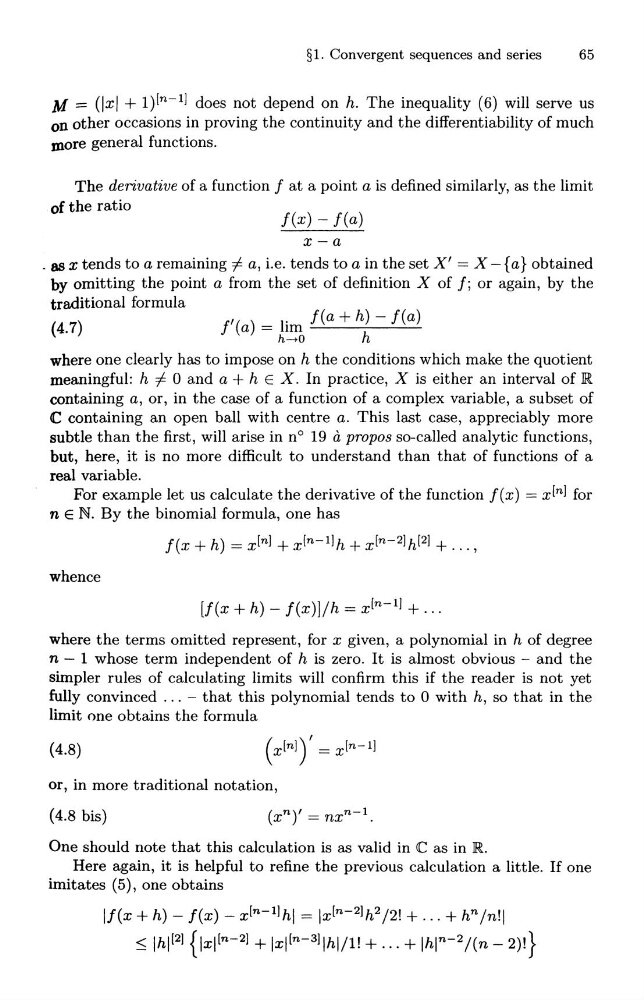
§l. Convergent sequences and series
65
M = (Ixl + l)[n-l] does not depend on h. The inequality (6) will serve us
on other occasions in proving the continuity and the differentiability of much
more general functions.
The derivative of a function f at a point a is defined similarly, as the limit
of the ratio
f(x) - f(a)
x-a
. 88 X tends to a remaining -I- a, i.e. tends to a in the set X' = X - {a} obtained
by omitting the point a from the set of definition X of f; or again, by the
traditional formula
f'(a) = lim f(a + h) - f(a)
(4.7)
h-+O
h
where one clearly has to impose on h the conditions which make the quotient
meaningful: h -I- 0 and a + hEX. In practice, X is either an interval of IR
containing a, or, in the case of a function of a complex variable, a subset of
C containing an open ball with centre a. This last case, appreciably more
subtle than the first, will arise in nO 19 a propos so-called analytic functions,
but, here, it is no more difficult to understand than that of functions of a
real variable.
For example let us calculate the derivative of the function f(x) = x[n] for
n E N. By the binomial formula, one has
f(x + h) = x[n] + x[n-l]h + x[n-2]h[2] + ... ,
whence
[I(x + h) - f(x)Jlh = x[n-l] + ...
where the terms omitted represent, for x given, a polynomial in h of degree
n - 1 whose term independent of h is zero. It is almost obvious - and the
simpler rules of calculating limits will confirm this if the reader is not yet
fully convinced ... - that this polynomial tends to 0 with h, so that in the
limit one obtains the formula
(4.8)
or, in more traditional notation,
(4.8 bis)
One should note that this calculation is as valid in C as in R
Here again, it is helpful to refine the previous calculation a little. If one
imitates (5), one obtains
I/(x + h) - I(x) - x[n-l]hl = Ix[n-2]h 2 /2! + ... + h n In!1
:5 Ihl[2) {lxl[n-2] + Ixl[n-3)lhl/l! + ... + Ihl n - 2 /(n - 2)!}
65
M = (Ixl + l)[n-l] does not depend on h. The inequality (6) will serve us
on other occasions in proving the continuity and the differentiability of much
more general functions.
The derivative of a function f at a point a is defined similarly, as the limit
of the ratio
f(x) - f(a)
x-a
. 88 X tends to a remaining -I- a, i.e. tends to a in the set X' = X - {a} obtained
by omitting the point a from the set of definition X of f; or again, by the
traditional formula
f'(a) = lim f(a + h) - f(a)
(4.7)
h-+O
h
where one clearly has to impose on h the conditions which make the quotient
meaningful: h -I- 0 and a + hEX. In practice, X is either an interval of IR
containing a, or, in the case of a function of a complex variable, a subset of
C containing an open ball with centre a. This last case, appreciably more
subtle than the first, will arise in nO 19 a propos so-called analytic functions,
but, here, it is no more difficult to understand than that of functions of a
real variable.
For example let us calculate the derivative of the function f(x) = x[n] for
n E N. By the binomial formula, one has
f(x + h) = x[n] + x[n-l]h + x[n-2]h[2] + ... ,
whence
[I(x + h) - f(x)Jlh = x[n-l] + ...
where the terms omitted represent, for x given, a polynomial in h of degree
n - 1 whose term independent of h is zero. It is almost obvious - and the
simpler rules of calculating limits will confirm this if the reader is not yet
fully convinced ... - that this polynomial tends to 0 with h, so that in the
limit one obtains the formula
(4.8)
or, in more traditional notation,
(4.8 bis)
One should note that this calculation is as valid in C as in R
Here again, it is helpful to refine the previous calculation a little. If one
imitates (5), one obtains
I/(x + h) - I(x) - x[n-l]hl = Ix[n-2]h 2 /2! + ... + h n In!1
:5 Ihl[2) {lxl[n-2] + Ixl[n-3)lhl/l! + ... + Ihl n - 2 /(n - 2)!}