

54
II - Convergence: Discrete variables
"nature" , concrete or metaphysical, of the objects about which one is reasoning; an eminently "modern" approach: you have probably met it already in
Euclid's geometry.
We can class these axioms in four groups.
First of all there is a group of purely algebraic formulae concerning the
two fundamental operations; they apply to the rational numbers, to the real
numbers and to the complex numbers and state that, endowed with these two
operations, lR. or
(1.2) x + y = y + x for all x, y;
(1.3) there exists an element 0 such that 0 + x = x for all x;
(1.4) given x there exists a y such that x + y = 0;
(1.5) x(yz) = (xy)z for all x, y, z;
(1.6) xy = yx for all x, y;
(1.7) there exists an element 1 "# 0 such that Lx = x for all x;
(1.8) for each x "# 0 there exists a y such that xy = 1;
(1.9) x(y + z) = xy + xz for all x, y, z.
It is not the role of an exposition of analysis to develop the consequences
of these axioms, but among the "remarkable identities" of algebra there is
one which we shall use often, namely the binomial formula, which generalises
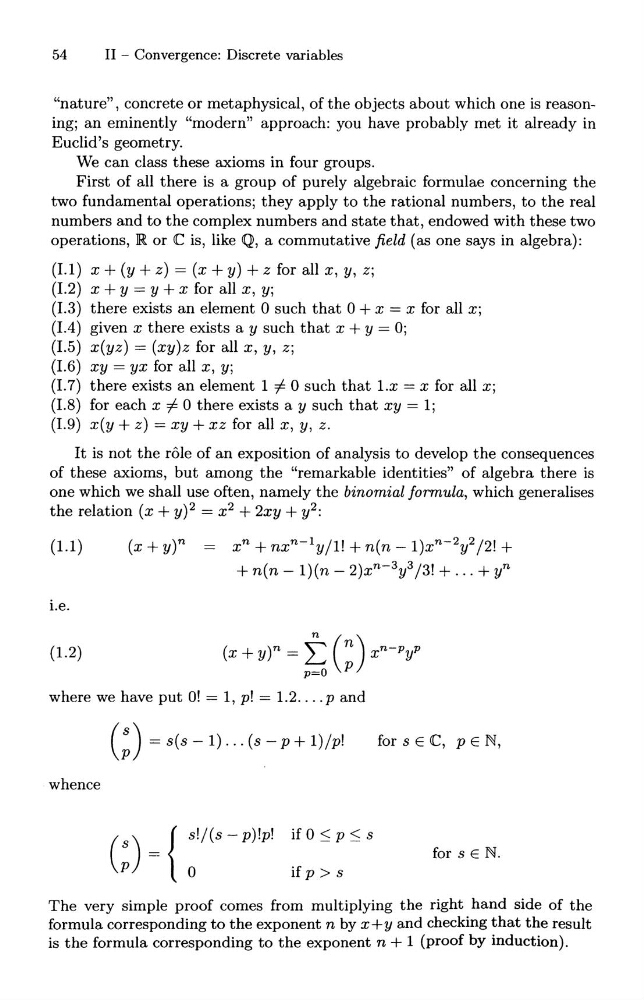
the relation (x + y)2 = x 2 + 2xy + y2:
(1.1)
i.e.
(1.2)
xn + nx n - 1 y/1! + n(n - 1)x n - 2 y2/2! +
+ n(n - l)(n - 2)x n - 3 y3/3! + ... + yn
(x + y)n = t (n) xn-pyP
p=o p
where we have put O! = 1, p! = 1.2 .... p and
(;) = s(s - 1) ... (s - P + l)/p!
for s E
( s) = { s!/(s - p)!p! if 0 ::; p ::; s
p
0
lip>s
for sEN.
The very simple proof comes from multiplying the right hand side of the
formula corresponding to the exponent n by x+y and checking that the result
is the formula corresponding to the exponent n + 1 (proof by induction).
II - Convergence: Discrete variables
"nature" , concrete or metaphysical, of the objects about which one is reasoning; an eminently "modern" approach: you have probably met it already in
Euclid's geometry.
We can class these axioms in four groups.
First of all there is a group of purely algebraic formulae concerning the
two fundamental operations; they apply to the rational numbers, to the real
numbers and to the complex numbers and state that, endowed with these two
operations, lR. or
(1.2) x + y = y + x for all x, y;
(1.3) there exists an element 0 such that 0 + x = x for all x;
(1.4) given x there exists a y such that x + y = 0;
(1.5) x(yz) = (xy)z for all x, y, z;
(1.6) xy = yx for all x, y;
(1.7) there exists an element 1 "# 0 such that Lx = x for all x;
(1.8) for each x "# 0 there exists a y such that xy = 1;
(1.9) x(y + z) = xy + xz for all x, y, z.
It is not the role of an exposition of analysis to develop the consequences
of these axioms, but among the "remarkable identities" of algebra there is
one which we shall use often, namely the binomial formula, which generalises
the relation (x + y)2 = x 2 + 2xy + y2:
(1.1)
i.e.
(1.2)
xn + nx n - 1 y/1! + n(n - 1)x n - 2 y2/2! +
+ n(n - l)(n - 2)x n - 3 y3/3! + ... + yn
(x + y)n = t (n) xn-pyP
p=o p
where we have put O! = 1, p! = 1.2 .... p and
(;) = s(s - 1) ... (s - P + l)/p!
for s E
( s) = { s!/(s - p)!p! if 0 ::; p ::; s
p
0
lip>s
for sEN.
The very simple proof comes from multiplying the right hand side of the
formula corresponding to the exponent n by x+y and checking that the result
is the formula corresponding to the exponent n + 1 (proof by induction).