

§ 1. Convergent sequences and series
51
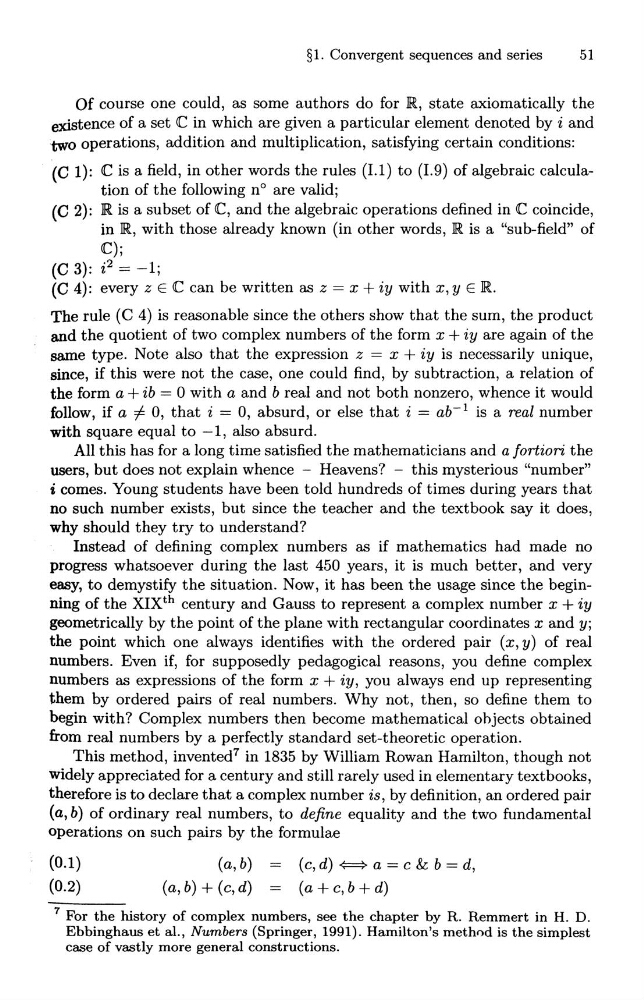
Of course one could, as some authors do for JR, state axiomatically the
existence of a set
(C 1):
(C 4): every z E
and the quotient of two complex numbers of the form x + iy are again of the
same type. Note also that the expression z = x + iy is necessarily unique,
since, if this were not the case, one could find, by subtraction, a relation of
the form a + ib = 0 with a and b real and not both nonzero, whence it would
follow, if a =I 0, that i = 0, absurd, or else that i = ab- 1 is a real number
with square equal to -1, also absurd.
All this has for a long time satisfied the mathematicians and a fortiori the
users, but does not explain whence - Heavens? - this mysterious "number"
i comes. Young students have been told hundreds of times during years that
no such number exists, but since the teacher and the textbook say it does,
why should they try to understand?
Instead of defining complex numbers as if mathematics had made no
progress whatsoever during the last 450 years, it is much better, and very
easy, to demystify the situation. Now, it has been the usage since the beginning of the XIXth century and Gauss to represent a complex number x + iy
geometrically by the point of the plane with rectangular coordinates x and y;
the point which one always identifies with the ordered pair (x, y) of real
numbers. Even if, for supposedly pedagogical reasons, you define complex
numbers as expressions of the form x + iy, you always end up representing
them by ordered pairs of real numbers. Why not, then, so define them to
begin with? Complex numbers then become mathematical ohjects obtained
from real numbers by a perfectly standard set-theoretic operation.
This method, invented 7 in 1835 by William Rowan Hamilton, though not
widely appreciated for a century and still rarely used in elementary textbooks,
therefore is to declare that a complex number is, by definition, an ordered pair
(a, b) of ordinary real numbers, to define equality and the two fundamental
operations on such pairs by the formulae
(0.1)
(0.2)
(a, b)
(a, b) + (c, d)
(c, d) ~ a = c & b = d,
(a + c, b + d)
7 For the history of complex numbers, see the chapter by R. Remmert in H. D.
Ebbinghaus et al., Numbers (Springer, 1991). Hamilton's methl)d is the simplest
case of vastly more general constructions.
51
Of course one could, as some authors do for JR, state axiomatically the
existence of a set
(C 1):
(C 4): every z E
and the quotient of two complex numbers of the form x + iy are again of the
same type. Note also that the expression z = x + iy is necessarily unique,
since, if this were not the case, one could find, by subtraction, a relation of
the form a + ib = 0 with a and b real and not both nonzero, whence it would
follow, if a =I 0, that i = 0, absurd, or else that i = ab- 1 is a real number
with square equal to -1, also absurd.
All this has for a long time satisfied the mathematicians and a fortiori the
users, but does not explain whence - Heavens? - this mysterious "number"
i comes. Young students have been told hundreds of times during years that
no such number exists, but since the teacher and the textbook say it does,
why should they try to understand?
Instead of defining complex numbers as if mathematics had made no
progress whatsoever during the last 450 years, it is much better, and very
easy, to demystify the situation. Now, it has been the usage since the beginning of the XIXth century and Gauss to represent a complex number x + iy
geometrically by the point of the plane with rectangular coordinates x and y;
the point which one always identifies with the ordered pair (x, y) of real
numbers. Even if, for supposedly pedagogical reasons, you define complex
numbers as expressions of the form x + iy, you always end up representing
them by ordered pairs of real numbers. Why not, then, so define them to
begin with? Complex numbers then become mathematical ohjects obtained
from real numbers by a perfectly standard set-theoretic operation.
This method, invented 7 in 1835 by William Rowan Hamilton, though not
widely appreciated for a century and still rarely used in elementary textbooks,
therefore is to declare that a complex number is, by definition, an ordered pair
(a, b) of ordinary real numbers, to define equality and the two fundamental
operations on such pairs by the formulae
(0.1)
(0.2)
(a, b)
(a, b) + (c, d)
(c, d) ~ a = c & b = d,
(a + c, b + d)
7 For the history of complex numbers, see the chapter by R. Remmert in H. D.
Ebbinghaus et al., Numbers (Springer, 1991). Hamilton's methl)d is the simplest
case of vastly more general constructions.