

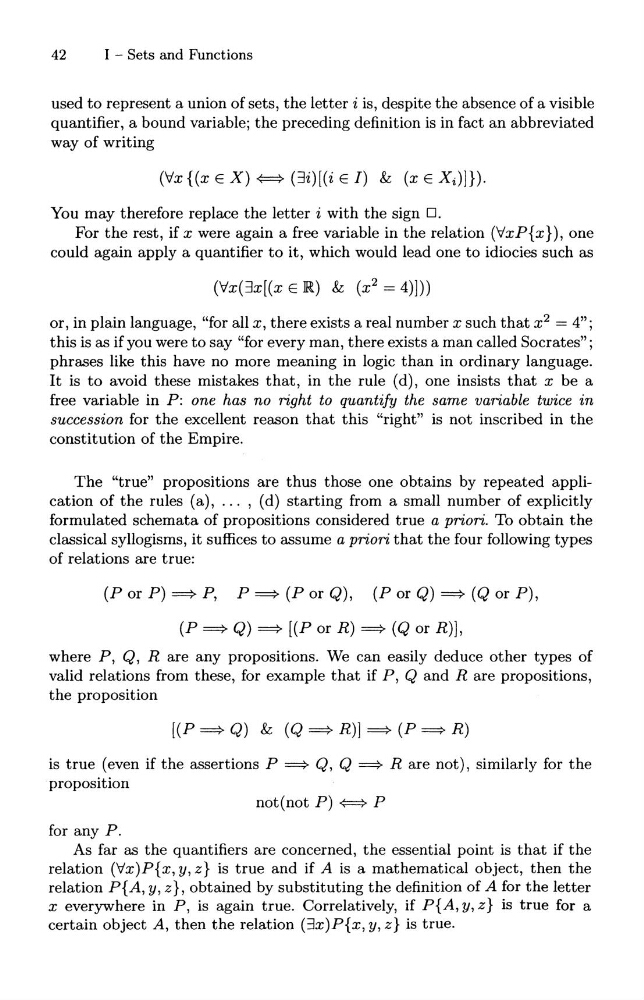
42
I - Sets and Functions
used to represent a union of sets, the letter i is, despite the absence of a visible
quantifier, a bound variable; the preceding definition is in fact an abbreviated
way of writing
(Vx{(x E X) ¢=> (3i)[(i E J) & (x E Xi)]})'
You may therefore replace the letter i with the sign D.
For the rest, if x were again a free variable in the relation (VxP{x}), one
could again apply a quantifier to it, which would lead one to idiocies such as
(Vx(3x[(x E JR.) & (x 2 = 4)]))
or, in plain language, "for all x, there exists a real number x such that x 2 = 4";
this is as if you were to say "for every man, there exists a man called Socrates" ;
phrases like this have no more meaning in logic than in ordinary language.
It is to avoid these mistakes that, in the rule (d), one insists that x be a
free variable in P: one has no right to quantify the same variable twice in
succession for the excellent reason that this "right" is not inscribed in the
constitution of the Empire.
The "true" propositions are thus those one obtains by repeated application of the rules (a), ... , (d) starting from a small number of explicitly
formulated schemata of propositions considered true a priori. To obtain the
classical syllogisms, it suffices to assume a priori that the four following types
of relations are true:
(P or P) ==> P, P ==> (P or Q), (P or Q) ==> (Q or P),
(P ==> Q) ==> [(P or R) ==> (Q or R)],
where P, Q, R are any propositions. We can easily deduce other types of
valid relations from these, for example that if P, Q and R are propositions,
the proposition
[(P ==> Q) & (Q ==> R)] ==> (P ===? R)
is true (even if the assertions P ==> Q, Q ==> R are not), similarly for the
proposition
not(not P) ¢=> P
for any P.
As far as the quantifiers are concerned, the essential point is that if the
relation (Vx )P{ x, y, z} is true and if A is a mathematical object, then the
relation P{A, y, z}, obtained by SUbstituting the definition of A for the letter
x everywhere in P, is again true. Correlatively, if P{ A, y, z} is true for a
certain object A, then the relation (3x)P{x,y,z} is true.
I - Sets and Functions
used to represent a union of sets, the letter i is, despite the absence of a visible
quantifier, a bound variable; the preceding definition is in fact an abbreviated
way of writing
(Vx{(x E X) ¢=> (3i)[(i E J) & (x E Xi)]})'
You may therefore replace the letter i with the sign D.
For the rest, if x were again a free variable in the relation (VxP{x}), one
could again apply a quantifier to it, which would lead one to idiocies such as
(Vx(3x[(x E JR.) & (x 2 = 4)]))
or, in plain language, "for all x, there exists a real number x such that x 2 = 4";
this is as if you were to say "for every man, there exists a man called Socrates" ;
phrases like this have no more meaning in logic than in ordinary language.
It is to avoid these mistakes that, in the rule (d), one insists that x be a
free variable in P: one has no right to quantify the same variable twice in
succession for the excellent reason that this "right" is not inscribed in the
constitution of the Empire.
The "true" propositions are thus those one obtains by repeated application of the rules (a), ... , (d) starting from a small number of explicitly
formulated schemata of propositions considered true a priori. To obtain the
classical syllogisms, it suffices to assume a priori that the four following types
of relations are true:
(P or P) ==> P, P ==> (P or Q), (P or Q) ==> (Q or P),
(P ==> Q) ==> [(P or R) ==> (Q or R)],
where P, Q, R are any propositions. We can easily deduce other types of
valid relations from these, for example that if P, Q and R are propositions,
the proposition
[(P ==> Q) & (Q ==> R)] ==> (P ===? R)
is true (even if the assertions P ==> Q, Q ==> R are not), similarly for the
proposition
not(not P) ¢=> P
for any P.
As far as the quantifiers are concerned, the essential point is that if the
relation (Vx )P{ x, y, z} is true and if A is a mathematical object, then the
relation P{A, y, z}, obtained by SUbstituting the definition of A for the letter
x everywhere in P, is again true. Correlatively, if P{ A, y, z} is true for a
certain object A, then the relation (3x)P{x,y,z} is true.