

22
I - Sets and Functions
and sometimes to advantage, as we shall see, write u( n) for what is usually
written Un and declare that a sequence of real numbers is nothing other than
a map of the integers > 0 into the set of real numbers.
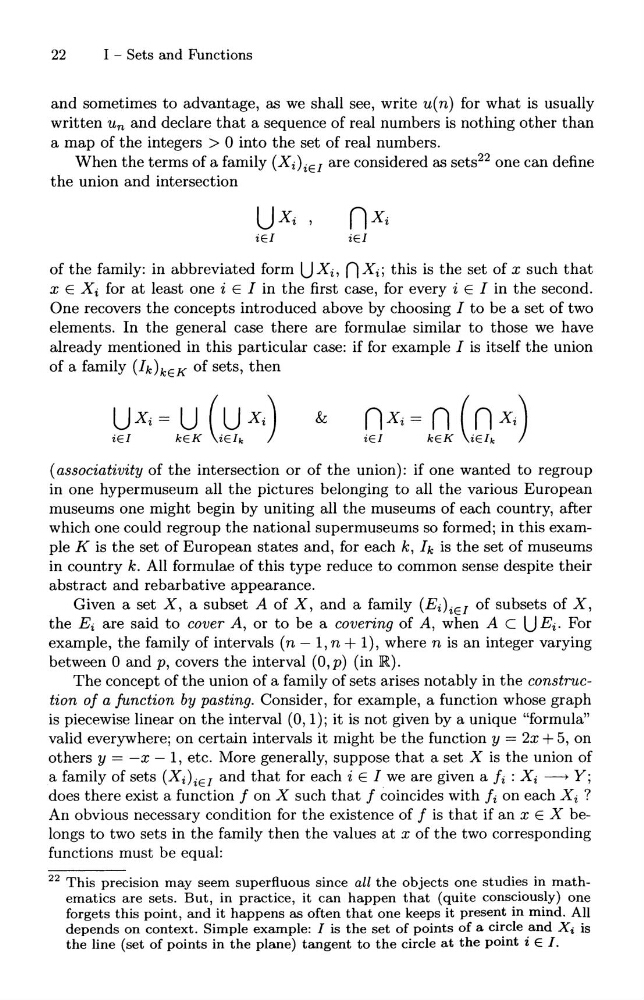
When the terms of a family (Xi)iEI are considered as sets 22 one can define
the union and intersection
UXi'
iEI
of the family: in abbreviated form UXi' nXi; this is the set of x such that
x E Xi for at least one i E I in the first case, for every i E I in the second.
One recovers the concepts introduced above by choosing I to be a set of two
elements. In the general case there are formulae similar to those we have
already mentioned in this particular case: if for example I is itself the union
of a family (h)kEK of sets, then
&
(associativity of the intersection or of the union): if one wanted to regroup
in one hypermuseum all the pictures belonging to all the various European
museums one might begin by uniting all the museums of each country, after
which one could regroup the national supermuseums so formed; in this example K is the set of European states and, for each k, Ik is the set of museums
in country k. All formulae of this type reduce to common sense despite their
abstract and rebarbative appearance.
Given a set X, a subset A of X, and a family (Ei)iEI of subsets of X,
the Ei are said to cover A, or to be a covering of A, when A c U E i . For
example, the family of intervals (n - 1, n + 1), where n is an integer varying
between 0 and p, covers the interval (O,p) (in JR.).
The concept of the union of a family of sets arises notably in the construction of a function by pasting. Consider, for example, a function whose graph
is piecewise linear On the interval (0,1); it is not given by a unique "formula"
valid everywhere; on certain intervals it might be the function y = 2x + 5, on
others y = -x - 1, etc. More generally, suppose that a set X is the union of
a family of sets (Xi)iEI and that for each i E I we are given a fi : Xi ---> Y;
does there exist a function f on X such that f coincides with fi on each Xi ?
An obvious necessary condition for the existence of f is that if an x E X belongs to two sets in the family then the values at x of the two corresponding
functions must be equal:
22 This precision may seem superfluous since all the objects one studies in mathematics are sets. But, in practice, it can happen that (quite consciously) one
forgets this point, and it happens as often that one keeps it present in mind. All
depends on context. Simple example: I is the set of points of a circle and Xi is
the line (set of points in the plane) tangent to the circle at the point i E I.
I - Sets and Functions
and sometimes to advantage, as we shall see, write u( n) for what is usually
written Un and declare that a sequence of real numbers is nothing other than
a map of the integers > 0 into the set of real numbers.
When the terms of a family (Xi)iEI are considered as sets 22 one can define
the union and intersection
UXi'
iEI
of the family: in abbreviated form UXi' nXi; this is the set of x such that
x E Xi for at least one i E I in the first case, for every i E I in the second.
One recovers the concepts introduced above by choosing I to be a set of two
elements. In the general case there are formulae similar to those we have
already mentioned in this particular case: if for example I is itself the union
of a family (h)kEK of sets, then
&
(associativity of the intersection or of the union): if one wanted to regroup
in one hypermuseum all the pictures belonging to all the various European
museums one might begin by uniting all the museums of each country, after
which one could regroup the national supermuseums so formed; in this example K is the set of European states and, for each k, Ik is the set of museums
in country k. All formulae of this type reduce to common sense despite their
abstract and rebarbative appearance.
Given a set X, a subset A of X, and a family (Ei)iEI of subsets of X,
the Ei are said to cover A, or to be a covering of A, when A c U E i . For
example, the family of intervals (n - 1, n + 1), where n is an integer varying
between 0 and p, covers the interval (O,p) (in JR.).
The concept of the union of a family of sets arises notably in the construction of a function by pasting. Consider, for example, a function whose graph
is piecewise linear On the interval (0,1); it is not given by a unique "formula"
valid everywhere; on certain intervals it might be the function y = 2x + 5, on
others y = -x - 1, etc. More generally, suppose that a set X is the union of
a family of sets (Xi)iEI and that for each i E I we are given a fi : Xi ---> Y;
does there exist a function f on X such that f coincides with fi on each Xi ?
An obvious necessary condition for the existence of f is that if an x E X belongs to two sets in the family then the values at x of the two corresponding
functions must be equal:
22 This precision may seem superfluous since all the objects one studies in mathematics are sets. But, in practice, it can happen that (quite consciously) one
forgets this point, and it happens as often that one keeps it present in mind. All
depends on context. Simple example: I is the set of points of a circle and Xi is
the line (set of points in the plane) tangent to the circle at the point i E I.