

§3. Infinite products
413
with exponents ni ~ 0 almost all zero, Euler obtained a supernatural identity
that he wrote
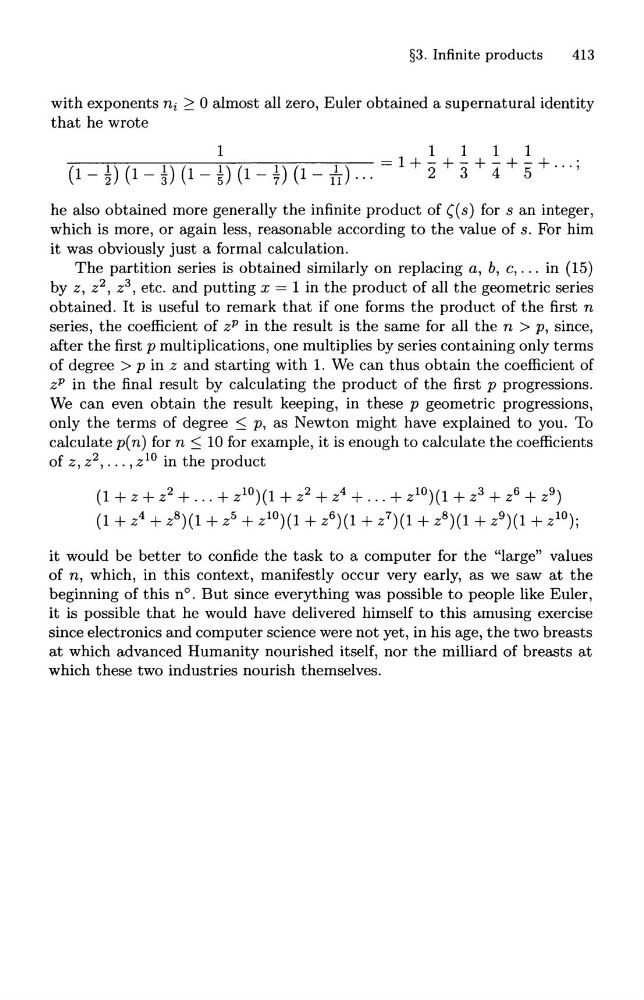
1
1 1 1 1
( 1)( 1)(
1)( 1)(
1) =1+-+-+-+-+ ... ;
1- 2 1- 3 1- 5 1-"7 I-IT ...
2 3 4 5
he also obtained more generally the infinite product of «(8) for 8 an integer,
which is more, or again less, reasonable according to the value of 8. For him
it was obviously just a formal calculation.
The partition series is obtained similarly on replacing a, b, c, . .. in (15)
by z, Z2, Z3, etc. and putting x = 1 in the product of all the geometric series
obtained. It is useful to remark that if one forms the product of the first n
series, the coefficient of zP in the result is the same for all the n > p, since,
after the first p multiplications, one multiplies by series containing only terms
of degree > p in z and starting with 1. We can thus obtain the coefficient of
zP in the final result by calculating the product of the first p progressions.
We can even obtain the result keeping, in these p geometric progressions,
only the terms of degree :-::; p, as Newton might have explained to you. To
calculate p( n) for n :-::; 10 for example, it is enough to calculate the coefficients
of z, z2, ... ,z10 in the product
(1 + z + z2 + ... + zIo)(1 + z2 + z4 + ... + zlO)(1 + z3 + z6 + z9)
(1 + z4 + z8)(1 + z5 + zlO)(1 + z6)(1 + z7)(1 + z8)(1 + z9)(1 + ZIO);
it would be better to confide the task to a computer for the "large" values
of n, which, in this context, manifestly occur very early, as we saw at the
beginning of this nO. But since everything was possible to people like Euler,
it is possible that he would have delivered himself to this amusing exercise
since electronics and computer science were not yet, in his age, the two breasts
at which advanced Humanity nourished itself, nor the milliard of breasts at
which these two industries nourish themselves.
413
with exponents ni ~ 0 almost all zero, Euler obtained a supernatural identity
that he wrote
1
1 1 1 1
( 1)( 1)(
1)( 1)(
1) =1+-+-+-+-+ ... ;
1- 2 1- 3 1- 5 1-"7 I-IT ...
2 3 4 5
he also obtained more generally the infinite product of «(8) for 8 an integer,
which is more, or again less, reasonable according to the value of 8. For him
it was obviously just a formal calculation.
The partition series is obtained similarly on replacing a, b, c, . .. in (15)
by z, Z2, Z3, etc. and putting x = 1 in the product of all the geometric series
obtained. It is useful to remark that if one forms the product of the first n
series, the coefficient of zP in the result is the same for all the n > p, since,
after the first p multiplications, one multiplies by series containing only terms
of degree > p in z and starting with 1. We can thus obtain the coefficient of
zP in the final result by calculating the product of the first p progressions.
We can even obtain the result keeping, in these p geometric progressions,
only the terms of degree :-::; p, as Newton might have explained to you. To
calculate p( n) for n :-::; 10 for example, it is enough to calculate the coefficients
of z, z2, ... ,z10 in the product
(1 + z + z2 + ... + zIo)(1 + z2 + z4 + ... + zlO)(1 + z3 + z6 + z9)
(1 + z4 + z8)(1 + z5 + zlO)(1 + z6)(1 + z7)(1 + z8)(1 + z9)(1 + ZIO);
it would be better to confide the task to a computer for the "large" values
of n, which, in this context, manifestly occur very early, as we saw at the
beginning of this nO. But since everything was possible to people like Euler,
it is possible that he would have delivered himself to this amusing exercise
since electronics and computer science were not yet, in his age, the two breasts
at which advanced Humanity nourished itself, nor the milliard of breasts at
which these two industries nourish themselves.