

§3. Infinite products
399
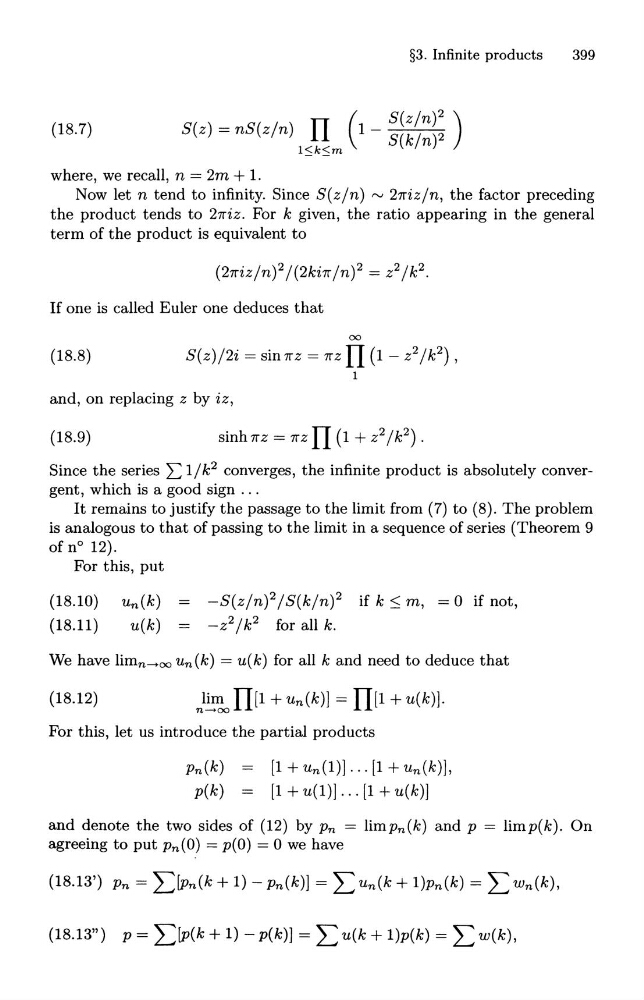
(18.7)
II ( S(z j n)2)
S(z) = nS(zjn)
1 - S(kjn)2
l::;k::;m
where, we recall, n = 2m + 1.
Now let n tend to infinity. Since S(zjn) rv 2nizjn, the factor preceding
the product tends to 2niz. For k given, the ratio appearing in the general
term of the product is equivalent to
If one is called Euler one deduces that
(18.8)
00
S(z)j2i = sin nz = nz II (1 - Z2 jk 2 ) ,
1
and, on replacing z by iz,
(18.9)
Since the series L: Ijk2 converges, the infinite product is absolutely convergent, which is a good sign ...
It remains to justify the passage to the limit from (7) to (8). The problem
is analogous to that of passing to the limit in a sequence of series (Theorem 9
of nO 12).
For this, put
(18.10)
(18.11)
un(k)
u(k)
-S(zjn)2 jS(kjn)2 if k ~ m, = 0 if not,
_z2jk 2 for all k.
We have limn --+ oo un(k) = u(k) for all k and need to deduce that
(18.12)
For this, let us introduce the partial products
Pn(k)
[1 + un(I)] ... [1 + un(k)J,
p(k)
[1 + u(I)] ... [1 + u(k)]
and denote the two sides of (12) by Pn = limpn(k) and P = limp(k). On
agreeing to put Pn(O) = p(O) = 0 we have
(18.13") P = L(P(k + 1) - p(k)] = L u(k + l)p(k) = L w(k),
399
(18.7)
II ( S(z j n)2)
S(z) = nS(zjn)
1 - S(kjn)2
l::;k::;m
where, we recall, n = 2m + 1.
Now let n tend to infinity. Since S(zjn) rv 2nizjn, the factor preceding
the product tends to 2niz. For k given, the ratio appearing in the general
term of the product is equivalent to
If one is called Euler one deduces that
(18.8)
00
S(z)j2i = sin nz = nz II (1 - Z2 jk 2 ) ,
1
and, on replacing z by iz,
(18.9)
Since the series L: Ijk2 converges, the infinite product is absolutely convergent, which is a good sign ...
It remains to justify the passage to the limit from (7) to (8). The problem
is analogous to that of passing to the limit in a sequence of series (Theorem 9
of nO 12).
For this, put
(18.10)
(18.11)
un(k)
u(k)
-S(zjn)2 jS(kjn)2 if k ~ m, = 0 if not,
_z2jk 2 for all k.
We have limn --+ oo un(k) = u(k) for all k and need to deduce that
(18.12)
For this, let us introduce the partial products
Pn(k)
[1 + un(I)] ... [1 + un(k)J,
p(k)
[1 + u(I)] ... [1 + u(k)]
and denote the two sides of (12) by Pn = limpn(k) and P = limp(k). On
agreeing to put Pn(O) = p(O) = 0 we have
(18.13") P = L(P(k + 1) - p(k)] = L u(k + l)p(k) = L w(k),