

§2. Series expansions
381
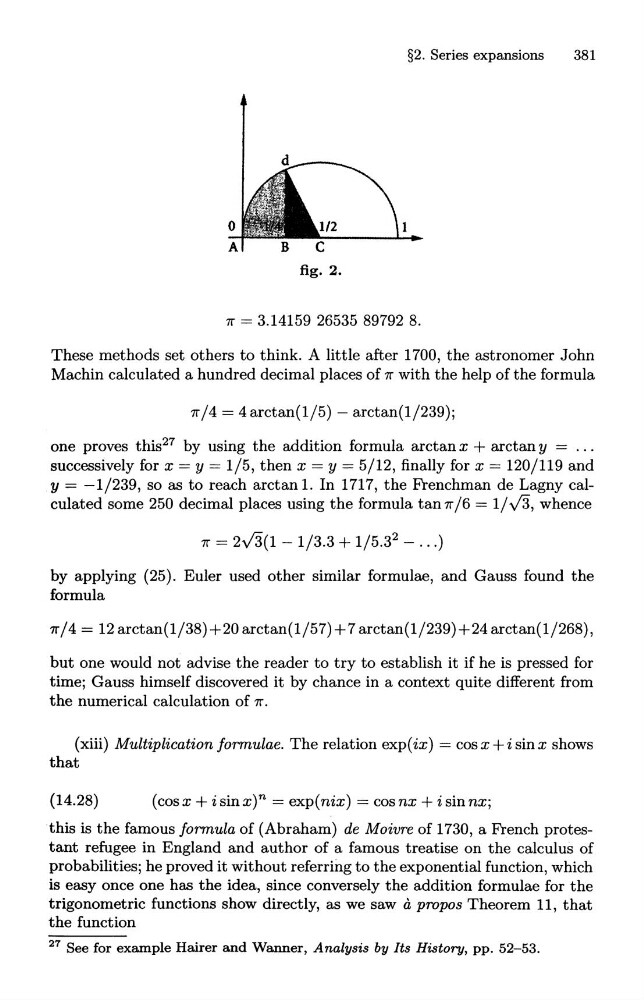
fig. 2.
7r = 3.14159 26535 89792 8.
These methods set others to think. A little after 1700, the astronomer John
Machin calculated a hundred decimal places of 7r with the help of the formula
7r/4 = 4arctan(1/5) - arctan(1/239);
one proves this 27 by using the addition formula arctan x + arctan y =
successively for x = y = 1/5, then x = y = 5/12, finally for x = 120/119 and
y = -1/239, so as to reach arctanl. In 1717, the Frenchman de Lagny calculated some 250 decimal places using the formula tan7r/6 = 1/V3, whence
7r = 2V3(1 - 1/3.3 + 1/5.3 2 - ••• )
by applying (25). Euler used other similar formulae, and Gauss found the
formula
7r/4 = 12 arctan(1/38) +20 arctan(1/57)+7 arctan(1/239) +24 arctan(1/268),
but one would not advise the reader to try to establish it if he is pressed for
time; Gauss himself discovered it by chance in a context quite different from
the numerical calculation of 7r.
(xiii) Multiplication formulae. The relation exp(ix) = cosx+isinx shows
that
(14.28)
(cos x + isinx)n = exp(nix) = cosnx + isinnx;
this is the famous formula of (Abraham) de Moivre of 1730, a French protestant refugee in England and author of a famous treatise on the calculus of
probabilities; he proved it without referring to the exponential function, which
is easy once one has the idea, since conversely the addition formulae for the
trigonometric functions show directly, as we saw a propos Theorem 11, that
the function
27 See for example Hairer and Wanner, Analysis by Its History, pp. 52-53.
381
fig. 2.
7r = 3.14159 26535 89792 8.
These methods set others to think. A little after 1700, the astronomer John
Machin calculated a hundred decimal places of 7r with the help of the formula
7r/4 = 4arctan(1/5) - arctan(1/239);
one proves this 27 by using the addition formula arctan x + arctan y =
successively for x = y = 1/5, then x = y = 5/12, finally for x = 120/119 and
y = -1/239, so as to reach arctanl. In 1717, the Frenchman de Lagny calculated some 250 decimal places using the formula tan7r/6 = 1/V3, whence
7r = 2V3(1 - 1/3.3 + 1/5.3 2 - ••• )
by applying (25). Euler used other similar formulae, and Gauss found the
formula
7r/4 = 12 arctan(1/38) +20 arctan(1/57)+7 arctan(1/239) +24 arctan(1/268),
but one would not advise the reader to try to establish it if he is pressed for
time; Gauss himself discovered it by chance in a context quite different from
the numerical calculation of 7r.
(xiii) Multiplication formulae. The relation exp(ix) = cosx+isinx shows
that
(14.28)
(cos x + isinx)n = exp(nix) = cosnx + isinnx;
this is the famous formula of (Abraham) de Moivre of 1730, a French protestant refugee in England and author of a famous treatise on the calculus of
probabilities; he proved it without referring to the exponential function, which
is easy once one has the idea, since conversely the addition formulae for the
trigonometric functions show directly, as we saw a propos Theorem 11, that
the function
27 See for example Hairer and Wanner, Analysis by Its History, pp. 52-53.