

§2. Series expansions
369
(13.2)
exp(z) = lim(1 + z/p)p
for any z E C.
The algebraic binomial formula shows that generally
(1 + u/p)p
(13.3)
whence
1 + p(u/p) + p(p - l)u 2 /p2.2! + ...
+ p(p - 1) ... (p - P + l)u P /pp.p!
L
(1 - l/p)(1 - 2/p) ... [1 - (n - 1)/p] un In!,
O~n~p
(13.4)
(1 + zp/p)P = L(1 - l/p)(1 - 2/p) ... z1 n ] = L up(n).
n~p
As p increases indefinitely, the term z1 n ] in this expression tends to z[n] and
its coefficient, a product of n - 1 factors all tending to 1, tends to 1, so that
the general term of (4) tends to that of the series exp(z). If one considers the
right hand side of (4) as a series whose terms of index n > p are all zero and
if one observes that the numbers 1-I/p, 1- 2/p, etc. all lie between 0 and 1,
it is clear that
lup(n)1 ~ Izpl[n]
for all nand p. But since the sequence (zp) converges there exists a number
M > 0 such that IZpl ~ M for all p, whence lup(n)1 ~ M[n] = v(n), the
general term of a convergent series independent of p, namely exp M. The hypotheses of Theorem 9 are therefore satisfied, whence the relation (1), qed.
Theorem 11 - which depends only on the algebraic binomial formula and
on the dominated convergence theorem - might form the starting point of
another mode of exposition of the properties of the functions exp and log.
First, it allows us to define exp z by the formula (2) and to prove that exp z =
E zn In!, which reverses the logical order adopted up to the present. We now
have to show that
exp(x + y) = exp(x) exp(y)
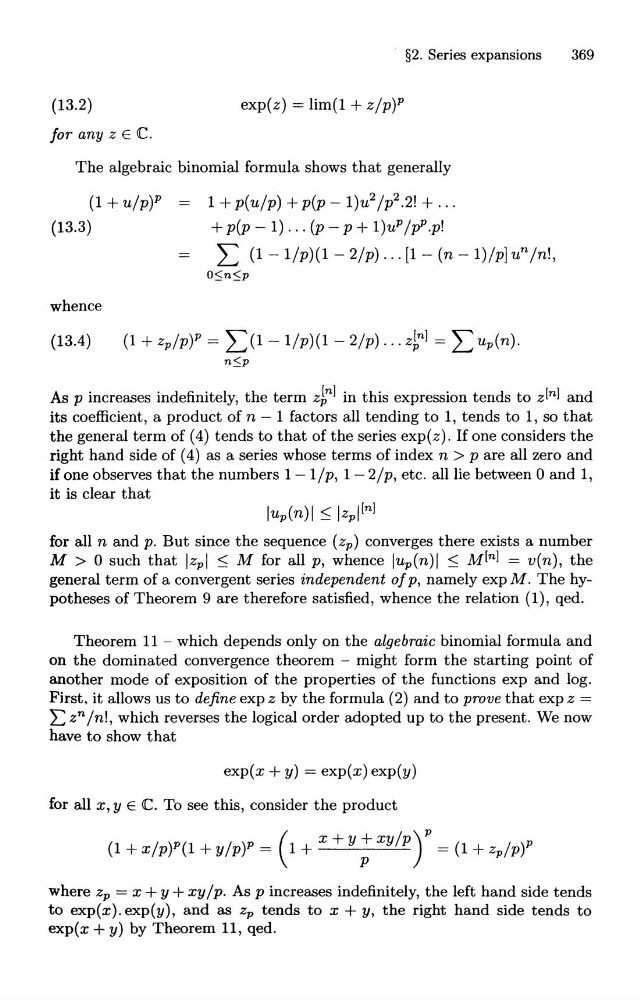
for all x, y E C. To see this, consider the product
where zp = x + y + xy/p. As p increases indefinitely, the left hand side tends
to exp(x). exp(y) , and as Zp tends to x + y, the right hand side tends to
exp(x + y) by Theorem 11, qed.
369
(13.2)
exp(z) = lim(1 + z/p)p
for any z E C.
The algebraic binomial formula shows that generally
(1 + u/p)p
(13.3)
whence
1 + p(u/p) + p(p - l)u 2 /p2.2! + ...
+ p(p - 1) ... (p - P + l)u P /pp.p!
L
(1 - l/p)(1 - 2/p) ... [1 - (n - 1)/p] un In!,
O~n~p
(13.4)
(1 + zp/p)P = L(1 - l/p)(1 - 2/p) ... z1 n ] = L up(n).
n~p
As p increases indefinitely, the term z1 n ] in this expression tends to z[n] and
its coefficient, a product of n - 1 factors all tending to 1, tends to 1, so that
the general term of (4) tends to that of the series exp(z). If one considers the
right hand side of (4) as a series whose terms of index n > p are all zero and
if one observes that the numbers 1-I/p, 1- 2/p, etc. all lie between 0 and 1,
it is clear that
lup(n)1 ~ Izpl[n]
for all nand p. But since the sequence (zp) converges there exists a number
M > 0 such that IZpl ~ M for all p, whence lup(n)1 ~ M[n] = v(n), the
general term of a convergent series independent of p, namely exp M. The hypotheses of Theorem 9 are therefore satisfied, whence the relation (1), qed.
Theorem 11 - which depends only on the algebraic binomial formula and
on the dominated convergence theorem - might form the starting point of
another mode of exposition of the properties of the functions exp and log.
First, it allows us to define exp z by the formula (2) and to prove that exp z =
E zn In!, which reverses the logical order adopted up to the present. We now
have to show that
exp(x + y) = exp(x) exp(y)
for all x, y E C. To see this, consider the product
where zp = x + y + xy/p. As p increases indefinitely, the left hand side tends
to exp(x). exp(y) , and as Zp tends to x + y, the right hand side tends to
exp(x + y) by Theorem 11, qed.