

§2. Series expansions
357
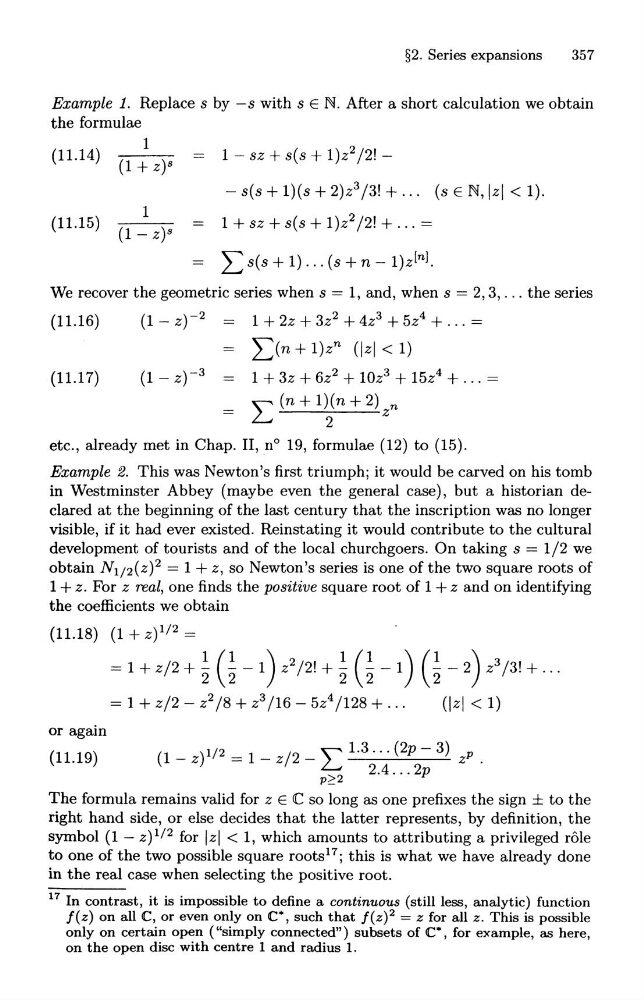
Example 1. Replace s by -s with sEN. After a short calculation we obtain
the formulae
(11.14)
1
1 - sz + s(s + l)z2/2! -
- s(s + l)(s + 2)z3/3! + ... (s E N, Izl < 1).
(11.15)
1
1 + sz + s(s + l)z2/2! + ... =
2: s(s + 1) ... (s + n - l)z[n 1 •
We recover the geometric series when s = 1, and, when s = 2,3, ... the series
(11.16)
(l-z)-2
(11.17)
(1 - z)-3
1 + 2z + 3z 2 + 4z 3 + 5z 4 + ... =
2:(n + l)zn (Izl < 1)
1 + 3z + 6z 2 + lOz 3 + 15z 4 + ... =
" (n + 1)(n + 2) n
~
2
z
etc., already met in Chap. II, nO 19, formulae (12) to (15).
Example 2. This was Newton's first triumph; it would be carved on his tomb
in Westminster Abbey (maybe even the general case), but a historian declared at the beginning of the last century that the inscription was no longer
visible, if it had ever existed. Reinstating it would contribute to the cultural
development of tourists and of the local churchgoers. On taking s = 1/2 we
obtain N1/2(Z)2 = 1 + z, so Newton's series is one of the two square roots of
1 + z. For z real, one finds the positive square root of 1 + z and on identifying
the coefficients we obtain
(11.18) (1 + z)1/2 =
= 1 + z/2 + ~ (~-1) z2/2! + ~ (~-1) (~- 2) z3/3! + ...
= 1 + z/2 - z2/8 + z3/16 - 5z 4 /128 + ...
(Izl < 1)
or again
(1 - z)1/2 = 1 _ z/2 _ 2: 1.3 ... (2p - 3) zP .
>
2.4 ... 2p
p_2
(11.19)
The formula remains valid for z E C so long as one prefixes the sign ± to the
right hand side, or else decides that the latter represents, by definition, the
symbol (1 - Z)1/2 for Izl < 1, which amounts to attributing a privileged role
to one of the two possible square roots 17 ; this is what we have already done
in the real case when selecting the positive root.
17 In contrast, it is impossible to define a continuous (still less, analytic) function
f(z) on all C, or even only on C·, such that f(Z)2 = z for all z. This is possible
only on certain open ("simply connected") subsets of C·, for example, as here,
on the open disc with centre 1 and radius 1.
357
Example 1. Replace s by -s with sEN. After a short calculation we obtain
the formulae
(11.14)
1
1 - sz + s(s + l)z2/2! -
- s(s + l)(s + 2)z3/3! + ... (s E N, Izl < 1).
(11.15)
1
1 + sz + s(s + l)z2/2! + ... =
2: s(s + 1) ... (s + n - l)z[n 1 •
We recover the geometric series when s = 1, and, when s = 2,3, ... the series
(11.16)
(l-z)-2
(11.17)
(1 - z)-3
1 + 2z + 3z 2 + 4z 3 + 5z 4 + ... =
2:(n + l)zn (Izl < 1)
1 + 3z + 6z 2 + lOz 3 + 15z 4 + ... =
" (n + 1)(n + 2) n
~
2
z
etc., already met in Chap. II, nO 19, formulae (12) to (15).
Example 2. This was Newton's first triumph; it would be carved on his tomb
in Westminster Abbey (maybe even the general case), but a historian declared at the beginning of the last century that the inscription was no longer
visible, if it had ever existed. Reinstating it would contribute to the cultural
development of tourists and of the local churchgoers. On taking s = 1/2 we
obtain N1/2(Z)2 = 1 + z, so Newton's series is one of the two square roots of
1 + z. For z real, one finds the positive square root of 1 + z and on identifying
the coefficients we obtain
(11.18) (1 + z)1/2 =
= 1 + z/2 + ~ (~-1) z2/2! + ~ (~-1) (~- 2) z3/3! + ...
= 1 + z/2 - z2/8 + z3/16 - 5z 4 /128 + ...
(Izl < 1)
or again
(1 - z)1/2 = 1 _ z/2 _ 2: 1.3 ... (2p - 3) zP .
>
2.4 ... 2p
p_2
(11.19)
The formula remains valid for z E C so long as one prefixes the sign ± to the
right hand side, or else decides that the latter represents, by definition, the
symbol (1 - Z)1/2 for Izl < 1, which amounts to attributing a privileged role
to one of the two possible square roots 17 ; this is what we have already done
in the real case when selecting the positive root.
17 In contrast, it is impossible to define a continuous (still less, analytic) function
f(z) on all C, or even only on C·, such that f(Z)2 = z for all z. This is possible
only on certain open ("simply connected") subsets of C·, for example, as here,
on the open disc with centre 1 and radius 1.