

350
IV - Powers, Exponentials, Logarithms, Trigonometric Functions
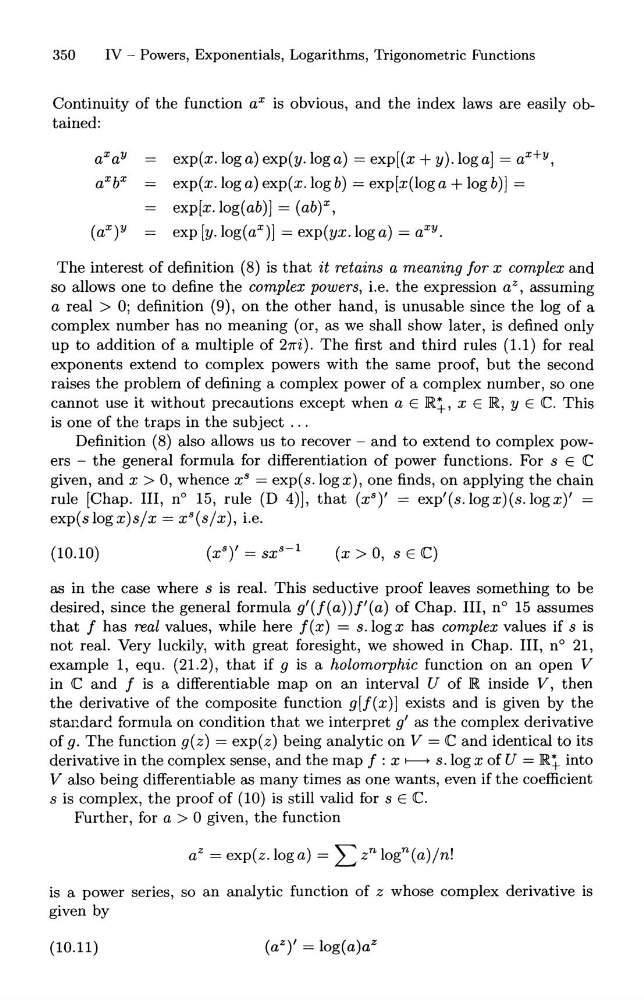
Continuity of the function aX is obvious, and the index laws are easily obtained:
exp(x.loga) exp(y.loga) = exp[(x + y).loga] = a X + Y ,
exp(x.loga) exp(x.logb) = exp[x(loga + log b)] =
exp[x.log(ab)] = (ab)X,
exp [y.log(a X )] = exp(yx.loga) = a XY •
The interest of definition (8) is that it retains a meaning for x complex and
so allows one to define the complex powers, i.e. the expression a Z , assuming
a real> 0; definition (9), on the other hand, is unusable since the log of a
complex number has no meaning (or, as we shall show later, is defined only
up to addition of a multiple of 21Ti). The first and third rules (1.1) for real
exponents extend to complex powers with the same proof, but the second
raises the problem of defining a complex power of a complex number, so one
cannot use it without precautions except when a E 1R+, x E 1R, y E C. This
is one of the traps in the subject ...
Definition (8) also allows us to recover - and to extend to complex powers - the general formula for differentiation of power functions. For SEC
given, and x > 0, whence x 8 = exp(s.logx), one finds, on applying the chain
rule [Chap. III, nO 15, rule (D 4)], that (x s ), = exp'(s.logx)(s.logx)' =
exp(s log x)s/x = XS(s/x), i.e.
(10.10)
(x> 0, sEq
as in the case where s is real. This seductive proof leaves something to be
desired, since the general formula g'(f(a»f'(a) of Chap. III, nO 15 assumes
that f has real values, while here f(x) = s.log x has complex values if s is
not real. Very luckily, with great foresight, we showed in Chap. III, n° 21,
example 1, equ. (21.2), that if 9 is a holomorphic function on an open V
in C and f is a differentiable map on an interval U of IR inside V, then
the derivative of the composite function g[f(x)] exists and is given by the
stal:dard formula on condition that we interpret g' as the complex derivative
of g. The function g(z) = exp(z) being analytic on V = C and identical to its
derivative in the complex sense, and the map f : x f-------4 s.log x of U = 1R+ into
V also being differentiable as many times as one wants, even if the coefficient
s is complex, the proof of (10) is still valid for sEC.
Further, for a > 0 given, the function
a Z = exp(z.loga) = L zn logn(a)/n!
is a power series, so an analytic function of z whose complex derivative is
given by
(10.11)
IV - Powers, Exponentials, Logarithms, Trigonometric Functions
Continuity of the function aX is obvious, and the index laws are easily obtained:
exp(x.loga) exp(y.loga) = exp[(x + y).loga] = a X + Y ,
exp(x.loga) exp(x.logb) = exp[x(loga + log b)] =
exp[x.log(ab)] = (ab)X,
exp [y.log(a X )] = exp(yx.loga) = a XY •
The interest of definition (8) is that it retains a meaning for x complex and
so allows one to define the complex powers, i.e. the expression a Z , assuming
a real> 0; definition (9), on the other hand, is unusable since the log of a
complex number has no meaning (or, as we shall show later, is defined only
up to addition of a multiple of 21Ti). The first and third rules (1.1) for real
exponents extend to complex powers with the same proof, but the second
raises the problem of defining a complex power of a complex number, so one
cannot use it without precautions except when a E 1R+, x E 1R, y E C. This
is one of the traps in the subject ...
Definition (8) also allows us to recover - and to extend to complex powers - the general formula for differentiation of power functions. For SEC
given, and x > 0, whence x 8 = exp(s.logx), one finds, on applying the chain
rule [Chap. III, nO 15, rule (D 4)], that (x s ), = exp'(s.logx)(s.logx)' =
exp(s log x)s/x = XS(s/x), i.e.
(10.10)
(x> 0, sEq
as in the case where s is real. This seductive proof leaves something to be
desired, since the general formula g'(f(a»f'(a) of Chap. III, nO 15 assumes
that f has real values, while here f(x) = s.log x has complex values if s is
not real. Very luckily, with great foresight, we showed in Chap. III, n° 21,
example 1, equ. (21.2), that if 9 is a holomorphic function on an open V
in C and f is a differentiable map on an interval U of IR inside V, then
the derivative of the composite function g[f(x)] exists and is given by the
stal:dard formula on condition that we interpret g' as the complex derivative
of g. The function g(z) = exp(z) being analytic on V = C and identical to its
derivative in the complex sense, and the map f : x f-------4 s.log x of U = 1R+ into
V also being differentiable as many times as one wants, even if the coefficient
s is complex, the proof of (10) is still valid for sEC.
Further, for a > 0 given, the function
a Z = exp(z.loga) = L zn logn(a)/n!
is a power series, so an analytic function of z whose complex derivative is
given by
(10.11)