

348
IV - Powers, Exponentials, Logarithms, Trigonometric Functions
t 4 - 3t 3 + 3t 2 - 3t + 2 = 0;
this can be rewritten as (t - 1)(t - 2)(t 2 + 1) = 0, so that we immediately
obtain four solutions of the given differential equation: exp x, exp 2x, exp ix
and exp( -ix) and, more generally, all the functions
y = C1 exp(x) + C2 exp(2x) + C3 exp(ix) + C4 exp( -ix)
with arbitrary complex constants, since clearly every sum of solutions is again
a solution. It is not obvious, but it is true, that all the solutions of the given
differential equation can be found in this way.
We can now establish the fundamental result linking the functions exp
and log:
Theorem 7.
(10.2)
(10.3)
log(expx) = x for all x real,
exp(log y) = y for all y real > o.
Recall the proof already given (Chap. III, nO 2, example 1). By definition,
(10.4)
logy = limn(y1/n -1)
for all y > O. Since exp(x)l/n = exp(xln) for x E lR and n an integer, it
follows that
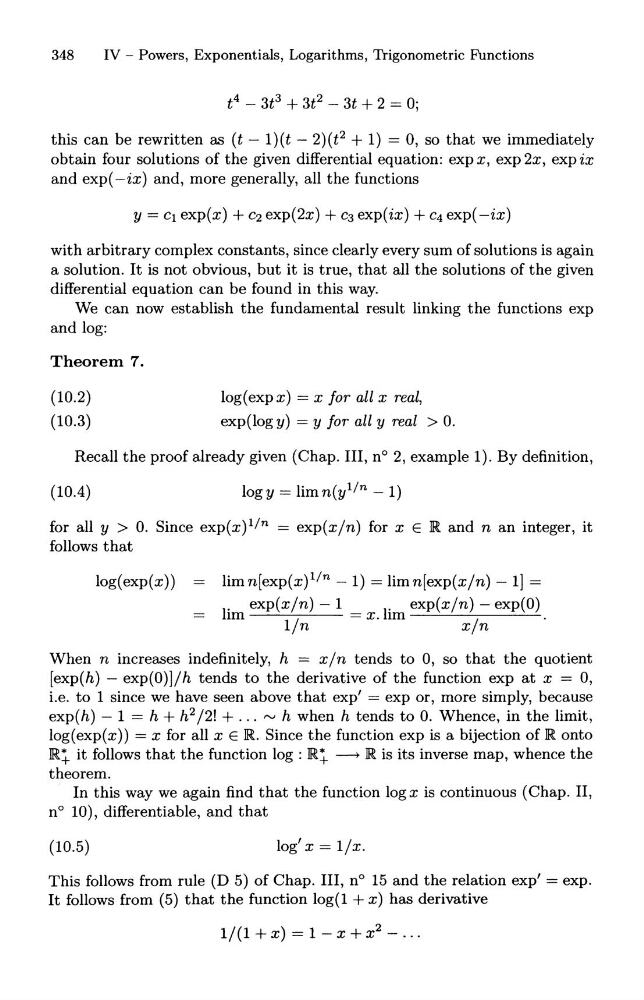
log(exp(x))
lim n[exp(x)l/n - 1) = lim n[exp(xln) - 1] =
I . exp(xln) - 1 _
1. exp(xln) - exp(O)
1m
I - x . 1m
I
.
1 n
x n
When n increases indefinitely, h = xln tends to 0, so that the quotient
[exp(h) - exp(O)]jh tends to the derivative of the function exp at x = 0,
i.e. to 1 since we have seen above that exp' = exp or, more simply, because
exp(h) - 1 = h + h 2 /2! + ... '" h when h tends to o. Whence, in the limit,
log(exp(x)) = x for all x E lR. Since the function exp is a bijection of lR onto
lR+ it follows that the function log : lR+ --+ lR is its inverse map, whence the
theorem.
In this way we again find that the function log x is continuous (Chap. II,
n° 10), differentiable, and that
(10.5)
log' x = 1/x.
This follows from rule (D 5) of Chap. III, nO 15 and the relation exp' = expo
It follows from (5) that the function 10g(1 + x) has derivative
1/(1 + x) = 1 - x + x 2 - •.•
IV - Powers, Exponentials, Logarithms, Trigonometric Functions
t 4 - 3t 3 + 3t 2 - 3t + 2 = 0;
this can be rewritten as (t - 1)(t - 2)(t 2 + 1) = 0, so that we immediately
obtain four solutions of the given differential equation: exp x, exp 2x, exp ix
and exp( -ix) and, more generally, all the functions
y = C1 exp(x) + C2 exp(2x) + C3 exp(ix) + C4 exp( -ix)
with arbitrary complex constants, since clearly every sum of solutions is again
a solution. It is not obvious, but it is true, that all the solutions of the given
differential equation can be found in this way.
We can now establish the fundamental result linking the functions exp
and log:
Theorem 7.
(10.2)
(10.3)
log(expx) = x for all x real,
exp(log y) = y for all y real > o.
Recall the proof already given (Chap. III, nO 2, example 1). By definition,
(10.4)
logy = limn(y1/n -1)
for all y > O. Since exp(x)l/n = exp(xln) for x E lR and n an integer, it
follows that
log(exp(x))
lim n[exp(x)l/n - 1) = lim n[exp(xln) - 1] =
I . exp(xln) - 1 _
1. exp(xln) - exp(O)
1m
I - x . 1m
I
.
1 n
x n
When n increases indefinitely, h = xln tends to 0, so that the quotient
[exp(h) - exp(O)]jh tends to the derivative of the function exp at x = 0,
i.e. to 1 since we have seen above that exp' = exp or, more simply, because
exp(h) - 1 = h + h 2 /2! + ... '" h when h tends to o. Whence, in the limit,
log(exp(x)) = x for all x E lR. Since the function exp is a bijection of lR onto
lR+ it follows that the function log : lR+ --+ lR is its inverse map, whence the
theorem.
In this way we again find that the function log x is continuous (Chap. II,
n° 10), differentiable, and that
(10.5)
log' x = 1/x.
This follows from rule (D 5) of Chap. III, nO 15 and the relation exp' = expo
It follows from (5) that the function 10g(1 + x) has derivative
1/(1 + x) = 1 - x + x 2 - •.•