

§l. Set Theory
15
(3.2)
0=0,
1 = {0} = {O},
2 = {0, {0}} = {O, I},
3= {0,{0}, {0, {0}}} = {0,1,2},
4= {0,{0}, {0, {0}}, {0, {0}, {0,{0}}}} = {0,1,2,3},
etc. For example, 3 is the set whose elements are (a) the empty set, (b) the
set whose unique element is the empty set, (c) the set whose only elements
are the empty set and the set whose unique element is the empty set (fig. 1).
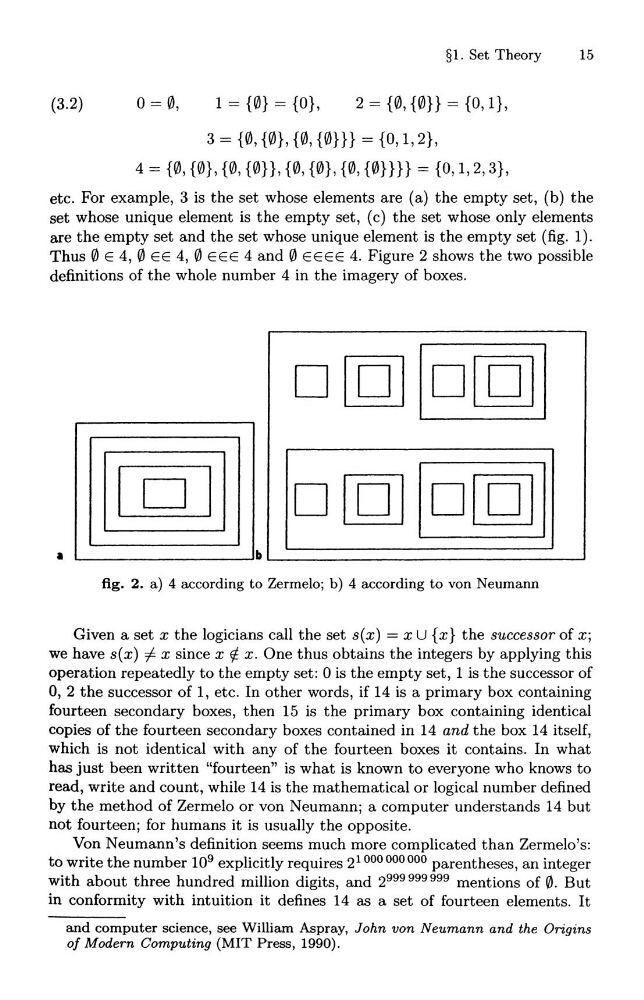
Thus 0 E 4, 0 EE 4, 0 EEE 4 and 0 EEEE 4. Figure 2 shows the two possible
definitions of the whole number 4 in the imagery of boxes.
•
~ ________________ ~b~ ______________________________ - J
fig. 2. a) 4 according to Zermelo; b) 4 according to von Neumann
Given a set x the logicians call the set s(x) = xU {x} the successor of x;
we have s(x) -=I- x since x ri c x. One thus obtains the integers by applying this
operation repeatedly to the empty set: 0 is the empty set, 1 is the successor of
0, 2 the successor of 1, etc. In other words, if 14 is a primary box containing
fourteen secondary boxes, then 15 is the primary box containing identical
copies of the fourteen secondary boxes contained in 14 and the box 14 itself,
which is not identical with any of the fourteen boxes it contains. In what
has just been written "fourteen" is what is known to everyone who knows to
read, write and count, while 14 is the mathematical or logical number defined
by the method of Zermelo or von Neumann; a computer understands 14 but
not fourteen; for humans it is usually the opposite.
Von Neumann's definition seems much more complicated than Zermelo's:
to write the number 10 9 explicitly requires 21000000000 parentheses, an integer
with about three hundred million digits, and 2999999999 mentions of 0. But
in conformity with intuition it defines 14 as a set of fourteen elements. It
and computer science, see William Aspray, John von Neumann and the Origins
of Modern Computing (MIT Press, 1990).
15
(3.2)
0=0,
1 = {0} = {O},
2 = {0, {0}} = {O, I},
3= {0,{0}, {0, {0}}} = {0,1,2},
4= {0,{0}, {0, {0}}, {0, {0}, {0,{0}}}} = {0,1,2,3},
etc. For example, 3 is the set whose elements are (a) the empty set, (b) the
set whose unique element is the empty set, (c) the set whose only elements
are the empty set and the set whose unique element is the empty set (fig. 1).
Thus 0 E 4, 0 EE 4, 0 EEE 4 and 0 EEEE 4. Figure 2 shows the two possible
definitions of the whole number 4 in the imagery of boxes.
•
~ ________________ ~b~ ______________________________ - J
fig. 2. a) 4 according to Zermelo; b) 4 according to von Neumann
Given a set x the logicians call the set s(x) = xU {x} the successor of x;
we have s(x) -=I- x since x ri c x. One thus obtains the integers by applying this
operation repeatedly to the empty set: 0 is the empty set, 1 is the successor of
0, 2 the successor of 1, etc. In other words, if 14 is a primary box containing
fourteen secondary boxes, then 15 is the primary box containing identical
copies of the fourteen secondary boxes contained in 14 and the box 14 itself,
which is not identical with any of the fourteen boxes it contains. In what
has just been written "fourteen" is what is known to everyone who knows to
read, write and count, while 14 is the mathematical or logical number defined
by the method of Zermelo or von Neumann; a computer understands 14 but
not fourteen; for humans it is usually the opposite.
Von Neumann's definition seems much more complicated than Zermelo's:
to write the number 10 9 explicitly requires 21000000000 parentheses, an integer
with about three hundred million digits, and 2999999999 mentions of 0. But
in conformity with intuition it defines 14 as a set of fourteen elements. It
and computer science, see William Aspray, John von Neumann and the Origins
of Modern Computing (MIT Press, 1990).