

§ 1. Direct construction
343
The logarithm function g = loga is of course, by definition, the inverse
of the exponential function I = eXPa' which is differentiable as often as one
wishes. The existence of g' at a point b > 0 thus amounts to the fact that
the derivative I' is not zero at the point a = g(b). And this is so, because f'
is proportional to I, which never vanishes 10 •
In conclusion, we see that the function loga x, the inverse of x 1-+ aX =
eXPa(x), is differentiable and that its derivative at a point x is the reciprocal
of the derivative of the function y 1-+ eXPa Y at the point y = loga x, i.e. is
equal to 1/10g(a)a Y = 1/10g(a)x as stated.
To deduce that the logarithmic functions are indefinitely differentiable,
and to calculate their successive derivatives, it is better, even if the reader
has known how differentiate 1 I x for a long time, to proceed first to the case
of the power functions.
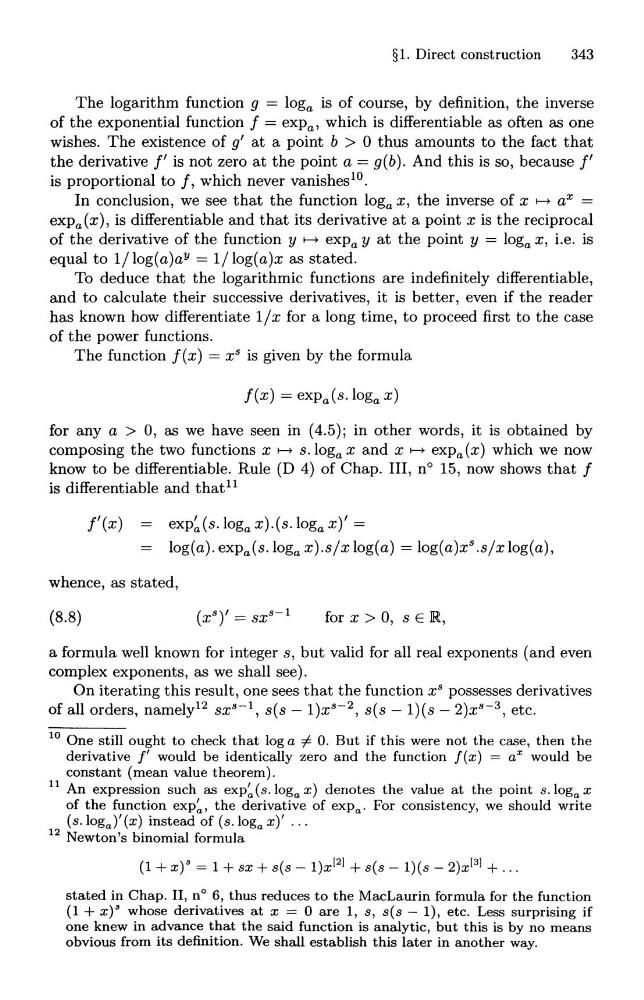
The function I(x) = X S is given by the formula
for any a > 0, as we have seen in (4.5); in other words, it is obtained by
composing the two functions x 1-+ s.loga x and x 1-+ eXPa(x) which we now
know to be differentiable. Rule (D 4) of Chap. III, nO 15, now shows that I
is differentiable and that l l
f'(x)
exp~ (s.loga x).(s.loga x)' =
log(a). eXPa(s.loga x).slx log(a) = 10g(a)xS .slx log(a),
whence, as stated,
(8.8)
for x > 0, s E JR,
a formula well known for integer s, but valid for all real exponents (and even
complex exponents, as we shall see).
On iterating this result, one sees that the function X S possesses derivatives
of all orders, namelyI2 SXS-I, s(s _1)x S - 2 , s(s -1)(s - 2)x s -3, etc.
10 One still ought to check that log a t- O. But if this were not the case, then the
derivative f' would be identically zero and the function f(x) = aX would be
constant (mean value theorem).
11 An expression such as exp~(s.logax) denotes the value at the point s.logax
of the function exp~, the derivative of eXPa. For consistency, we should write
(s.loga)'(x) instead of (s.logax), ...
12 Newton's binomial formula
(1 + xt = 1 + sx + s(s - 1)X[2] + s(s - 1)(s - 2)X[3] + ...
stated in Chap. II, nO 6, thus reduces to the MacLaurin formula for the function
(1 + xy whose derivatives at x = 0 are 1, s, s(s - 1), etc. Less surprising if
one knew in advance that the said function is analytic, but this is by no means
obvious from its definition. We shall establish this later in another way.
343
The logarithm function g = loga is of course, by definition, the inverse
of the exponential function I = eXPa' which is differentiable as often as one
wishes. The existence of g' at a point b > 0 thus amounts to the fact that
the derivative I' is not zero at the point a = g(b). And this is so, because f'
is proportional to I, which never vanishes 10 •
In conclusion, we see that the function loga x, the inverse of x 1-+ aX =
eXPa(x), is differentiable and that its derivative at a point x is the reciprocal
of the derivative of the function y 1-+ eXPa Y at the point y = loga x, i.e. is
equal to 1/10g(a)a Y = 1/10g(a)x as stated.
To deduce that the logarithmic functions are indefinitely differentiable,
and to calculate their successive derivatives, it is better, even if the reader
has known how differentiate 1 I x for a long time, to proceed first to the case
of the power functions.
The function I(x) = X S is given by the formula
for any a > 0, as we have seen in (4.5); in other words, it is obtained by
composing the two functions x 1-+ s.loga x and x 1-+ eXPa(x) which we now
know to be differentiable. Rule (D 4) of Chap. III, nO 15, now shows that I
is differentiable and that l l
f'(x)
exp~ (s.loga x).(s.loga x)' =
log(a). eXPa(s.loga x).slx log(a) = 10g(a)xS .slx log(a),
whence, as stated,
(8.8)
for x > 0, s E JR,
a formula well known for integer s, but valid for all real exponents (and even
complex exponents, as we shall see).
On iterating this result, one sees that the function X S possesses derivatives
of all orders, namelyI2 SXS-I, s(s _1)x S - 2 , s(s -1)(s - 2)x s -3, etc.
10 One still ought to check that log a t- O. But if this were not the case, then the
derivative f' would be identically zero and the function f(x) = aX would be
constant (mean value theorem).
11 An expression such as exp~(s.logax) denotes the value at the point s.logax
of the function exp~, the derivative of eXPa. For consistency, we should write
(s.loga)'(x) instead of (s.logax), ...
12 Newton's binomial formula
(1 + xt = 1 + sx + s(s - 1)X[2] + s(s - 1)(s - 2)X[3] + ...
stated in Chap. II, nO 6, thus reduces to the MacLaurin formula for the function
(1 + xy whose derivatives at x = 0 are 1, s, s(s - 1), etc. Less surprising if
one knew in advance that the said function is analytic, but this is by no means
obvious from its definition. We shall establish this later in another way.