

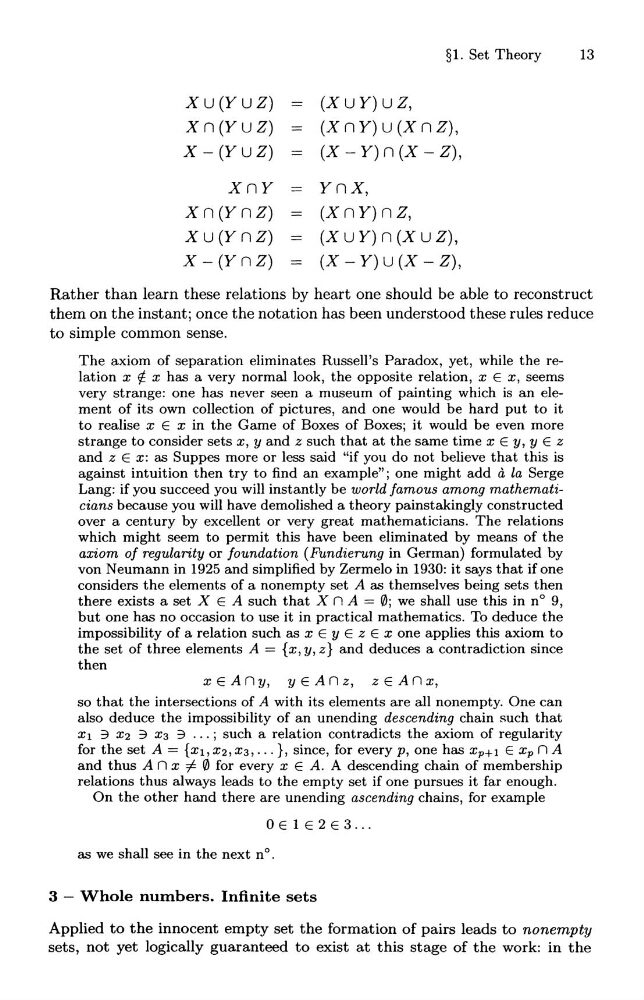
Xu (Y Uz)
X n (YUZ)
X - (YUZ)
XnY
Xn (Ynz)
Xu (YnZ)
X - (Ynz)
§l. Set Theory
13
(X UY) UZ,
(X n Y) U (X n Z),
(X - Y) n (X - Z),
Ynx,
(XnY) n Z,
(X U Y) n (X U Z),
(X - Y) U (X - Z),
Rather than learn these relations by heart one should be able to reconstruct
them on the instant; once the notation has been understood these rules reduce
to simple common sense.
The axiom of separation eliminates Russell's Paradox, yet, while the relation x rt x has a very normal look, the opposite relation, x E x, seems
very strange: one has never seen a museum of painting which is an element of its own collection of pictures, and one would be hard put to it
to realise x E x in the Game of Boxes of Boxes; it would be even more
strange to consider sets x, yand z such that at the same time x E y, Y E z
and z E x: as Suppes more or less said "if you do not believe that this is
against intuition then try to find an example"; one might add Ii la Serge
Lang: if you succeed you will instantly be world famous among mathematicians because you will have demolished a theory painstakingly constructed
over a century by excellent or very great mathematicians. The relations
which might seem to permit this have been eliminated by means of the
axiom of regularity or foundation (Fundierung in German) formulated by
von Neumann in 1925 and simplified by Zermelo in 1930: it says that if one
considers the elements of a nonempty set A as themselves being sets then
there exists a set X E A such that X n A = 0; we shall use this in nO 9,
but one has no occasion to use it in practical mathematics. To deduce the
impossibility of a relation such as x EyE z E x one applies this axiom to
the set of three elements A = {x, y, z} and deduces a contradiction since
then
x E Any, yEA n z, z E A n x,
so that the intersections of A with its elements are all nonempty. One can
also deduce the impossibility of an unending descending chain Ruch that
Xl 3 X2 3 X3 3 ... ; such a relation contradicts the axiom of regularity
for the set A = {Xl, X2, X3,"'}' since, for every p, one has Xp+l E xp n A
and thus A n x =f. 0 for every x E A. A descending chain of membership
relations thus always leads to the empty set if one pursues it far enough.
On the other hand there are unending ascending chains, for example
OE1E2E3 ...
as we shall see in the next n O .
3 - Whole numbers. Infinite sets
Applied to the innocent empty set the formation of pairs leads to nonempty
sets, not yet logically guaranteed to exist at this stage of the work: in the
X n (YUZ)
X - (YUZ)
XnY
Xn (Ynz)
Xu (YnZ)
X - (Ynz)
§l. Set Theory
13
(X UY) UZ,
(X n Y) U (X n Z),
(X - Y) n (X - Z),
Ynx,
(XnY) n Z,
(X U Y) n (X U Z),
(X - Y) U (X - Z),
Rather than learn these relations by heart one should be able to reconstruct
them on the instant; once the notation has been understood these rules reduce
to simple common sense.
The axiom of separation eliminates Russell's Paradox, yet, while the relation x rt x has a very normal look, the opposite relation, x E x, seems
very strange: one has never seen a museum of painting which is an element of its own collection of pictures, and one would be hard put to it
to realise x E x in the Game of Boxes of Boxes; it would be even more
strange to consider sets x, yand z such that at the same time x E y, Y E z
and z E x: as Suppes more or less said "if you do not believe that this is
against intuition then try to find an example"; one might add Ii la Serge
Lang: if you succeed you will instantly be world famous among mathematicians because you will have demolished a theory painstakingly constructed
over a century by excellent or very great mathematicians. The relations
which might seem to permit this have been eliminated by means of the
axiom of regularity or foundation (Fundierung in German) formulated by
von Neumann in 1925 and simplified by Zermelo in 1930: it says that if one
considers the elements of a nonempty set A as themselves being sets then
there exists a set X E A such that X n A = 0; we shall use this in nO 9,
but one has no occasion to use it in practical mathematics. To deduce the
impossibility of a relation such as x EyE z E x one applies this axiom to
the set of three elements A = {x, y, z} and deduces a contradiction since
then
x E Any, yEA n z, z E A n x,
so that the intersections of A with its elements are all nonempty. One can
also deduce the impossibility of an unending descending chain Ruch that
Xl 3 X2 3 X3 3 ... ; such a relation contradicts the axiom of regularity
for the set A = {Xl, X2, X3,"'}' since, for every p, one has Xp+l E xp n A
and thus A n x =f. 0 for every x E A. A descending chain of membership
relations thus always leads to the empty set if one pursues it far enough.
On the other hand there are unending ascending chains, for example
OE1E2E3 ...
as we shall see in the next n O .
3 - Whole numbers. Infinite sets
Applied to the innocent empty set the formation of pairs leads to nonempty
sets, not yet logically guaranteed to exist at this stage of the work: in the