

326
IV - Powers, Exponentials, Logarithms, Trigonometric Functions
Since x p / q must be real and> 0, we conclude that x p / q must be the l > 0
qth root of the number x P > 0 whose existence and uniqueness were established in Chap. II, n° 10, example 3 and again in Chap. III, nO 4, as a Consequence of the intermediate value theorem. There is no need to recapitulate
it here.
To have the right to write x p / q for the positive qth root of x P we need
to establish that it depends only on the ratio p/q, i.e. that if a, b, e, dare
integers, with band d nonzero, then
(1.3)
having agreed to write x l / n for the positive nth root of a number x > o. In
fact, we shall even show that
(1.3')
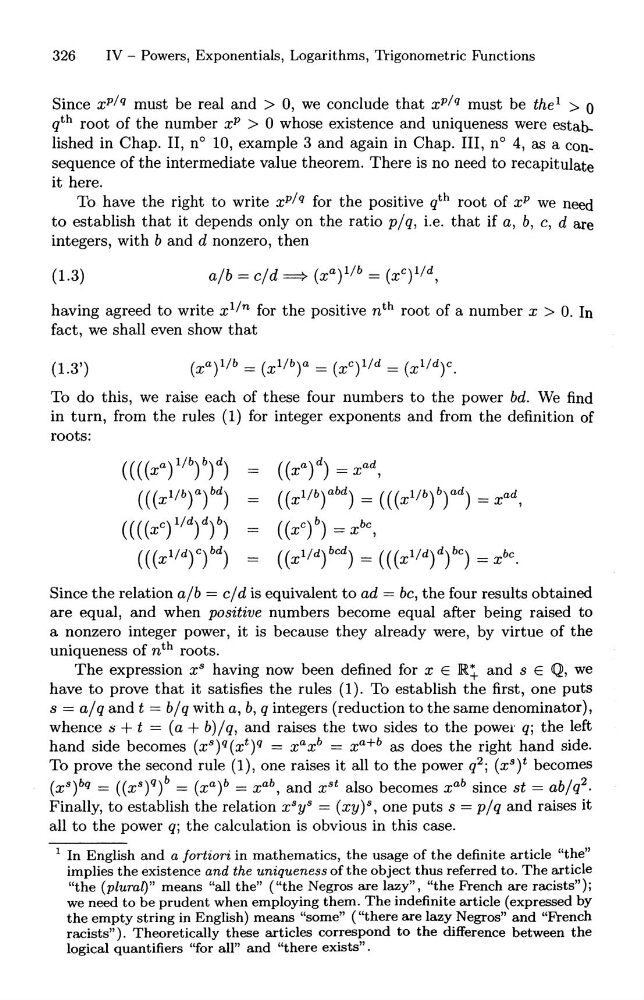
To do this, we raise each of these four numbers to the power bd. We find
in turn, from the rules (1) for integer exponents and from the definition of
roots:
(( ((xa) lib) b)d)
(( (xl/b) a) bd)
((((XC)I/d)d)b)
(((Xl/dt)bd)
((Xa)d) = X ad ,
((xl/bt bd ) = (((xl/b)bt d ) = x ad ,
( (XC) b) = Xbc,
((XI/d)bCd) = (((xl/d)d)bC) = Xbc.
Since the relation alb = e/d is equivalent to ad = be, the four results obtained
are equal, and when positive numbers become equal after being raised to
a nonzero integer power, it is because they already were, by virtue of the
uniqueness of nth roots.
The expression X S having now been defined for x E lR:t and SEQ, we
have to prove that it satisfies the rules (1). To establish the first, one puts
s = a/q and t = b/q with a, b, q integers (reduction to the same denominator),
whence Ii + t = (a + b)/q, and raises the two sides to the powel" q; the left
hand side becomes (XS)q(xt)q = xax b = xa+b as does the right hand side.
To prove the second rule (1), one raises it all to the power q2; (XS)t becomes
(xs)b q = ((xB)q)b = (xa)b = x ab , and x st also becomes x ab since st = ab/q2.
Finally, to establish the relation xSyS = (xy)S, one puts s = p/q and raises it
all to the power q; the calculation is obvious in this case.
1 In English and a fortiori in mathematics, the usage of the definite article "the"
implies the existence and the uniqueness of the object thus referred to. The article
"the (plum!:)" means "all the" ("the Negros are lazy", "the French are racists");
we need to be prudent when employing them. The indefinite article (expressed by
the empty string in English) means "some" ("there are lazy Negros" and "French
racists" ). Theoretically these articles correspond to the difference between the
logical quantifiers "for all" and "there exists" .
IV - Powers, Exponentials, Logarithms, Trigonometric Functions
Since x p / q must be real and> 0, we conclude that x p / q must be the l > 0
qth root of the number x P > 0 whose existence and uniqueness were established in Chap. II, n° 10, example 3 and again in Chap. III, nO 4, as a Consequence of the intermediate value theorem. There is no need to recapitulate
it here.
To have the right to write x p / q for the positive qth root of x P we need
to establish that it depends only on the ratio p/q, i.e. that if a, b, e, dare
integers, with band d nonzero, then
(1.3)
having agreed to write x l / n for the positive nth root of a number x > o. In
fact, we shall even show that
(1.3')
To do this, we raise each of these four numbers to the power bd. We find
in turn, from the rules (1) for integer exponents and from the definition of
roots:
(( ((xa) lib) b)d)
(( (xl/b) a) bd)
((((XC)I/d)d)b)
(((Xl/dt)bd)
((Xa)d) = X ad ,
((xl/bt bd ) = (((xl/b)bt d ) = x ad ,
( (XC) b) = Xbc,
((XI/d)bCd) = (((xl/d)d)bC) = Xbc.
Since the relation alb = e/d is equivalent to ad = be, the four results obtained
are equal, and when positive numbers become equal after being raised to
a nonzero integer power, it is because they already were, by virtue of the
uniqueness of nth roots.
The expression X S having now been defined for x E lR:t and SEQ, we
have to prove that it satisfies the rules (1). To establish the first, one puts
s = a/q and t = b/q with a, b, q integers (reduction to the same denominator),
whence Ii + t = (a + b)/q, and raises the two sides to the powel" q; the left
hand side becomes (XS)q(xt)q = xax b = xa+b as does the right hand side.
To prove the second rule (1), one raises it all to the power q2; (XS)t becomes
(xs)b q = ((xB)q)b = (xa)b = x ab , and x st also becomes x ab since st = ab/q2.
Finally, to establish the relation xSyS = (xy)S, one puts s = p/q and raises it
all to the power q; the calculation is obvious in this case.
1 In English and a fortiori in mathematics, the usage of the definite article "the"
implies the existence and the uniqueness of the object thus referred to. The article
"the (plum!:)" means "all the" ("the Negros are lazy", "the French are racists");
we need to be prudent when employing them. The indefinite article (expressed by
the empty string in English) means "some" ("there are lazy Negros" and "French
racists" ). Theoretically these articles correspond to the difference between the
logical quantifiers "for all" and "there exists" .