

Appendix to Chapter III
305
whose elements are, for example, functions I defined on a more or less arbitrary set M (functional spaces) and satisfying certain conditions. On the set
X = 8(M) of all bounded maps I of Minto C, the expression
(1.6)
dM(J,g) = sup I/(x) - g(x)1 = III - gilM
satisfies conditions (5) as we saw in Chap. III, nO 7. On the space CP(K) of
functions of class CP, p finite, on a compact interval K C R, one can use the
expression
(1.7)
d(J,g) = III - gilK + II!' - g'IIK + ... + 11/(p) - g(p) 11K;
distances of this kind feature in the theory of distributions (Chap. V, n° 34).
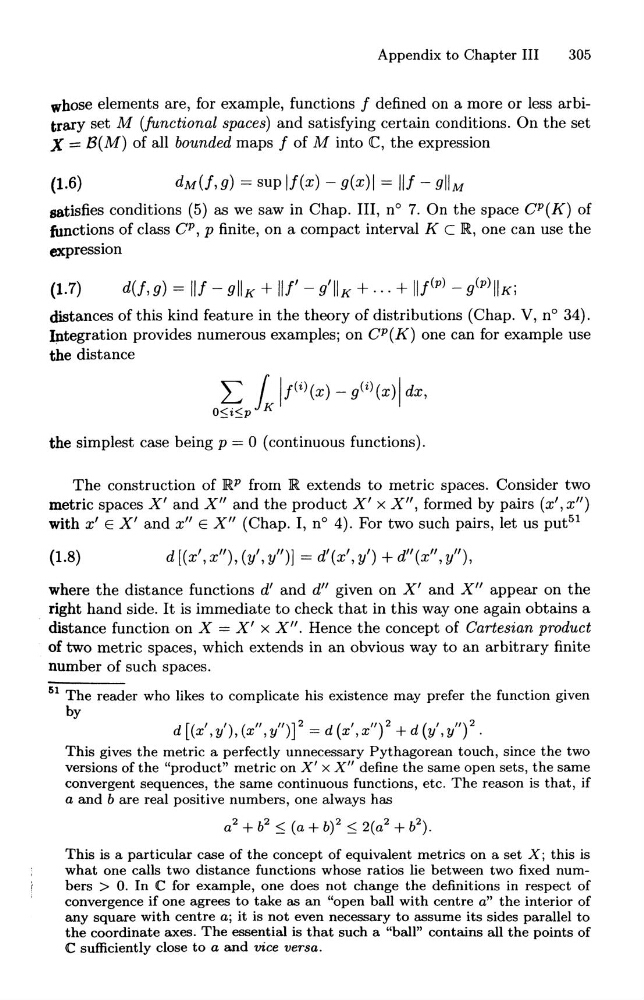
Integration provides numerous examples; on CP(K) one can for example use
the distance
the simplest case being p = 0 (continuous functions).
The construction of RP from R extends to metric spaces. Consider two
metric spaces X' and X" and the product X' x X", formed by pairs (x', x")
with x' E X' and x" E X" (Chap. I, nO 4). For two such pairs, let us put 51
(1.8)
d [(x', x"), (y', y")] = d' (x', y') + d" (x", y"),
where the distance functions d' and d" given on X' and X" appear on the
right hand side. It is immediate to check that in this way one again obtains a
distance function on X = X' X X". Hence the concept of Cartesian product
of two metric spaces, which extends in an obvious way to an arbitrary finite
number of such spaces.
51 The reader who likes to complicate his existence may prefer the function given
by
d [(x',y'), (x", y")] 2 = d (X',X")2 + d (Y',yll)2.
This gives the metric a perfectly unnecessary Pythagorean touch, since the two
versions of the "product" metric on X' x X" define the same open sets, the same
convergent sequences, the same continuous functions, etc. The reason is that, if
a and b are real positive numbers, one always has
a 2 + b 2 ~ (a + b)2 ~ 2(a 2 + b 2 ).
This is a particular case of the concept of equivalent metrics on a set X; this is
what one calls two distance functions whose ratios lie between two fixed numbers > O. In C for example, one does not change the definitions in respect of
convergence if one agrees to take as an "open ball with centre a" the interior of
any square with centre a; it is not even necessary to assume its sides parallel to
the coordinate axes. The essential is that such a "ball" contains all the points of
C sufficiently close to a and vice versa.
305
whose elements are, for example, functions I defined on a more or less arbitrary set M (functional spaces) and satisfying certain conditions. On the set
X = 8(M) of all bounded maps I of Minto C, the expression
(1.6)
dM(J,g) = sup I/(x) - g(x)1 = III - gilM
satisfies conditions (5) as we saw in Chap. III, nO 7. On the space CP(K) of
functions of class CP, p finite, on a compact interval K C R, one can use the
expression
(1.7)
d(J,g) = III - gilK + II!' - g'IIK + ... + 11/(p) - g(p) 11K;
distances of this kind feature in the theory of distributions (Chap. V, n° 34).
Integration provides numerous examples; on CP(K) one can for example use
the distance
the simplest case being p = 0 (continuous functions).
The construction of RP from R extends to metric spaces. Consider two
metric spaces X' and X" and the product X' x X", formed by pairs (x', x")
with x' E X' and x" E X" (Chap. I, nO 4). For two such pairs, let us put 51
(1.8)
d [(x', x"), (y', y")] = d' (x', y') + d" (x", y"),
where the distance functions d' and d" given on X' and X" appear on the
right hand side. It is immediate to check that in this way one again obtains a
distance function on X = X' X X". Hence the concept of Cartesian product
of two metric spaces, which extends in an obvious way to an arbitrary finite
number of such spaces.
51 The reader who likes to complicate his existence may prefer the function given
by
d [(x',y'), (x", y")] 2 = d (X',X")2 + d (Y',yll)2.
This gives the metric a perfectly unnecessary Pythagorean touch, since the two
versions of the "product" metric on X' x X" define the same open sets, the same
convergent sequences, the same continuous functions, etc. The reason is that, if
a and b are real positive numbers, one always has
a 2 + b 2 ~ (a + b)2 ~ 2(a 2 + b 2 ).
This is a particular case of the concept of equivalent metrics on a set X; this is
what one calls two distance functions whose ratios lie between two fixed numbers > O. In C for example, one does not change the definitions in respect of
convergence if one agrees to take as an "open ball with centre a" the interior of
any square with centre a; it is not even necessary to assume its sides parallel to
the coordinate axes. The essential is that such a "ball" contains all the points of
C sufficiently close to a and vice versa.