

298
III - Convergence: Continuous variables
(24.16)
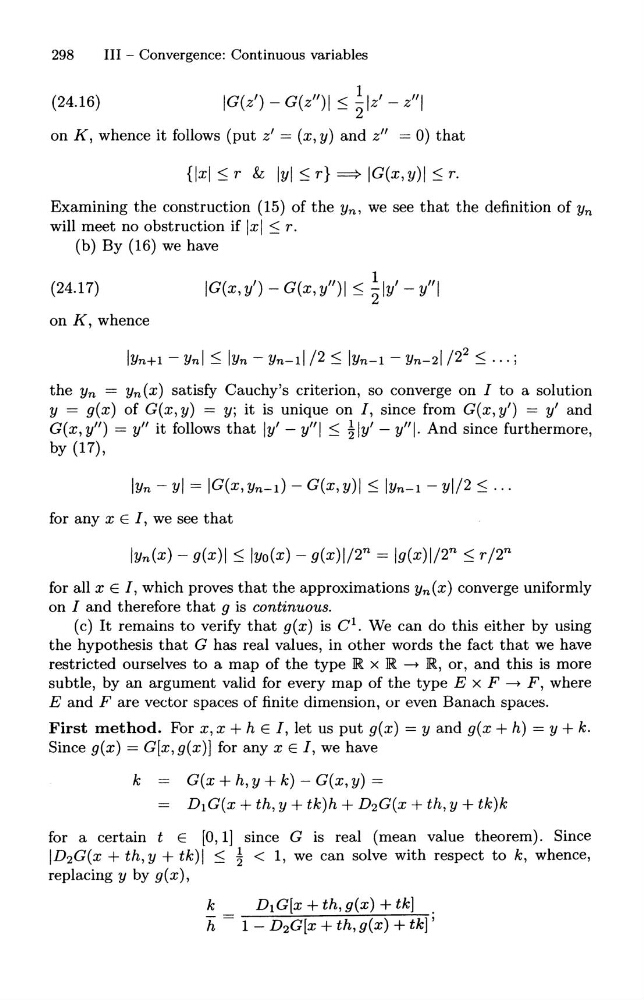
IG(z') - G(z")1 ::; ~Iz' - z"l
on K, whence it follows (put z' = (x, y) and z" = 0) that
{Ixl ::; r & lyl::; r} ==> IG(x,y)1 ::; r.
Examining the construction (15) of the Yn, we see that the definition of Yn
will meet no obstruction if Ixl ::; r.
(b) By (16) we have
(24.17)
1
IG(x, Y') - G(x, y")1 ::; "2ly' - y"l
on K, whence
IYn+1 - Ynl ::; IYn - Yn-Il /2::; IYn-1 - Yn-21 /2 2 ::; ••• ;
the Yn = Yn(x) satisfy Cauchy's criterion, so converge on I to a solution
Y = g(x) of G(x, y) = Y; it is unique on I, since from G(x, Y') = Y' and
G(x,y") = Y" it follows that Iy' - y"l ::; !Iy' - y"l. And since furthermore,
by (17),
IYn - yl = IG(x, Yn-I) - G(X, y)1 ::; IYn-1 - YI/2 ::; ...
for any x E I, we see that
IYn(x) - g(x)1 ::; IYo(x) - g(x)I/2n = Ig(x)I/2n ::; r/2n
for all x E I, which proves that the approximations Yn(x) converge uniformly
on I and therefore that 9 is continuous.
(c) It remains to verify that g(x) is C I . We can do this either by using
the hypothesis that G has real values, in other words the fact that we have
restricted ourselves to a map of the type JR x JR -+ JR, or, and this is more
subtle, by an argument valid for every map of the type E x F -+ F, where
E and F are vector spaces of finite dimension, or even Banach spaces.
First method. For x, x + h E I, let us put g(x) = Y and g(x + h) = Y + k.
Since g(x) = G[x,g(x)] for any x E I, we have
k
G(x + h,y + k) - G(x,y) =
DIG(x + th, Y + tk)h + D 2G(x + th, Y + tk)k
for a certain t E [0,1] since G is real (mean value theorem). Since
ID2G(x + th, Y + tk)1 ::; ! < 1, we can solve with respect to k, whence,
replacing Y by g(x),
k
DIG[x+th,g(x)+tk].
h = 1- D 2G[x + th,g(x) + tk]'
III - Convergence: Continuous variables
(24.16)
IG(z') - G(z")1 ::; ~Iz' - z"l
on K, whence it follows (put z' = (x, y) and z" = 0) that
{Ixl ::; r & lyl::; r} ==> IG(x,y)1 ::; r.
Examining the construction (15) of the Yn, we see that the definition of Yn
will meet no obstruction if Ixl ::; r.
(b) By (16) we have
(24.17)
1
IG(x, Y') - G(x, y")1 ::; "2ly' - y"l
on K, whence
IYn+1 - Ynl ::; IYn - Yn-Il /2::; IYn-1 - Yn-21 /2 2 ::; ••• ;
the Yn = Yn(x) satisfy Cauchy's criterion, so converge on I to a solution
Y = g(x) of G(x, y) = Y; it is unique on I, since from G(x, Y') = Y' and
G(x,y") = Y" it follows that Iy' - y"l ::; !Iy' - y"l. And since furthermore,
by (17),
IYn - yl = IG(x, Yn-I) - G(X, y)1 ::; IYn-1 - YI/2 ::; ...
for any x E I, we see that
IYn(x) - g(x)1 ::; IYo(x) - g(x)I/2n = Ig(x)I/2n ::; r/2n
for all x E I, which proves that the approximations Yn(x) converge uniformly
on I and therefore that 9 is continuous.
(c) It remains to verify that g(x) is C I . We can do this either by using
the hypothesis that G has real values, in other words the fact that we have
restricted ourselves to a map of the type JR x JR -+ JR, or, and this is more
subtle, by an argument valid for every map of the type E x F -+ F, where
E and F are vector spaces of finite dimension, or even Banach spaces.
First method. For x, x + h E I, let us put g(x) = Y and g(x + h) = Y + k.
Since g(x) = G[x,g(x)] for any x E I, we have
k
G(x + h,y + k) - G(x,y) =
DIG(x + th, Y + tk)h + D 2G(x + th, Y + tk)k
for a certain t E [0,1] since G is real (mean value theorem). Since
ID2G(x + th, Y + tk)1 ::; ! < 1, we can solve with respect to k, whence,
replacing Y by g(x),
k
DIG[x+th,g(x)+tk].
h = 1- D 2G[x + th,g(x) + tk]'