

286
III - Convergence: Continuous variables
us that Dd(x, b) = g1(X, b). Same argument switching the roles of x and y.
The function f is thus C 1 since g1 and g2 are Co, etc.
One can also start from the relation (21.12') applied to the fn. If one
remains in a compact disc K c U this shows that
(22.2)
Ifn(z + h) - fn(z) - Dfn(z)hl ::;
::; Ihl· sup IIDfn(z + th) - Dfn(z)ll;
O$t~1
now the linear maps D fn converge to the linear map g. If one could deduce
from (2), by passing to the limit, that
(22.3)
If(z + h) - f(z) - g(z)hl ::; Ihl.sup Ilg(z + th) - g(z)ll,
then differentiability of f and the values of its derivatives would follow, since,
g(z) being continuous, the sup is 0(1) and the right hand side is o(h).
So there remains the passage to the limit in (2). This poses no problem
for the left hand side. As to the right hand side, for given x, y and h we
have a function CPn(t) = II Dfn(z + th) - Dfn(Z) II 2:: 0 defined on [0,1] and
converging to a limit cp(t) = Ilg(zHh)-g(z) II; the CPn even converge uniformly
on [0,1] because of the hypotheses on the derivatives of fn. It is therefore
enough to establish the following result:
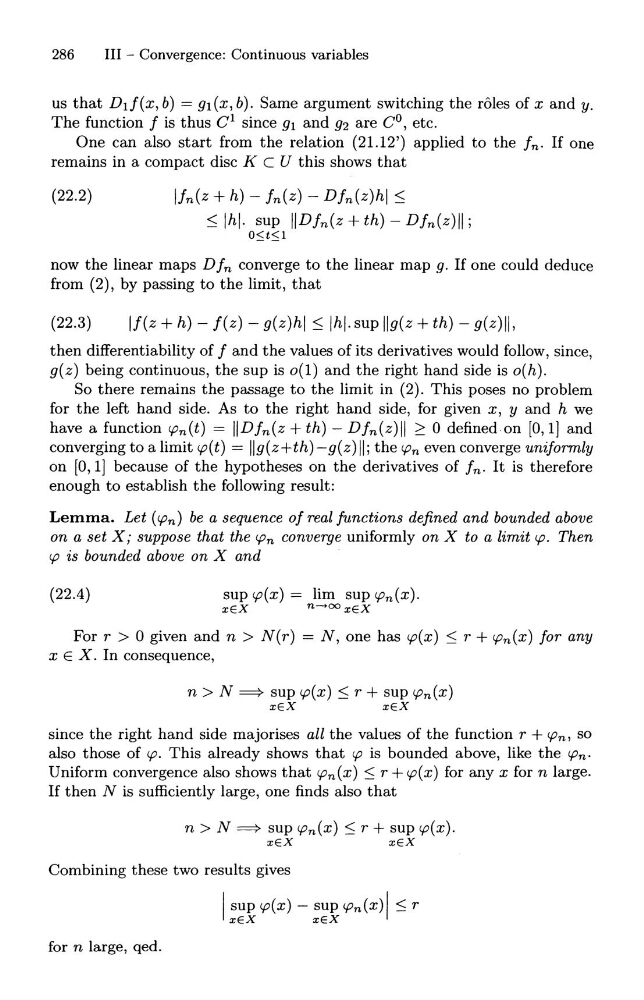
Lemma. Let (CPn) be a sequence of real functions defined and bounded above
on a set X; suppose that the CPn converge uniformly on X to a limit cpo Then
cP is bounded above on X and
(22.4)
sup cp(x) = lim sup CPn(x).
xEX
n-+ooxEX
For r > 0 given and n > N(r) = N, one has cp(x) ::; r + CPn(x) for any
x EX. In consequence,
n> N ~ sup cp(x) ::; r + sup CPn(x)
xEX
xEX
since the right hand side majorises all the values of the function r + CPn, so
also those of cpo This already shows that cP is bounded above, like the CPn·
Uniform convergence also shows that CPn(x) ::; r + cp(x) for any x for n large.
If then N is sufficiently large, one finds also that
n> N ~ sup CPn(x) ::; r + sup cp(x).
xEX
xEX
Combining these two results gives
I sup cp(x) - sup CPn(X) I ~ r
xEX
xEX
for n large, qed.
III - Convergence: Continuous variables
us that Dd(x, b) = g1(X, b). Same argument switching the roles of x and y.
The function f is thus C 1 since g1 and g2 are Co, etc.
One can also start from the relation (21.12') applied to the fn. If one
remains in a compact disc K c U this shows that
(22.2)
Ifn(z + h) - fn(z) - Dfn(z)hl ::;
::; Ihl· sup IIDfn(z + th) - Dfn(z)ll;
O$t~1
now the linear maps D fn converge to the linear map g. If one could deduce
from (2), by passing to the limit, that
(22.3)
If(z + h) - f(z) - g(z)hl ::; Ihl.sup Ilg(z + th) - g(z)ll,
then differentiability of f and the values of its derivatives would follow, since,
g(z) being continuous, the sup is 0(1) and the right hand side is o(h).
So there remains the passage to the limit in (2). This poses no problem
for the left hand side. As to the right hand side, for given x, y and h we
have a function CPn(t) = II Dfn(z + th) - Dfn(Z) II 2:: 0 defined on [0,1] and
converging to a limit cp(t) = Ilg(zHh)-g(z) II; the CPn even converge uniformly
on [0,1] because of the hypotheses on the derivatives of fn. It is therefore
enough to establish the following result:
Lemma. Let (CPn) be a sequence of real functions defined and bounded above
on a set X; suppose that the CPn converge uniformly on X to a limit cpo Then
cP is bounded above on X and
(22.4)
sup cp(x) = lim sup CPn(x).
xEX
n-+ooxEX
For r > 0 given and n > N(r) = N, one has cp(x) ::; r + CPn(x) for any
x EX. In consequence,
n> N ~ sup cp(x) ::; r + sup CPn(x)
xEX
xEX
since the right hand side majorises all the values of the function r + CPn, so
also those of cpo This already shows that cP is bounded above, like the CPn·
Uniform convergence also shows that CPn(x) ::; r + cp(x) for any x for n large.
If then N is sufficiently large, one finds also that
n> N ~ sup CPn(x) ::; r + sup cp(x).
xEX
xEX
Combining these two results gives
I sup cp(x) - sup CPn(X) I ~ r
xEX
xEX
for n large, qed.