

284
III - Convergence: Continuous variables
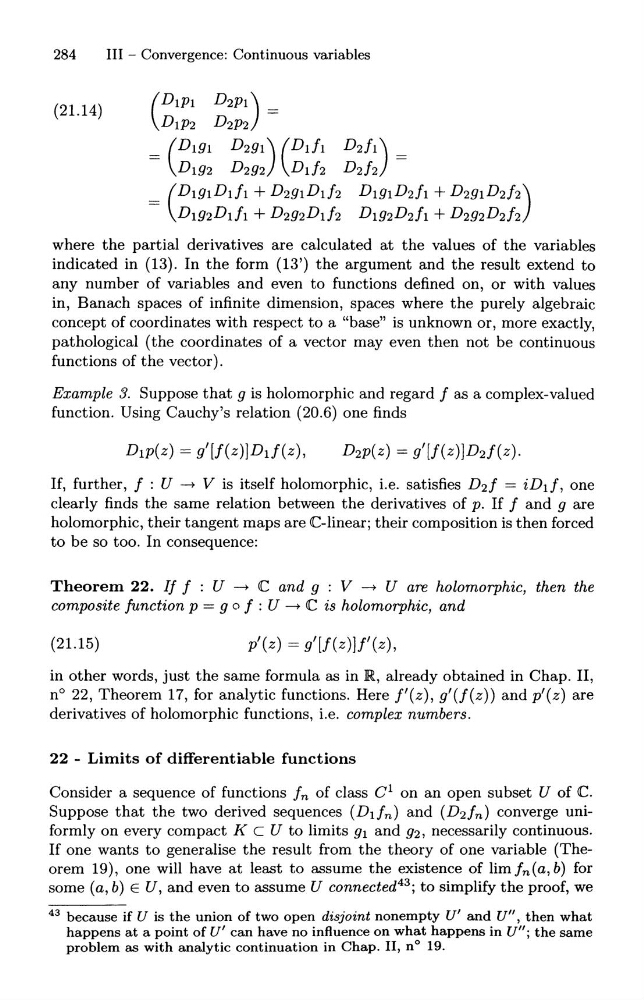
(21.14)
where the partial derivatives are calculated at the values of the variables
indicated in (13). In the form (13') the argument and the result extend to
any number of variables and even to functions defined on, or with values
in, Banach spaces of infinite dimension, spaces where the purely algebraic
concept of coordinates with respect to a "base" is unknown or, more exactly,
pathological (the coordinates of a vector may even then not be continuous
functions of the vector).
Example 3. Suppose that 9 is holomorphic and regard f as a complex-valued
function. Using Cauchy's relation (20.6) one finds
D1P(z) = g'[f(z)JDd(z),
D2P(z) = g'[f(z)JD2J(z).
If, further, f : U ~ V is itself holomorphic, i.e. satisfies D2J = iDd, one
clearly finds the same relation between the derivatives of p. If f and 9 are
holomorphic, their tangent maps are C-linearj their composition is then forced
to be so too. In consequence:
Theorem 22. If f : U ~ C and 9 : V ~ U are holomorphic, then the
composite function p = 9 0 f : U ~ C is holomorphic, and
(21.15)
p'(z) = g'[f(z)Jf'(z),
in other words, just the same formula as in JR., already obtained in Chap. II,
n O 22, Theorem 17, for analytic functions. Here f' (z), g' (f (z)) and p' (z) are
derivatives of holomorphic functions, i.e. complex numbers.
22 - Limits of differentiable functions
Consider a sequence of functions fn of class C1 on an open subset U of C.
Suppose that the two derived sequences (Ddn) and (D2fn) converge uniformly on every compact K c U to limits g1 and g2, necessarily continuous.
If one wants to generalise the result from the theory of one variable (Theorem 19), one will have at least to assume the existence of lim f n (a, b) for
some (a, b) E U, and even to assume U connected 43 j to simplify the proof, we
43 because if U is the union of two open disjoint nonempty U' and U", then what
happens at a point of U' can have no influence on what happens in U"; the same
problem as with analytic continuation in Chap. II, nO 19.
III - Convergence: Continuous variables
(21.14)
where the partial derivatives are calculated at the values of the variables
indicated in (13). In the form (13') the argument and the result extend to
any number of variables and even to functions defined on, or with values
in, Banach spaces of infinite dimension, spaces where the purely algebraic
concept of coordinates with respect to a "base" is unknown or, more exactly,
pathological (the coordinates of a vector may even then not be continuous
functions of the vector).
Example 3. Suppose that 9 is holomorphic and regard f as a complex-valued
function. Using Cauchy's relation (20.6) one finds
D1P(z) = g'[f(z)JDd(z),
D2P(z) = g'[f(z)JD2J(z).
If, further, f : U ~ V is itself holomorphic, i.e. satisfies D2J = iDd, one
clearly finds the same relation between the derivatives of p. If f and 9 are
holomorphic, their tangent maps are C-linearj their composition is then forced
to be so too. In consequence:
Theorem 22. If f : U ~ C and 9 : V ~ U are holomorphic, then the
composite function p = 9 0 f : U ~ C is holomorphic, and
(21.15)
p'(z) = g'[f(z)Jf'(z),
in other words, just the same formula as in JR., already obtained in Chap. II,
n O 22, Theorem 17, for analytic functions. Here f' (z), g' (f (z)) and p' (z) are
derivatives of holomorphic functions, i.e. complex numbers.
22 - Limits of differentiable functions
Consider a sequence of functions fn of class C1 on an open subset U of C.
Suppose that the two derived sequences (Ddn) and (D2fn) converge uniformly on every compact K c U to limits g1 and g2, necessarily continuous.
If one wants to generalise the result from the theory of one variable (Theorem 19), one will have at least to assume the existence of lim f n (a, b) for
some (a, b) E U, and even to assume U connected 43 j to simplify the proof, we
43 because if U is the union of two open disjoint nonempty U' and U", then what
happens at a point of U' can have no influence on what happens in U"; the same
problem as with analytic continuation in Chap. II, nO 19.